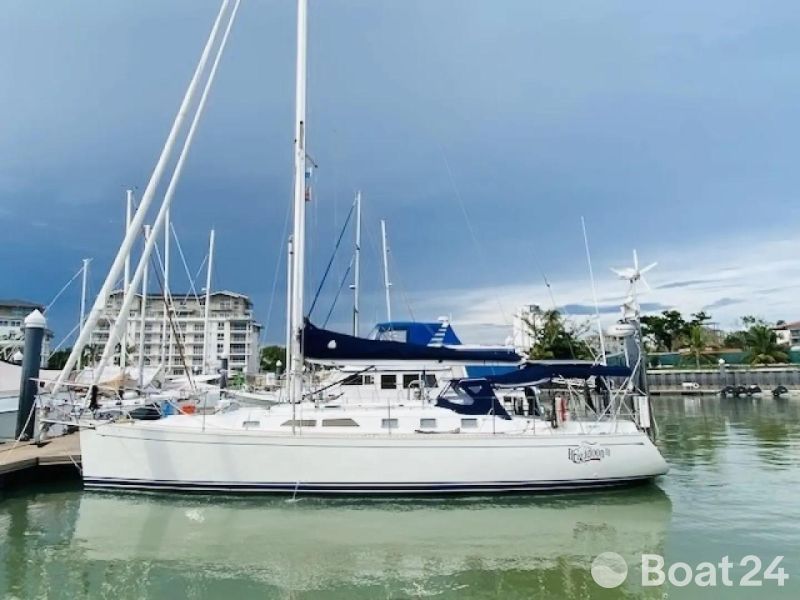
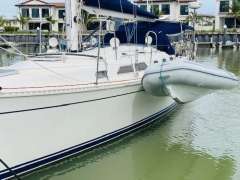
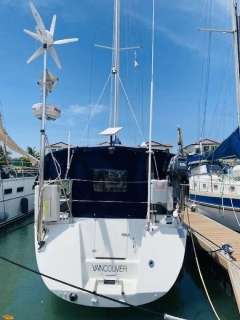
Boat Overview Brigadoon III is one of (55) Saga 43s designed by Robert Perry and built by Saga Yachts in Saint Catharines, Ontario. With the sought-after two-head, Pullman berth layout, it was immediately exported to the US following its construction.
These boats have a very distinctive place in the world of offshore cruising yachts because they resist nearly every trend that has come to dominate modern boat design. At a glance, it may not appear as voluminous or beamy as many contemporary cruisers, but that restraint is exactly what gives the boat its remarkable character. Perry conceived the Saga 43 as a yacht that could be sailed easily by a couple, or even singlehanded, without sacrificing speed, safety, or true ocean-going capability. The result is a design that feels purposeful in a way that many modern cruisers, built more for dockside living than passagemaking, simply do not.
Design and Performance What makes the Saga 43 so unique begins with its hull form. With a relatively narrow beam of about twelve feet and a light displacement for its length, it avoids the wide and flat geometry that dominates production boats. Instead, it carries a long, clean waterline that allows it to move efficiently through the water rather than pounding over it. This translates directly into real-world performance offshore, where the boat is known to maintain passage speeds in the seven to eight knot range with less effort and less strain on both crew and gear. Compared to heavier classics like the Valiant 40 or the Pacific Seacraft 40, the Saga 43 feels quicker and more responsive, yet it does not give up the kind of seakindly motion and directional stability that bluewater sailors depend on. Where those older designs rely heavily on displacement and conservative hull shapes, the Saga 43 achieves a balance between performance and comfort that feels more modern without becoming extreme.
Sailing Characteristics Another defining aspect of the boat is how it handles under sail. Perry paid close attention to balance, and that shows in the lightness of the helm and the way the boat tracks even when conditions build. The sail plan is set up for short-handed sailing, with features like a self-tacking jib and all control lines led aft, allowing the crew to manage the boat safely from the cockpit. Some versions include a variable geometry rig, which lets sailors adjust sail configuration without going forward on deck, an enormous advantage when offshore conditions become challenging. This ease of handling is not just a convenience; it is a safety feature that makes long-distance cruising more realistic for smaller crews. In contrast, many traditional offshore boats require more physical effort and larger crews to manage sail changes, especially in heavy weather.
Offshore Credentials The Saga 43’s offshore credentials are further reinforced by its ballast ratio and stability profile. With a deep fin keel and a significant proportion of its weight concentrated low in the hull, the boat has a strong righting moment and reassuring behavior in rough seas. Unlike wide, form-stable designs that depend on beam for initial stability but can become abrupt in their motion, the Saga 43 offers a more predictable and comfortable ride. Its motion at sea is often described as rhythmic rather than jarring, which becomes critically important during long passages where crew fatigue can be as much a risk as the weather itself.
Interior Layout Below deck, the boat continues to distinguish itself through a philosophy of practical comfort rather than excess. The interior is not cavernous, but it is thoughtfully arranged for life underway. Typically configured with two cabins and two heads, it provides privacy and functionality without wasting space. The forward owner’s cabin, often referred to as the great cabin, is complemented by an aft guest cabin and a proper navigation station, reflecting the boat’s offshore focus. The galley is particularly well designed, positioned and shaped so that a cook can brace securely while the boat is in motion, which is something that cannot be said for many modern, open-plan interiors. The use of quality woods like teak or cherry, along with solid construction techniques such as balsa coring for insulation and rigidity, gives the interior a warm, durable feel that stands up to years of use at sea.
Tankage and Systems Tankage and systems also reflect the boat’s long-range intent. With generous capacities for water and fuel, along with efficient diesel power typically provided by a Yanmar engine, the Saga 43 is capable of extended cruising without constant reliance on marinas. Many owners outfit their boats with upgraded electrical systems, renewable energy sources, and modern navigation equipment, further enhancing their autonomy. Under power, the boat cruises efficiently at speeds comparable to its sailing performance, making it versatile in light winds or tight situations.
Overall Appeal What ultimately sets the Saga 43 apart is how cohesively all these elements come together. It is not the fastest boat of its size, nor the most spacious, nor the most luxurious in a dockside sense. But it achieves a rare balance where speed, safety, ease of handling, and livability all reinforce each other. Compared with more traditional bluewater cruisers like the Valiant 40 and Pacific Seacraft 40, it offers improved performance and easier handling without abandoning offshore integrity. Compared with modern production cruisers, it sacrifices interior volume in favor of better motion, greater efficiency, and a design that truly excels at sea rather than at the marina.
Purpose of Design In an era where many cruising yachts are optimized for comfort at anchor or in port, the Saga 43 remains firmly rooted in the idea that a sailboat’s primary purpose is to sail well over long distances and in demanding conditions. That clarity of purpose is what gives the design its enduring appeal and what makes it stand out so clearly among offshore cruising yachts.
Additional Information Accommodation Stepping aboard, you are welcomed by a spacious cockpit designed for both comfort and ease of handling underway.
Descending the companionway, to port is a large queen berth with an adjacent storage locker. Just forward to port is a full head with separate shower.
To starboard of the companionway is a wraparound, open-concept galley with generous counter space and ample storage.
Midships, the salon features settees to port and starboard with a central dining table, providing a comfortable and functional living area.
Forward, the vessel offers a large Pullman-style queen berth with an en suite head and shower, along with substantial storage.
To starboard is a dedicated chart table with ample workspace for navigation and planning.
Interior Comforts and Amenities
* Microwave
* Zacor Custom Peek-a-Boo blinds on all windows and port lights
* Weems and Plath wall mounted brass barometer
* Individual thermostat in the main head
* All faucets and shower fixtures replaced (2023)
* MeteoMan recording barometer
* Fusion MS-AV650 audio with two mid-range speakers and one subwoofer (2022)
* Sunbrella lee cloths for all berths and settees
* Carbon Monoxide monitors in all cabins
* All LED lighting
* Water maker Schenker Zen 30, 12 volt, 30 liters/hr with spare filters (2023)
* Air conditioning: Dometic 120-volt reverse cycle 16,000 BTU heating and cooling
* Hot water heater: Hurricane Zepher diesel hydronic heating system with on-demand hot water - Individual thermostats for the (2) staterooms and main salon (2022)
* (4) Hella multi-speed bulkhead mounted fans
* Refrigerator (approx. 5.5 cu. ft.)
* Separate freezer (approx. 2.2 cu. ft.)
* Double stainless-steel sinks with new faucet (2023)
* Separate filtered water tap
* Whale foot pump
* Force 10, 3 burner propane stove and oven
* Solenoid LPG control in galley
* Corian counters
Electronics and Navigation The Raymarine electronics below were installed in June, 2014 (excluding the autopilot).
* Raymarine C95 multi-function display
* Raymarine i50 Tridata instrument
* Raymarine i60 Analog Wind and i60 Close Haul wind displays
* Raymarine radar RD218 18” Digital Radome
* Raymarine autopilot ACU 400 linear drive unit with EVI heading sensor and P70 Pilot Controller
Electrical Systems
* VHF Standard Horizon Explorer with Cockpit RAM 4 remote station (remote added in 2023)
* Iridium Satellite Phone
* SSB ICOM IC-718 (installed 2011)
* Compass 4” Ritchie, binnacle mounted, lighted, magnetic
* (2) AGM house batteries (new 2026)
* Interstate MTZ starting battery (new 2024)
* 120-amp alternator installed (new 2026)
* Shore power plug-in converted to SmartPlug (2025)
* Iridium Go Exec with Data Hub (2023)
* Vesper Cortex AIS (2024)
* watt Renogy rigid panels mounted over Bimini (2023)
* 220-watt Renogy portable solar panel over dodger (2024)
Deck and Hull Equipment
* Hull, topsides and binnacle painted with Awlgrip (2020)
* Bottom painted with (2) coats of ablative antifouling paint (2025)
* Kato stainless steel hoist for raising/lowering outboard motor
* Edson outboard motor mount on pushpit
* Custom stainless steel exterior frames for windows in main salon
* Additional LED anchor light with photo sensor permanently mounted at low level, just above bimini (2022)
* Winches. (2) Lewmar 58 in cockpit, (1) Lewmar 40 and (1) Lewmar Ocean Power OPI electric on the cabin top, (2) Lewmar 30 on the mast - All are 2-speed self-tailing
* Cleats. (6) 12” and (2) 8”
* Dinghy. AB like new Lammina 9.5’ aluminum rigid bottom inflatable with a forward gas compartment and removable dinghy wheels
* Yamaha 2-stroke 15 hp outboard
* Waterproof cockpit cushions
* Retractable hose hot/cold fresh water deck shower with temperature control
* Sunbrella dodger, bimini and see-through connector piece between the dodger and bimini. The dodger and connector have Sunbrella shade covers (all new in 2023)
* Zip on back panel with window for wind/rain protection (2023)
* Zip on side panels for spray protection
* Zip on shade panels for the bimini
* Mainsheet and furling lines replaced (2023)
* Doyle cradle cover for main with lazy jacks
* Spade S100 (44 lb) anchor
* Secondary anchor. Fortress FX with SFX-23 in Stowaway Bag (2023)
* Primary anchor chain and rode. 180 ft. of 5/16” high test chain and 150 ft. of new nylon line (all replaced in 2023)
* Secondary anchor chain and rode. 10 ft. 5/6” chain and 140 ft. of 3/4” rode
* Windlass: Lofrans Project 1000 vertical rope/chain windlass and capstan
* Fenders: (5) 7” diameter and (1) 9” diameter with navy boat blanket covers to match the canvas
* Dock lines: All 3/4” Novatec Neptune Navy double braid nylon docklines to match fender covers and canvas (2023)
* (2) 30’ long, all with an eye splice at one end
* Dyneema bridle for hoisting dinghy alongside when at anchor using main halyard and electric winch
* Custom Sunbrella 4’ square hatch cover with grommets to suspend over the forward hatch at night for rain protection
Sails and Rigging
* Mainsail: North Sails Full Batten NPC Radian NorDac NDR 9.0, 46.7 sq.m. with (3) reefs (2023)
* Electric fog horn. Marinco Model 10036, ABYC #A23 Certified (2022)
* Stern boarding ladder replaced (2023)
Mechanical Upgrades
* Exhaust mixing elbow replaced and valves adjusted during routine service (2020)
* Flagship Marine security systems - Complete with (2) secret under deck, pressure, sensitive alarms with lights and sirens
Engine Info
* Yanmar diesel
* Model 4JH2E
* Engine hours: 4450 (April 2026)
* HP 51
Dinghy Info
* 2017 AB Lammina AL
* HIN: CAN50079E717
* Yamaha 15 hp
* Serial: 1098404
Tankage
* Fuel: (2) tanks = 74 US gallons
* Water: (2) tanks = 133 US gallons total
* Holding: (2) = 40 US gallon tanks
Owners Comments and Boat History The yacht is one of (55) Saga 43s designed by Robert Perry and built by Saga Yachts in Saint Catherine’s Ontario. It was immediately exported to the US where the first owner sailed it for a period before selling it to its second owners who moored it in Chesapeake Bay where the boat saw limited use since the owners lived in Pennsylvania.
After purchasing the yacht in 2011, we undertook extensive upgrading and then sailed it to Puerto Rico in 2013. For several months each winter, we sailed throughout the Caribbean, storing the boat on land for the remainder of each year in either Puerto Rico or Antigua.
After five winters in the Caribbean, we sailed back to Annapolis MD via Turks and Caicos and the Bahamas. In 2019 the boat was transported by truck from Annapolis to Anacortes, WA, where it was re-rigged and the hull and topsides were painted with Awlgrip. We kept the boat for a short period of time in Blaine, WA before importing it into British Columbia, Canada. Canadian taxes were paid at that time.
From 2020 to 2023, the boat was moored in North Vancouver, where we were living, and we cruised during the summer seasons in and around Vancouver Island. In August, 2023 we departed Vancouver and sailed south through the US, Mexico, El Salvador, Nicaragua, Costa Rica and continued cruising throughout the Caribbean. After Costa Rica, we continued on to Panama, went through the Canal, spent time in the San Blas Islands and Colombia, crossed the Caribbean Sea to the Dominican Republic, Puerto Rico and the Virgin Islands and plan to continue on to Grenada.
There are many reviews and accolades to be found on the internet attesting to suitability of the Saga 43 for offshore cruising. Its designer, Robert Perry, is well recognized for his design of many offshore capable yachts and he continues to participate in the very active Saga Users Group.
Although there are a few other Saga 43s currently listed for sale, we believe that Brigadoon III is definitely the most attractive for many reasons. A few of the most significant features are summarized below.
* The two-head, Pullman berth layout makes much more sense than the one-head, centerline berth layout. Malfunctioning toilets is a common occurrence on any yacht and having a second head available while repairs are undertaken is a life saver. Also, with two separate heads, having a guest in the aft cabin with their own head is vastly superior to having owners and guests all sharing a single head. The Pullman berth is adequately sized for two persons and its location, further aft, results in less motion while underway or in a rolly anchorage. It also provides easier access to the forepeak storage area.
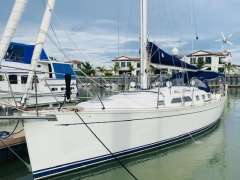
* Even the newest Saga 43s are showing their age in terms of dull, oxidized gelcoat. The hulls and topsides have to be continually waxed and polished. Even then, the results are nowhere near the appearance of a new or newly painted yacht. The hull and topsides of Brigadoon III were recently painted with Awlgrip resulting in a like new shine. Furthermore, Awlgrip does not require waxing and buffing, only a simple cleaning from time to time.
* Sails are the most important and most expensive component of any sailboat. Brigadoon has near new state of the art North Sails.
* The Hurricane diesel heater is the most sophisticated hydronic marine heater available. Heat can be distributed and regulated to four separate zones on the boat, including the main head with enclosed shower. In tropical climates, distribution of heat can be turned.
Disclaimer The company offers the details of this vessel in good faith but cannot guarantee or warrant the accuracy of this information nor warrant the condition of the vessel. A buyer should instruct his agents, or his surveyors, to investigate such details as the buyer desires validated. This vessel is offered subject to prior sale, price change or withdrawal without notice.