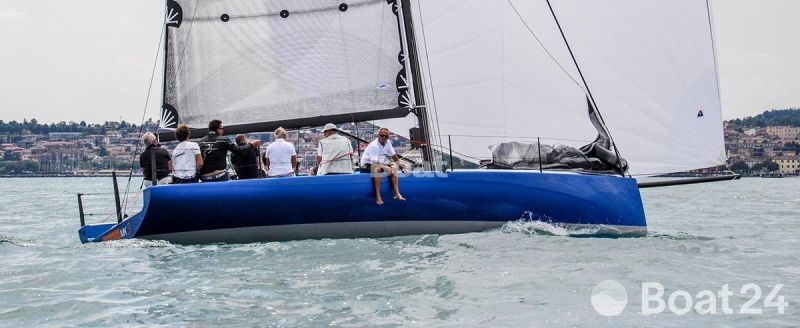
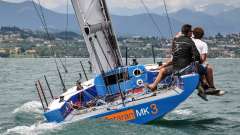
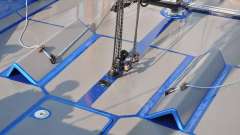
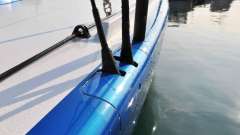
The ICE 33 represents the latest generation of highly competitive racing yachts designed by Italian designer Umberto Felci. A 10m monohull, with zero compromises, envisioned to sail fast in real-time and to perform great results in IRC and ORC Categories. 72m2 upwind and 210m2 downwind with a 2m retractable bowsprit.
Mataran Mk3 is the fastest ICE 33 ever built and managed to receive several historic wins and awards • Carbon fibre epoxy infusion sandwich construction • Hall Spars Carbon fibre mast and boom • Carbon fibre retractable bowsprit • Foldable outboard engine • Full set of Millennium racing sails wardrobe • Yamaha 9,9 hp outboard engine * Craddle to store the boat incl 2 boxes * Boat comes with 17 sails J1, J2, J3; J4 some from 2025, 2018 and 2022 Main 3x (2015, 2022 and 2025) A0, A1,5, A2 multiple Code 0 * Cariboni latest gen canting keel 2022 * Garmin latest gen Monitors 2022 * New electronics 2022 * Newly painted hull and mast 2022 * New pbo Armare rigging 2022 * New deckfoam 2022 New rudder bearing 2026 Brand new Yamaha engine 2026
Essentially these new analyses have allowed us to estimate precisely whether the increase in wave resistance generated by the curved topsides, that is submerged at a certain heel angle, is nullified by the extra power that becomes available. However, this specific study remains restricted within a limited cloud of boats characterized by a low relative displacement and by a high relative sail area. The basic concept is that of modelling a hull that at low heel angles and submerged, is the slimmest as possible and a has a low wetted area. Then the geometry change at the high angles, where the chalice shape, offers new supports and offer a solid increase in the global righting moment.
This hull gives the double objective of having very little friction resistance and slight wave resistance at the lower angle and thus ensures excellent performance when sailing downwind in a light wind, together with an increase in heeling, an increase in the righting moment, therefore in the power available, that gives high performances when sailing upwind, too. Obviously, in order to underline these characteristics the ICE33, must be sailed as flat as possible, taking full advantage of the beamy hull and crew weight, until it becomes necessary to further power supplied by the torpedo and hull shape when the wind increases.
Notwithstanding the weight of the torpedo comprises 55% of the final weight, in theory it could be further reduced in order to optimize the 33 in conditions of particularly light wind.
The images show how, whilst maintaining unchanged the principle parameters of the canoe body (volume, CP, RM20 etc) the answers in terms of resistance of the two typologies of hulls developed around different midsections have been analysed: the first, decidedly “roundy”, the second characterized by a boxy-type mid-section .
The first one was further analysed to the point where it became a “roundy” canoe body “cutted” and equipped with chine extended along almost the whole length in order to emphasize the effect coming from the increased RM at high angles.
As previously set out, many of the available parameters were left unvaried so the final evaluation was carried out by correlating the increase in RM and the increase in resistance. Crossing these results with a parametric analysis of the prevailing meteorological conditions in the Mediterranean area we arrived at the answer represented by the hull of the ICE33.
From the structural and constructive point of view the choices were made with the objective of creating a composite as light as possible but at the same time one that would meet the minimum laminates imposed by ISO regulations. There has been detailed work in studying the interconnections between the structures, the forestay and shroud fitting attachments, the fin recess and its reinforcement structure.
An interesting element is the fin structure which, together with great efficiency and rigidity, offers an ergonomically important element, that is the chaise longue which, in the case of long regattas with a reduced crew, allows for a very comfortable stand-by phase.
The outboard motor concealed lifting system has also undergone detailed engineering so as to render this operation simple and efficacious, enabling the motor to be completely hidden and the hole necessary for passing the engine strut drive closed with a sliding hatch, perfectly flush with the hull.
A high modulus Hall carbon mast with PBO Smart rigging, the very latest generation of deck equipment and numerous small but high quality details such as, for example, carbon pulpits and stanchions, complete the efficacy and the “look” of this thorough-bred racer that will launch with an over-all weight of 1900 kilos, of which 1000 are dedicated to the keel and torpedo. The sail area upwind, in the racing version with square top mainsail, is around 72 m2, whilst downwind it is around 210 m2, thanks to a mast head gennaker at the and a more than 2 metre long, retractable bowsprit. The Open version will make use of a furling Code Zero or similar. The first boat will be launched towards the middle of June and will take part in some races in the Adriatic, among them the Bernetti and Barcolana, followed by the Trofeo Gorla and the Centomiglia on Lake Garda