


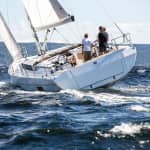
The Bali 7.0 marks the French shipyard's entry into the large cruising catamaran segment. With an overall length of 22.53 metres, it clearly surpasses all previous models of the brand. The shipyard is positioning the vessel as an owner's yacht with crew quarters. The concept is aimed at users looking for comfort and range for extended cruises.
Room concept and layout
With the Bali 7.0, the shipyard is also consistently realising its trademark - that of open spaces. The sliding door between the saloon and aft cockpit has long been part of the shipyard's DNA. What is new is the continuous opening to the front. Panoramic glazing connects the saloon with the bow lounge. This becomes an extended living area. Cockpit, saloon and foredeck form one continuous area.
A complete hull can be used as an owner's suite. This comprises a sleeping area, a separate lounge, a walk-in wardrobe and a bathroom. Sliding doors provide privacy as required. The layout is modelled on hotel suites. Large windows provide natural light. The guest cabins also have spacious layouts.
Galley and service concept
The galley is located in the port hull. This arrangement creates space for a bar in the saloon. The galley offers work space for elaborate preparations. A dumbwaiter connects the galley, saloon and flybridge. The system enables "discreet service" between the levels, according to the shipyard.
The crew have their own cabins and a separate lounge. The Bali 7.0 has space for six to eight guests. The layout provides space for two to three crew members. The separation of the areas follows the concept of larger yachts.


Sailing characteristics and propulsion
The sail area is 280 square metres for the main and genoa. A foresail of 62 square metres completes the sails. The shipyard states that the ship is designed for ocean voyages. Xavier Faÿ developed the hull shape together with Briand Yacht Design. The design is intended to combine seaworthiness with easy handling.
Two engines with 195 or 230 hp power the large catamaran. The empty displacement is 40 tonnes. Fully loaded, the ship reaches 50 tonnes. The draught is 1.85 metres. The mast height is 32.40 metres. The manoeuvres are controlled automatically. The shipyard promises intuitive operation for small crews.
Range and autonomy
The fuel tank holds up to 2,000 litres. The fresh water capacity reaches 1,520 litres. Lithium batteries and solar panels provide the energy supply. Air conditioning systems work without a generator in certain configurations. The shipyard emphasises quiet operation at anchor.
This equipment is aimed at long-distance sailors. The range enables multi-day passages. The power supply should allow longer mooring times without shore power. There is no specific information on the range under motor. The actual autonomy depends on consumption and utilisation.
Design and material
The Bali 7.0 has a different design language. The forward offset deckhouse stretches the lines. Tinted superstructures characterise the look. Large openings connect the interior and exterior areas. Berco Design and Piaton are responsible for the design. The equipment is orientated towards the upmarket segment.
Market positioning and background
Bali Catamarans is part of the Catana Group. The family-owned company operates five production sites in France, Tunisia and Portugal. The group employs over 1,300 people. The head office is located in Canet-en-Roussillon in the south of France.
The Bali 7.0 extends the portfolio upwards. Previously, the model range ended with smaller sizes. With the new flagship, the shipyard is competing with established providers of large cruising catamarans. Boris Compagnon, representative of the group, emphasises the combination of Catana offshore qualities with Bali design.
The shipyard does not give a price for the Bali 7.0, but comparable catamarans of this size cost between 2.5 and 4 million euros. The exact pricing depends on the equipment and options.
Classification
The Bali 7.0 demonstrates the shipyard's ambition to gain a foothold in the luxury segment. The open space concept differs from classic cruising catamarans. The design for crew operation meets the requirements of larger yachts. The range is sufficient for Atlantic crossings. The energy supply enables self-sufficient mooring.
The sailing characteristics cannot be assessed without a practical test. The stated sail area seems appropriate for the displacement. The automation makes handling easier. The question of stability and sea behaviour in heavy weather remains unanswered.
Technical data:
- Length overall (with bathing platform): 22,53 m
- Hull length (with bowsprit): 21,83 m
- Waterline length: 20.84 m
- Maximum width: 10.32 m
- Draught: 1.85 m
- Mast height: 32.40 m
- Short displacement: 40 tonnes
- Maximum displacement: 50 tonnes
- Engines: 2 x 195 hp or 2 x 230 hp
- Fuel: 2,000 litres
- Fresh water: 1,520 litres
- Mainsail and genoa: 280 m²
- Mainsail: 159 m²
- Genoa: 120 m²
- Foresail: 62 m²

Pascal Schürmann
Chef de texte YACHT
