


Arcona 385: Powerful and comfortable performance cruiser on test


Baggenfjärden, the archipelago area between Värmdö, Ingarö and the noble Saltsjöbaden, is Stockholm's natural regatta arena. Surrounded by partly high and wooded islands, it is considered a tricky area by the locals and is also the home of the Arcona 385. In contrast, we sail the boat on the Flensburg Fjord in moderate easterly and later sometimes quite brisk south-westerly winds.
High sailing potential
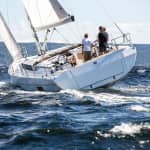
The Arcona 385 sails visibly stiff and generally does not heel much. She seems to convert gusts into speed more easily than her competitors, who tend to respond to sudden pushes with more leeway. The Swede is also very balanced on the rudder and can easily be held on the wind edge with little pressure on the double wheels. This makes it easy for the helmsman to steer the boat optimally. However, the steering on the test boat is deliberately set with little tension by the Arcona shipyard. The play on the wheel is uncomfortable and takes some getting used to, and the system feels spongy.
The Arcona's keel and rudder were optimised for minimum resistance in collaboration with the University of Gothenburg. With noticeable success. Cruising with the Swede is a dream, even if the rudder system is not optimally adjusted. She also accelerates extremely agilely in the gusts. Even strong pushes do not force the boat off course. If there is too much load on the wheel, it is sufficient to release the well-dimensioned traveller, which runs across the entire width of the cockpit, a few centimetres to leeward to relieve the pressure.
Also interesting:
- Performance cruiser comparison test: six fast cruising yachts compete against each other
- Dehler 38 SQ: Dehler's modified performance cruiser on test
- First 36: Europe's performance cruiser of the year 2023
- Hallberg-Rassy 370: Sailing and living at the highest level in the YACHT test
- X 4.0: Lively understatement at 12 metres in the test
Comfortable cockpit
It is also pleasing that the Swedes pay attention to detail when choosing the fittings. For example, the heavy-duty halyards of the main and genoa run through stronger halyard stoppers and are deflected via roller bearing blocks. In addition, the foresail is equipped with a furling system and is reefed as standard using a smooth-running under-deck furling system.
Compared to the predecessor model Arcona 380, there have been visual adjustments on and below deck. The ship has also been given an open stern with the upgrade. Storage compartments for the halyards and swallow nests keep the cockpit organised. The cockpit table is a special feature. It is stowed in a flat compartment in the floor and anchored on a plinth if required - a solution familiar from the XP-38. The pedestal also serves as a footrest and provides support when in position, as the cockpit is very wide.
Measured values of the Arcona 385


Elaborate construction
One reason for the 385's good response is its lightweight construction. The hull and deck are manufactured in Estonia using a vacuum infusion process as a sandwich with a 20-millimetre Divinycell core.
Solid material is used around the keel suspension, the rudder coker, all the through-holes and the fittings. The forces from the mast and keel are absorbed by a galvanised steel frame, which is bolted to the hull and bulkheads. A durable construction method that has been tried and tested on the larger Arconas.
The jibs are anchored directly in the ship's side. The 19.50 metre high rig compensates for the lack of overlapping headsails. A code zero can also be set in light winds.
Tangible quality
Below deck, the Arcona is typically Scandinavian and downright luxurious for such a sporty yacht. The Estonian boat builders easily deliver the much-vaunted Orust quality à la Hallberg-Rassy, both in the choice of wood and in terms of detailed workmanship. The fact that it is not too dark despite the extensive use of Khaya mahogany is partly due to the pleasant light reddish colour of the wood and partly to the large windows. Only the flush-fitted and comparatively large deck hatches are tinted.
Thanks to the large beam, the space is very good. Even the forward berth offers a much better lying area than that of the competitors from Dehler or X-Yachts. Only in terms of headroom do you pay the price of beauty, i.e. the moderate freeboard. At 1.76 metres, most people will probably have to put their heads down in the foredeck. In the saloon, galley and aft cabin, however, the headroom is consistently over 1.90 metres. You can shower in the bathroom at 1.87 metres.
Lots of space, lots of room
The Arcona scores highly in terms of storage space. They are particularly generous in the foredeck and are practically accessible in the form of ventilated lockers and drawers. The space under the saloon berths is largely taken up by the diesel and fresh water tanks. However, provisions and cooking utensils can be stored in the overhead lockers and the galley. This will be even slightly larger on the production boats than on the tested prototype.
The shipyard has solved the ventilation problem well: the window above the cooker can be opened for cooking. In addition, two air scoops in front of the sliding hatch provide continuous ventilation protected from the rain.
In addition to the standard boat we sailed with two aft compartments of almost the same size and a sliding navigation table, a version with a standing desk for navigating is also available, which increases the storage space. A single compartment is also available in the stern. This creates a large forecastle with an emergency berth on the starboard side, which can be accessed through the bathroom. The shower room also increases in this configuration and is accessible through a separate door.
The berths in the aft compartments differ in the layout variants. With a width of 1.63 metres each, they are comfortable for a three-chamber boat of this class. As the engine box barely protrudes into the berth and the steering mechanism does not interfere, there is enough space for two adults. With one double locker per compartment, storage space is a little tight when fully occupied. However, the boats of the competition do not offer any more in this respect. In the version with only one cabin at the rear, the berth is even significantly larger, because in this case the longitudinal bulkhead is installed aft, shifted to the side.
Plausible price
Speaking of competition: in the 38-foot segment, the Dehler 38, the J-112 and the X-40 are three very similar boats. But with a huge price range.
Compared to the Dehler, the Arcona seems very expensive. However, vacuum infusion and such a solid wooden construction are not only more expensive than the standard boat from Germany, they also drive up the price. For a fair comparison, the regatta version from Dehler must therefore be considered. And this also reduces its price advantage.
- Base price ex shipyard: 382,980 € incl. 19% value added tax
- Standard equipment included: Engine, sheets, railing, navigation lights, battery, compass, cushions, galley/cooker, bilge pump, toilet, sailcloth, anchor with chain, fenders/mooring equipment, fire extinguisher, electric cooler, holding tank with suction system
- For an extra charge: Sails (main and genoa), antifouling, clear sailing handover
- Guarantee/against osmosis: 2/2 years
S2025, as the prices shown are defined, can be found in the here!
YACHT review of the Arcona 385
The Swedish yacht delivers strong sailing performance, especially upwind, and scores highly in terms of interior fittings and, above all, the quality of workmanship. She also plays a pioneering role in the technical installations. Top basic equipment.
Design and concept
High variance
Good cockpit layout
Tiring working positions
Sailing performance and trim
Stiff and fast in the wind
Very balanced control
Fast reactions
Living and finishing quality
Separate shower possible
High-quality interior fittings
Cross ventilation hardly possible
Equipment and technology
Very neatly installed on-board technology
Electric drive as an alternative
Control difficult to reach
The Arcona 385 in detail

Technical data of the Arcona 385
- Design engineer: Stefan Qviberg
- CE design category: A
- Torso length: 11,28 m
- Total length: 12,00 m
- Waterline length: 10,60 m
- Width: 3,80 m
- Draught/alternate..: 2,10/1,90/2,25 m
- Mast height above WL: 19,50 m
- Theor. torso speed: 7.9 kn
- Weight: 6,8 t
- Ballast/proportion: 2,4 t/35 %
- Mainsail: 52,0 m²
- Furling genoa (107 %): 36,0 m²
- machine (Yanmar): 21 kW/29 hp
- Fuel tank (stainless steel): 135 l
- Fresh water tert. (stainless steel): 200 l
- Holding tank (stainless steel): 70 l
Shipyard
Arcona Yachts AG, 13440 Gustavsberg (Sweden); www.arconayachts.se

Hauke Schmidt
Test & Technology editor
