


When it comes to the colour design of a yacht today, the possibilities are almost endless. The colour palettes of paint and gelcoat manufacturers alone are as colourful as a wallpaper catalogue. There are also various special effects such as metallic paintwork. Those who like to personalise their boat can also design it artistically using a spray gun. Or with foil. Covering the entire hull is now a standard technique, and there are almost no limits to the design of the film.
The same applies to the sails. Here, too, you can glue or print to your heart's content, your sponsor's wishes or your own wallet.
But where the choice is large, it often becomes a pain. What suits the boat, the profession? How much individualism is acceptable, when does it become tacky?
There are only two colours to paint a boat: Black and white. And only a fool would paint a boat black"
That's what designer Nathanael G. Herreshoff once said. If only it were that simple!
The choice of yacht design can be particularly difficult with a refit. This is because there are no ties to a shipyard catalogue as there are with a new purchase. Your imagination is free to run wild.
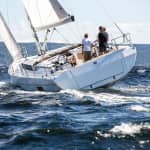
We have put together some examples of what a yacht can become in the gallery.
Painting or foiling?
If you have now acquired a taste for it, you need to clarify whether repainting or wrapping the hull is necessary and sensible at all. After all, unusual designs are also subject to contemporary tastes, and what may be considered cool today may be old-fashioned or kitschy tomorrow.
When repainting, the saying "once painted, always painted" applies. The layer thickness of a paint job is low compared to gelcoat. It is possible to polish out scratches on the paintwork, but only a few times, depending on the depth of the scratch - then the next full coat of paint is inevitably due.
The gelcoat, on the other hand, is thick enough to withstand several polishing cycles. But even with gelcoat, there comes a point when polishing no longer produces the desired result. Now is the time to think about a new coating.
Whether film or paint is used depends on the owner's personal preferences. And: the choice between the two is a question of the desired result, the service life and the costs.
If, for example, a special design is to be realised, with special motifs or a matt or textured surface, this would be a case for a film. And almost the only one. This is because a film coating is much more susceptible to mechanical stress than a paint finish.
Sometimes a crane strap is enough to move the film. Film wrapping also has only minor advantages from a cost perspective.
Preserve or modernise?
However, other considerations can also play a role when choosing a new design. For example, a faithful restoration makes sense when it comes to a yacht that represents a cultural-historical value in yachting, which would be diminished by a different colour scheme. By cultural-historical, we mean that some yachts have made a significant contribution to the development of yachting. Some of them were and are recognisable from afar due to their colour scheme. In this case, the colour scheme became an elementary part of the yacht design.
The competition between Hallberg-Rassy and Najad in the 1980s is an unforgettable example of this. At the time, mockers claimed that the yachts could only be told apart because one stripe was blue and the other red.
With such models, the value retention on the used boat market due to their good reputation can also be a decision criterion. The more faithful the paintwork is to the original, the more stable this reputation is likely to remain. However, the original colour should always be used!
If, on the other hand, you are the owner of a largely unknown yacht, the choice of colour plays a subordinate role. No used boat buyer will decide for or against the model because of the originality of the colour scheme.
Tips for the redesign
A sensible measure when redesigning can also be to apply the antifouling a little higher than necessary. This not only prevents soiling and yellowing in the so-called buffing zone. The hull will also look a little flatter if the colour of the antifouling forms a visible contrast.
The decorative strips also have the task of stretching the hull: one is a kind of optical rubbing strake - of course you could also fit a real one here - and the other is a wide double strip as what used to be called a water pass.
Another tip about double stripes: Their effect depends on the height ratio of the coloured and blank stripes. Uniform divisions, i.e. one third colour, one third blank, one third colour, are not recommended. A better effect can be achieved if the colour stripes are significantly higher than the blank stripe. This can be simulated well in advance with adhesive tape.
How motifs get into the Amwind sails
If you want to give your Amwind sails a personalised touch, you have two options, as with the hull: gluing or printing. Smaller areas of up to around two metres can be produced as stickers and applied in this way. This is usually familiar from larger regattas as sponsor logos. Another advantage of the sticker is that it can be removed.
If larger motifs are to be realised, there is no getting around printing. But this can be expensive. An area of around four by four metres can easily cost 4,000 to 5,000 euros.
Coloured or white downwind sails?
This also applies to downwind sails such as spinnakers and gennakers. White cloths are the "fastest" here, as this is the colour of the raw material. If you want colourful bubbles, you always have to accept a little more weight as the cloth is dyed. However, the additional weight is negligible when sailing.
When it comes to motifs that are to be visible on the sail, there are again two methods to choose from. Simple shapes, such as stars, are relatively easy to integrate into the cut. In principle, almost any motif can be realised in this way, but then the gennaker or spinnaker consists of many more individual parts than would be necessary; you can imagine it like a stained glass window. This drives up the price due to the enormous amount of labour involved and is therefore only realised by a few sailmakers. In addition, the cloth may not stand up so well in profile, as there can always be material deviations in different colours.
The other method is again printing. Almost anything can be realised here, but at a high cost. With complicated motifs, however, these are probably lower than if the motif is integrated into the cut.
