


Brand loyalty is a much-researched and yet mysterious thing. Achieving it is often the goal of extensive endeavours by companies. Why do people love this or that brand and avoid another? What causes people's affection for a company's products? Advertisers would now say that loyalty is the result of numerous expensive campaigns - consistent communication, visibility everywhere. Sometimes, however, it is simply a coincidence or an encounter that leads to an affinity with one shipyard or another, as in this case.
For Stephan Rolka, this affection for Trintella was born in the last week of January 1987, and die-hard water sports enthusiasts will already have guessed where that was: at boot in Düsseldorf. Rolka, who was still a student at the time, wandered through the halls with a rucksack and a great deal of curiosity in his luggage. What was still missing at the time was the budget for the boats on display. The shipyard representatives obviously recognised this. He was denied access to the objects of future desire. Only the legendary shipyard boss Anne Wever, who founded the Trintellas, didn't care: "I was allowed on the ship, I think it was even a 57, which was on display. And I was immediately smitten. From then on, I had a dream. It had to be a Trintella like that one day."
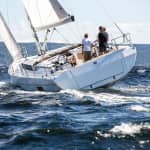
The dream of a boat whose shipyard no longer exists
A quarter of a century passes, Rolka is a successful entrepreneur, first in advertising, then in property, and he also has a family. Just no Trintella. But the dream and the fascination for the brand, whose shipyard has long since ceased to exist, have never left him. Then, in Breskens, in the south of the Netherlands, he comes across a 57 - an aluminium one. "I was blown away again. Six months of refit, I thought, and we can set off on the boat," laughs the busy Aachen native. "That turned into a good seven years." Many owners of older ships are familiar with this: Gradually, more and more construction sites appear, with a new disaster lurking around every corner. This requires the ability to suffer and perseverance. And people around you who support you or at least accept the time-consuming hobby. Fortunately, Rolka has all that. Alternatively, one option would be to tackle a moving refit, i.e. to improve the ship while it is still in operation. But that was definitely not Rolka's way, because he is a perfectionist. Looking past a whole series of shortcomings for years is not his thing. So he opted for the other option: to realise the work in one go as a mega-project.
Other interesting sailing yachts:
"It quickly became apparent that the work on the cruising yacht would be more extensive than we had anticipated. And there was no shipyard in Breskens that understood what we wanted and would have let us work on the ship ourselves. So, after a tip, we ended up at the Marine Technics shipyard in Zeebrugge." They let him get on with it, were pleased with the odd order and otherwise with the rental payments for the hall. For seven years.
Many problems on board the cruising yacht
The teak deck is the number one problem. 4,400 screws in an aluminium deck offer plenty of opportunities for leaks. The deck therefore has to come off. What remains are 4,400 holes. Welding is not an option because of the interior fittings and the insulation underneath. Neither is filling, as aluminium has a very high coefficient of thermal expansion. Heat and cold could cause leaks again. "We then had an idea: rivets!"
No sooner said than done. A special drill is purchased to drill out the holes and countersink the deck. The special rivets are then inserted to seal the hole and make it flush with the surface. The flexible sealing adhesive of the synthetic teak deck set then does the rest. The next project is the rudder. There is something wrong with the coker, it is obviously not quite straight in the ship. When it is removed, it becomes clear that the support in the hull on which the coker stands is at an angle to the waterline. This needs to be changed. However, it is necessary to turn this support inside the hull to create a flat surface on which the new coker can be installed. But how can this be done when the workpiece is a good 17 metres long and weighs almost 24 tonnes? Rolka remembers the company Wagner from Eschweiler, which offers mobile turning. They were commissioned, specialists travelled to Zeebrugge and set up the mobile lathe. The support is levelled there and the new coker can finally be installed.
A lot of work that pays off
Next, the entire cruising yacht is sandblasted, filled and sanded and given a really impressive finish with primer and paint. The same is done with the mast and boom, where the hydraulics from Reckmann are serviced at the same time. The same happens to the eleven Lewmar winches. The galley is converted to accommodate a larger cooker. "However, the entire kitchen had to be modified so that everything fitted as it should. Once again, a sub-project was bigger than planned," reports Rolka. Two fridges have also been installed. The Perkins diesel engine is also being overhauled in parts. It is so solidly built that only add-on parts need to be replaced. 124 hp from a displacement of 5.8 litres speaks for a certain longevity. Once the hull, deck, rudder, mast and engine have been dealt with, it's time for the electrics and electronics. Rolka looks for a competent contact person to guide him through the confusing variety on the market.
"Niko Reisch from Nordwestfunk was the only one who said straight away: 'Come on, let's meet on board and take a look at it'. And he actually accompanied us patiently through the entire project. That was great," says Rolka. It is now also clear that the electronics will come from Raymarine and the electrics from Mastervolt, both companies that Nordwestfunk represents in Germany. Rolka goes all out and orders three multifunctional displays, formerly known as plotters, one each for the navigation system, the deckhouse and the steering column. There are also countless other displays and network components. The same applies to the batteries, chargers and converters.
New parts for the cruising yacht
In the exposé of the cruising yacht, the components listed on two pages now begin with either Raymarine or Mastervolt. Webasto supplies air conditioning and heating for the cabins and saloon. When everything is installed and working together, when the new deck hatches are tight and the indirect lighting is on, when the hydraulics are working, the engine is running and the Flexiteak deck is in place, in short, when the refit is finished, seven years have passed. Seven years in which Rolka regularly travelled the two and a half hours from Aachen to the shipyard in Zeebrugge to lend a hand or to supervise or coordinate the work on the ship. Seven years, after which the total costs are estimated to amount to a seven-figure sum and thus to a multiple of the purchase price. And on top of that, seven years in which the family had to share their dad with the boat. All of this is now behind Rolka, who is both relieved and excited as he sets off on his first test run.
There is a good 20 knots of wind off Zeebrugge. The only thing that was not replaced during the refit of the cruising yacht was the sails. And that is noticeable. The ship is terribly luffy and the cloths are very dirty. It just doesn't look good and it's no fun either. And it doesn't fit in at all with the rest of the ship and the effort that has been made so far. The owner also realises this. He had already spoken to sail manufacturers, but initially wanted to try out the condition of the old sails. One phone call, and a few weeks later, new laminate cloths from sailmaker Wittevrongel were fitted. Once again, we set off for a trial run on the North Sea off Zeebrugge.
The "Fanfare" has good driving characteristics
The conditions are almost identical. But now the cruising yacht Trintella sails much more upright, the rudder pressure is reduced to such an extent that the resistance of the second helm in the doghouse is noticeable. The cruising yacht is easy to bring to the edge of the wind and easy to steer through the waves. Keyword waves: The hull takes them in its stride. A real seagoing vessel, even if the freeboard is rather low compared to today's designs. Conveniently, a brand-new Bavaria C 57 of the same length is moored in the harbour next door. The difference is really striking; the Trintella looks almost delicate compared to the huge dimensions of the modern design. And so the foredeck is also a wet place at sea. But you don't notice any of this aft. The deckhouse also protects the cockpit from splash water. Those on watch can make themselves comfortable in the shelter of the aluminium superstructure and wait for things to happen outside. What requires some attention are the many levels and steps between the saloon, deckhouse and cockpit. This is less ideal on a sea-going vessel. Otherwise, wide decks and handrails ensure safety.
"At the beginning, I thought it would take six months and then the boat would be finished. It turned out to be almost eight!" laughs owner Stephan Rolka
You can see below deck that the Trintella cruising yacht comes from a different era, an era that many people still, perhaps quietly, mourn today: cosiness and wood. The word "loft-like", which has become a bit fashionable for boat interior designers, does not spring to mind. On the contrary. This is real boat building. Once again: wood! Lots of it and skilfully shaped. The question "Can this also be made round?" seemed to be accompanied more often in the shipyard by the answer "Of course!". And round, as anyone who works with wood knows, always means elaborate. It starts right at the front in the centre with a round shower cubicle. It is accessible from each of the two side cabins in the foredeck, each of which has its own wet room and bunk beds.
Elegant solutions and plenty of space on board the cruising yacht
The cabinets in the cabins have round doors. Round doors also open the way into the saloon. A huge seating area dominates the port side. It is very cosy. The table can be folded out to double its size. This provides enough space for a feast with the whole crew. The navigation centre is located on the main bulkhead to starboard. The term "navigation table" no longer does justice to this operations and situation centre. The voyage can be planned here in peace and quiet. The bench has room for two. At its back is a sideboard, which is also an extension of the kitchen worktop. Towards the saloon, this ends in, you guessed it, a curve. If you bump into a sharp corner here below deck, you might as well play the lottery.
To starboard, the owner's cabin is accessed via the galley. The galley offers plenty of worktop space and lots of storage on both sides of the passageway. The large cooker invites you to cook on board. A good working position can also be found when the boat is in position. A nice detail: the spice rack. Rolka spent a long time looking for suitable containers so that they would look uniform. The owner's area is also lavish. A large bed, seating and an en-suite bathroom are standard today; at the end of the 1980s, this was superyacht standard. Incidentally, the 57 was also available with a skipper's cabin in the bow. Keyword superyacht. On the "Fanfare", this has become a storage room and the sail load.
"The boat sails much better with the new sails: more upright, faster, higher. I didn't expect the effect to be so clear"
The woodwork is of the very best craftsmanship. Trintella and its owner Anne Wever were known for this and for the overall very solid construction. The shipyard became popular with models such as the I(a) and the ketch with sterncastle III(a) and subsequently offered sailing yachts up to 75 feet. The designer was always Van de Stadt, the lines were divided into C for "Composiet", i.e. GRP, and A for "Aluminium". They were built near s'-Hertogenbosch, i.e. on the water but deep inland. Wever, himself a sailor, built boats until the end of the eighties. He then handed over the shipyard to his successor. But Wever's soul was also lost, and the shipyard failed several times. In the mid-nineties, it finally came to an end: Trintella now only exists as a brand name. Formerly 80 employees and a rich history fell victim to the succession plan. The rights to the name now belong to a Dutchman again, there is a website and two designs by Germán Frers. However, nothing has yet been built.
Will there ever be another Trintella without the DNA of Anne Wever, who died in 2009? For Stephan Rolka, it doesn't matter. He has his Trintella now. And sometimes it takes a quarter of a century to get there and a seven-year refit. "Buying a new yacht was out of the question, it had to be a Trintella. Even though the refit of the cruising yacht was ultimately quite costly, I would do it again. I just think it's a great boat," beams Rolka. Brand loyalty - because of a visit to a trade fair stand.
This article first appeared in YACHT 11/2023 and has been revised for this online version.
Technical data Trintella 57 "Fanfare"

- Shipyard/year of construction: Anne Wever/1987
- Designer: Van de Stadt
- Total length: 17.30 m
- Waterline length: 14.00 m
- Width: 4.96 m
- Draught: 2.15 m
- Weight: 23.5 tonnes
- Ballast/proportion: 9.5 t/40 %
- Sail area downwind: 190 m²
- Sail carrying capacity: 4.8
- Engine: (Perkins) 154 hp
