


6-sail racing yacht: "Pirat II" - time machine to the beginnings of sailing
Lasse Johannsen
· 29.01.2023


The water of Lake Constance sparkles bright green beneath the natural lacquered hull of a nautical antique that even die-hard classic boat enthusiasts would not be able to recognise ad hoc if they were asked. Not here in the harbour of Altnau on the Swiss shore of Lake Constance anyway. Completely hidden under a tarpaulin, from which only a short mast and the boom extending over the stern protrude, they might even walk past it. When wooden boat builder Stefan Züst, who looks after the boat but covers the canvas, manoeuvres it out of the box and out of the harbour with his hand and paddle and sets the huge gaff sail with beeping and running sound, questions would certainly arise. A special class in miniature perhaps?
No, what has been authentically preserved here and takes us back to the early days of German sailing is a so-called 6-sail length racing yacht, which was built in 1906 in the "Boot & Yachtbauerei W. v. Hacht" for the Hamburg shipowner Erich F. Laeisz. Like his cargo clippers such as "Pamir" and "Passat", he christened the boat with a name beginning with "P". To this day, "Pirat II" still appears on the transom.
Contrary to what the class name suggests, the antique regatta yacht measures nine metres in length, is only 1.73 metres wide and was once so delicately built that, despite its 400 kilograms of ballast in the keel, it weighed only 940 kilograms and was therefore more of an instrument than a ship - and yet so solid that "Pirat II" outlived the one racing season for which it was created by well over 100 years.
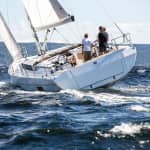
A laser is a clumsy piece against the "Pirat II"
Züst has a firm grip on the rudder standing free behind a short keel on the tiller protruding from the aft deck. He tightens the mainsheet, shifts the weight of his massive upper body to windward as the boat lays on its side, and suddenly starts laughing so loudly that you can't quite tell whether the hull is vibrating from the interplay of sail pressure and the water moving faster and faster along the side of the boat or from the booming bass of the Confederate. "A Laser is a clumsy thing in comparison," he says, grinning in circles and talking about the unusual seam frame design, which reminds him of classic racing rowing boats.
Züst should know. The giant runs a shipyard in the village where new wooden boats are built and around 100 yachts receive their annual maintenance. The vast majority of them are traditionally built, and it is not uncommon for restoration work to be carried out on the structure of these patients.
And the innards also reveal what is special about the design of this 6-sail racing yacht. The invention of the so-called seam frame system is attributed to the great German designer Max Oertz. He explained it in 1901 in his lecture "On sailing yachts and their modern design" to the Schiffbautechnische Gesellschaft: "For the construction of racing yachts up to a waterline length of 12 metres, the seam frame system has proven to be excellent. The longitudinal seams of the planks are tightly nailed and riveted to the upright oak seam frames. The result is exceptionally strong and elastic boats, while the weight saving on the hull allows 60 to 64% of the displacement to be used as ballast in the keel."
The sailing yacht boomed in 1906
The small racing yacht has only been extensively restored once since its launch. That was in the years 1989 to 1994.
The first summer saw the boat with sailing enthusiast shipowner Laeisz at the tiller and sheet at the start of all major regattas on the waters of northern Germany. In the magazines "Wassersport" and YACHT, she is not missing from any list of results, and her name can usually be found in the top places in "Race Class VI". Laeisz may have been particularly motivated to commission the boat by her participation in the famous Kiel Week of 1906. It was intended by the Kaiser as a national competition between England and Germany. As a result, an unprecedented level of new construction activity broke out in northern Germany. In some shipyards, up to a dozen sailing yachts were launched at the same time. Anyone who wanted to keep up with the competition could not escape the boom.
Designer von Hacht had an excellent reputation
Born in 1870, Wilhelm von Hacht, known as Willy, already enjoyed an excellent reputation among the well-heeled gentlemen sailors at this time. He had already learnt his trade at the age of 14 and then worked as a journeyman at his grandfather's shipyard, which he continued to run at the age of 19 after his grandfather's death in 1889 and took over on his own account in 1895.
Under his grandfather, von Hacht ran a repair yard for smaller commercial vessels on a branch of the Outer Alster. Willy von Hacht, however, focussed on the increasingly popular construction of pleasure craft on the Alster and built rowing and sailing boats. He was quickly successful, became a sought-after address for regatta yachts, which he designed himself, and expanded the business in 1907.
"There are only a few classes in the German Sailing Association in which Hacht has not built outstanding, winning boats in recent years," was how YACHT 1925 described v. Hacht's success on the occasion of his 30th anniversary. "In the 30 square metre class, he has constantly battled with Rasmussen and Estlander for the lead in recent years."
His client list included well-known names until v. Hacht's death in 1931. Soon after his debut, he was trusted by successful sailors from the North German Regatta Club, where he was also accepted, as well as wealthy merchants and the sailing Prussian princes. And also Erich F. Laeisz.
"Pirate II" goes south as early as 1907
However, he parted with his 6-sail racing yacht right after the first summer. It was the transition period to the international metre formula, which dominated the regatta scene from then on, and most of the racing yachts measured according to the sail length method were sold to the south. They find themselves, re-rigged and re-measured, with a D in their sails at the start of the 35 square metre racing class.
"Pirat II" set sail for the south in 1907 and was based on Lake Traunsee, Lake Wörthersee, Lake Mondsee and Lake Zurich until the trained wooden boat builder Karl Dietrich acquired her in 1989 and, together with his friend and fellow sailor Klaus Vamberszky, restored her to her present condition in a five-year radical overhaul and then sailed her on Lake Constance.
The order in which the boat, which was built using the seamless frame construction method, was assembled in detail is still a mystery today
Dietrich still fondly remembers this time, even though it cost the men more than 3,000 hours of hard labour. "We stood in front of it in awe and wondered how v. Hacht built it back then," he says looking back, because the thin, bent-in frames are embedded in the seam frames that are firmly nailed to the outer skin panelling, which leaves us puzzled as to the order in which the puzzle was once put together.
Even after the restoration, the "Pirat II" still radiates the authenticity of the early years
"Even after 80 years, it was still so firmly joined together that there was no gap anywhere," says Dietrich, who documented the work photographically, which was still the exception in analogue times.
The old photographs show a hull skeleton that includes composite components made of galvanised steel - floor beams, knees and even round frames - in addition to the stringer-like seam frames running between the frames and the hull. According to Dietrich, however, the planks of the outer skin were only six millimetres thick, which is little more than a Stark veneer. They were less concerned with maintaining the low weight during the restoration, he says, laughing and describing how they only replaced a few red parts such as the keel beam and then applied two layers of two millimetre mahogany veneer diagonally to the hull using epoxy resin to give it lasting strength. The original substance is hidden underneath, visible from the inside, and radiates the authenticity of the early years, when gentlemen with patricide, tie and Prince Heinrich cap still sat on the high edge.
To ensure that the external appearance does not fall short of this, Dietrich and Vamberszky apply planks in the lengthwise direction in the subsequently natural varnished above-water area, which correspond to the original appearance in terms of dimensions and course. Made from cedar, of course.
The friends quickly recast the keel. According to Dietrich, it's a miracle that the old one was still there anyway. "The oak deadwood attacked the galvanised steel bolts with its tannic acid, so that some of them were down to zero," he says and shows a picture of the new keel, into which a stainless steel frame was cast, ending in solid keel bolts.
Even the deck could not be saved. The owner opted for one made of plywood and covered it with canvas, as Hacht had done in the past. A tremendous effort. According to Dietrich, it took him 200 hours just to rebuild the moulded and glued coamings.
Sailing makes up for all the hardship
The sailing, on the other hand, makes up for all the hardship. The racing yacht, which looks like new, is winning prizes again after 90 years, even though it displaces around 300 kilograms more after the radical overhaul. "We had a yardstick value that was about the same as the Lacustre, which was actually too favourable for us, but that didn't bother us any more," says former owner Dietrich, laughing again.
Following the switch to the 35 square metre racing class and at a time when the former 6-SL yacht was measured as an equaliser, this is the fourth method by which "Pirat II" is given a racing value that can be used to race on her. The first, the sail length measurement method, goes all the way back to 1898. Max Oertz describes it like this in the aforementioned lecture:
"In Germany, after many attempts and disappointments, we have arrived at a formula that has had a very favourable influence on the development of yacht types." The designer explains the calculation of the racing value R, which is calculated from the waterline length, sail area and circumference of the underwater hull using one formula for racing yachts and one for cruising yachts. "We see that in Germany we have used a special formula to make a strict distinction between cruising yachts and racing yachts, a measure with which Germany is unique. While the racing yacht aims to achieve the greatest possible speed, regardless of comfort below and on deck, and often requires juggler-like acrobatic dexterity from the sailors, the cruiser should, in addition to good speed, be seaworthy above all due to its shape ...", says Oertz.
The international metre formula was created in 1906. In Germany, it was adopted at the Sailing Day the following year. At the same time, the national measurement method based on the sail length formula was abolished.
In the south, the class was still being sailed at regattas into the 1930s
The summer of 1907 was the last in which new boats were built according to this relatively simple formula and without any building regulations. In the south, however, especially on the Austrian lakes, the boats were in great demand, were actively sailed in regattas until the 1930s and proved to be extremely durable.
Many of the decommissioned sailing racing yachts were sold to the Austrian lakes at the beginning of the 20th century
After Karl Dietrich and Klaus Vamberszky had restored the racing yacht, she went to an owner on Lake Constance in 2000, returned to Lake Zurich and from there back to Altnau, where Stefan Züst looks after her. He recently gave her a new mast made of spruce and focussed on the fitting arrangement, "... because you could hardly sail it with the old blocks and deflections!" In fact, the sail area of almost 50 square metres, which is only distributed over the main and jib, is quite impressive. And while a light breeze here on Lake Constance is enough to keep you busy, the question quietly arises as to how the gentlemen in ties and collars handled it on windy days on the Kiel Fjord in regatta mode.
Attention is required even in light winds, even if the boat drops off on a rough course, because the weight of the huge boom causes such a leeward trim that the nock drags through the water quite quickly.
But that's no problem for helmsman Züst today. Leaning a little further out, the brake comes out of the bright green water and "Pirate II" picks up speed with a roar of laughter. And again, it is not clear why the hull vibrates so gently.
Technical data 6-sail racing yacht "Pirat II"

- Designer and shipyard: W. v. Hacht
- Year of construction: 1906
- Restoration: 1989-1994
- Hull material: Cedar on oak
- Total length:8,95 m
- Width:1,73 m
- Depth:1,20 m
- Weight: 1,2 t
- Ballast: 0,4 t
- sail area: 45,0 m²
More on the topic:

Lasse Johannsen
Deputy Editor in Chief YACHT
