


Oceanis 52: Powerful cruising boat with blue water ambitions put to the test
Michael Good
· 14.03.2026


The fact that large and expensive yachts of all things find strong sales in economically strained times seems contradictory at first - but it is a reality. The leading series manufacturers are consistently pushing their programmes into the upmarket segment of 50 feet and more. Recently, they have also been developing more intensively in the luxury sector and enriching the market with a new generation of attractive, imaginative and versatile yachts.
More from the shipyard:
A good example of this development is the new Oceanis 52 from Beneteau. The current flagship of the cruising range succeeds the Oceanis 51.1 - one of the biggest sales successes of the industry leader. More than 420 units have rolled off the production line in eight years of construction, a remarkable output for a boat of this size. The new 52 is now set to build on this success story. The conditions for this seem favourable: more than 40 boats have already been firmly ordered shortly after the market launch.
Roberto Biscontini Yacht Design is responsible for the design. Together with compatriot Lorenzo Argento, the Italian recently designed both the luxury cruising yachts and the Oceanis Yacht 54 and Oceanis Yacht 60 as well as the much more sportily positioned First 44 and First 53 developed. This dual role between comfort and performance now also characterises the concept, look and construction of the new Oceanis 52, which is positioned at the intersection of cruising, sport and luxury and is designed to make harmonious compromises depending on requirements and use.
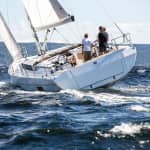
The central element of this deliberately open concept is its great versatility. This approach is particularly evident in the rig. The 52 comes with a furling mast and self-tacking jib as standard - a configuration designed for easy handling and relaxed travelling, which is also suitable for charter operations. Alternatively, a classic mast with a partially battened mainsail and an overlapping genoa are available on request. If you want to sharpen up your sporting ambitions even further, opt for the performance rig. Both Dacron and high-quality laminate sails are available for all variants.
Measured values of the Oceanis 52


The test boat, construction number one, is also equipped with the optional "First Line" performance package. The almost two metre higher triple-sailed mast carries almost 50 square metres more sail area than the standard version - an increase of 52 percent. Accordingly, the sail load factor increases from 4.0 to around 4.9, marking the transition from a classic cruising boat to a performance cruiser.
Handling under sail
The Frenchwoman showed that she is comfortable in this dual role during the test off Barcelona, where the Oceanis 52 is competing for the European Yacht of the Year 2026 award. In 18 to 20 knots of wind, the approximately 14-tonne cruiser cruises at a good turning angle of around 85 degrees at a speed of 7.8 knots - impressive figures, especially as the test is accompanied by waves of around two metres.
Upwind, the subject sails in a balanced and at the same time pleasingly stiff manner. The full-bodied Biscontini hull contributes a noticeable amount of dimensional stability - thanks to flat frames, especially in the aft hull area, and a pronounced uphaul. The heel remains moderate and easy to control even with increasing pressure, despite a ballast content of just 23 per cent in the bomb of the standard T-keel with a draught of 2.36 metres. However, the two rudder blades provide little feedback. The feeling on the wheel remains indifferent, clean steering upwind and in waves requires increased attention.
The handling is basically right. Without exception, the many sheets, halyards and trim lines are redirected below deck to the large winches in front of the steering columns. This requires careful handling of the numerous functions and good manoeuvre preparation. However, with a little practice and know-how, even single-handed sailors can cope with this layout. However, buyers should consider the option of electric winches, as the loads on the sheets are considerable.
Added to this is the standard mainsheet guide in the form of a cockpit, which is attached about halfway down the main boom before it goes down. The effort required to hoist and trim the mainsail is correspondingly high in windy conditions and can hardly be managed by hand using the winch. This can be remedied by the optionally available tarp bracket above the cockpit. With the mainsheet guide positioned further aft, trimming becomes much more efficient and noticeably less strenuous. The tarp bracket also serves as the basis for an enlarged sprayhood or a fixed bimini.
Two variants below deck for two requirements
Beneteau is taking a new approach to customisation. For the first time, the shipyard is no longer defining the basic version as a classic owner's boat, but as a variant consistently tailored to charter use. The standard layout has five cabins and three wet cells and is therefore designed for high occupancy rates and long-term, demanding use. The deliberately simple interior design matches this. The furniture is predominantly laminated and does not feature elaborate wood veneers. Although this gives a sober and functional impression, it is hard-wearing, easy to clean and easy to replace - clear advantages in charter operations.
The owner's version of the test boat is a completely different proposition. Beneteau has opted for a classic three-cabin layout with spacious double cabins and significantly higher quality standards. The furniture is of a higher quality, with carefully crafted real wood veneers and noticeably more attention to detail. The wet room in the foredeck is separate, with a separate toilet and separate shower area - a comfort feature that is now standard in the upper length class. There is also a very generously dimensioned work area on the port side, which combines navigation and office.
Prices of the Oceanis 52
The pricing of the Oceanis 52 is just as unusual as the layout and utilisation concept. Beneteau deliberately defines the entry level as the standard charter version with five cabins, a simple laminate interior and functional basic equipment. This version costs 529,550 euros gross, the sails are already included in the price. Anyone opting for the higher-quality owner's version - with a three-cabin layout, better basic equipment and upmarket wooden fittings - will have to factor in a surcharge of 32,725 euros. This puts the base price relevant for the market comparison at 562,275 euros and clearly positions the Oceanis 52 in the competitive environment of its class.
- Base price ex shipyard: 529.550 €
- Standard equipment included: Engine, sails, sheets, railing, navigation lights, battery, compass, sails, cushions, galley/cooker, bilge pump, toilet, fire extinguisher, electric cooler, holding tank with suction, anchor with chain, fenders/mooring € 2,770, antifouling € 7,520, clear sailing handover € 7,260
- Price ready to sail: 547.100 €
- Guarantee/against osmosis: 2/5 years
- Surcharge for comfort equipment: Genoa lifting points Perf. package; Traveller not available; Electric anchor windlass incl.; Tube kicker incl.; Backstay tensioner Perf. package; Spring cleats incl.Package; Spring cleats incl.; Sprayhood € 7,555; Teak in cockpit € 8,260; VHF radio E-Package; Log and echo sounder E-Package Wind measuring system; E-Package Autopilot E-Package Electric package; E-Package Electric package; Raymarine € 17,840; Charger incl.; Shore connection with RCD incl.; 230 volt sockets incl.; 12 volt socket in the sat nav incl.; Heating € 14,280; Pressurised water system incl., water heater incl., shower WC room incl., cockpit shower incl., comfort price € 595,035
- Included in the price: Furling mast, self-tacking jib, two cockpit tables, electric bathing platform with bathing ladder, Seanapps system (remote monitoring via app), sail load in the bow.
Status 2025, how the prices shown are defined, read here!
This price structure should also be seen in the context of the recently announced group-wide price adjustments at Beneteau. In direct comparison with the predecessor model Oceanis 51.1, the new 52, which is better and more extensively equipped in many areas, is around 40,000 euros cheaper. The French company's offer is also attractive compared to its main competitors.
Beneteau is consistently breaking new ground with the Oceanis 52. The flexible concept, the unusual separation between charter and owner's version and the good sailing characteristics result in a harmonious overall package. The 52 is not a boat for clearly defined pigeonholes, but that is precisely what makes it so interesting.
YACHT review of the Oceanis 52
Attractive and powerful cruising boat with blue water ambitions. The boat is adaptable and at the same time separates the requirements of owners and those of the charter market in a very targeted manner. This diversity is new.
Design and concept
Changeable concept
Solid construction
Competitive price
Plenty of space in the cockpit
Sailing performance and trim
Great performance potential
High rig variance
Sporty sailing characteristics
Little steering feel
Living and finishing quality
Two versions
Beautiful workmanship in detail
Generous berth dimensions
Ventilation in wet rooms scarce
Equipment and technology
Good equipment on deck
On-board technology neatly installed
Control without redundancy
No garage for the dinghy
The Oceanis 52 in detail

Technical data of the Oceanis 52
- Design engineer: Roberto Biscontini
- CE design category: A
- Torso length: 15,31 m
- Total length: 16,28 m
- Waterline length: 14,67 m
- Width: 4,84 m
- Draught/alternative: 2,36/1,92 m
- Mast height above WL: 22,00 m
- Theor. torso speed: 9.3 kn
- Weight: 14,5 t
- Ballast/proportion: 3,4 t/23 %
- Mainsail: 46,5 m²
- Self-tacking jib: 47,5 m²
- machine (Yanmar): 81 kW/110 hp
- Fuel tank (plastic): 200 l
- Fresh water tanks (plastic): 380 l
- Holding tanks (2): 1 x 64, 1 x 80 litres
- Batteries: 5 x 140 AH, 1 x 50 AH
Hull and deck construction
Hull: GRP sandwich, polyester resin, balsa wood core. Deck: GRP sandwich with vacuum infusion.
Motorisation
The 110 hp common rail diesel engine from Yanmar (4JH110) with Saildrive is installed ex works. A three-blade folding propeller is fitted as standard. No alternative is planned.
Performance package
The First Line equipment bundle includes, among other things, a higher three-hinged mast with Dyform shrouds, the bowsprit, a trimmable backstay, adjustable genoa lifting points, Dyneema running rigging, additional and electric winches and plastic steering wheels. The surcharge for the package is 40,700 euros gross.
Sail
A simple set of Dacron sails (main and jib) is included as standard. Better sails are available for an additional charge.
Shipyard
Chantiers Beneteau; 85800 Saint-Gilles-Croix-de-Vie (France); www.beneteau.com/de
Distribution
Dealer network
The strong competition
Bavaria C50

Voluminous cruising yacht from Germany, designed by Maurizio Cossutti Yacht Design. The Bavaria has a large bathing platform and a garage for the dinghy is built into the stern.
Dufour 54

The unusually flexible and convertible concept characterises the new top model from the yacht builders in La Rochelle. The new Dufour was presented for the first time at the boot trade fair in Düsseldorf.
Hanse 510

The boat from the co-operation between Hanseyachts and Berret-Racoupeau Yacht Design shows convincing sailing performance in the test and can also score points with an impeccably built interior. Read the test here.
Jeanneau Yachts 55

With an exciting and exclusive concept, Jeanneau can also meet the high demands of blue water sailors. The unusual layout on deck works in the Test good.

Michael Good
Editor Test & Technology
