


"Best of": Retro classic performance cruiser is the essence of a self-builder's career
Fridtjof Gunkel
· 15.02.2026


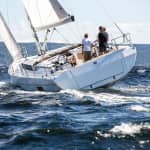
Hats off, chapeau, bravo! What lies before us in the Hohe Düne marina in Warnemünde demands the full attention of every sailor. There is no other way. We see a timeless-looking hull with a moderate width, a gentle deck step, an almost vertical stem and a closed yacht stern. A confident-looking boat. The superstructure is moderate, somewhat boxy, rather narrow. A fixed bowsprit. Overall, the boat is remotely reminiscent of English pilot cutters, those nimble sailing companions that had to be seaworthy, fast and manageable by a small crew in order to be lucrative. Fits.
The rig, however, no longer allows this association: two pairs of spreaders, shrouds attached on the outside, mast positioned almost in the centre lengthways, pinhead mainsail, only one backstay. The harmonious overall look is complemented by a dignified, elegant, masculine colour scheme: Anthracite and black, white, teak.
Other special boats:
A yacht that is difficult to categorise, for which there is no equivalent on the market. The superstructure is reminiscent of the boats of the French brand Black Pepper. The hull lines suggest a design by Georg Nissen or Judel/Vrolijk or even one of Martin Menzner's wooden boats. With a length-to-width ratio of 3.6, the boat is only moderately wide. The rig is modern and quite common in this geometry nowadays. However, this combination can only be found in this boat. It is also a feast for the eyes, not only in terms of its overall appearance, but also in terms of the details and craftsmanship of all the wood, carbon and GRP parts as well as the skilfully selected, fine and functional fittings from the underrated Italian manufacturer Antal.
So a single building. From where? Fits Janssen & Renkhoff or Jan Brügge Bootsbau from the Schlei or Wilhelm Wagner from Lake Constance. All false positives. It is a one-man shipyard. On the flanks of the superstructure we read: "Performance Classic 41 built by L. Schröder".
Lutz Schröder welcomes us on board. He designed and built the boat himself. Okay, the man is a master boat and ship builder and works as operations manager at the specialised shipyard Tamsen Maritim in Rostock. That doesn't automatically qualify him to design a yacht completely by himself and to carry out all the wood, metal and plastic work himself, including the installation of electrical, water and propulsion systems.
"Best of" joins the ranks of self-builders
This is not the first boat built by this multi-talented craftsman. At the age of 17, he had already converted a quarter-tonner of the Hiddensee class popular in the GDR in Greifswald. Compared to the usual derivatives of this self-built class, for which the class association provided the mould, the boat was a racer with more sail area, a flatter superstructure and a more modern keel. Lutz Schröder blew everyone away with his design called "Pretender" on the Greifswald Bodden, as his wife Christine, whom he met in those days, remembers.
Some time later, Schröder built a design by Heiligenhafen designer Jörgen Heinritz completely in just two years. A modern, 38-foot IMS yacht with an open stern, wide, equipped with a huge two-metre diameter wheel. The fast "Fastwave" was sold to the US East Coast.
Boatbuilding boost thanks to parental leave
Project number three was based on a Luffe 4004. The idea was to buy a well-known hull shell with a brand name, fit it out and equip it according to their own ideas and then be able to sell the boat better than a little-known one-off because of the series name. After just two years, the Luffe was ready to sail. The boat was also built with the idea of selling it again quickly and at a profit in order to improve his retirement provision and invest in his next boat. That worked out. After just two years, the Luffe 4004 went to a buyer, and the next big step followed: Schröder ordered a Luffe 45.
Tine Schröder: "Of course, the construction period was also exhausting. The boat eats up the money, Lutz works 40 hours at his job and then spends the rest of his time with the boat, there are no holidays together during this time, and not to forget our son, who was still in nappies at the time, robbed us of our nights and needed my full attention. But at least Lutz was able to take parental leave and switch on the boat-building turbo."
As with the smaller Luffe, the carbon mast was also created by the skilful boat builder. After around four years, the large Luffe went into the water. The family enjoyed a summer holiday and weekends on board. Just one year later, the restless Schröder had already sold the boat again, and in 2017 it went away. And now? "A bit of a trauma for me, but also for Lutz," says Tine Schröder, as things couldn't go on without a boat. However: "We talked about series ships, but didn't come to any conclusions." From the point of view of the experienced couple, there is no boat that sails very well, looks special, offers the comfort they want and also meets their own boatbuilding requirements.
Crowning highlight
In 2020, the time had come, Lutz could no longer sit still and secured a space in the hall where he had already built the Luffes. It was to be the last project. One that would incorporate all the experience that the self-builder had previously gained, a best-of, which is how the name for the boat was found. Lutz Schröder: "The new boat should have everything we had in mind. A pilot cutter, modernised with classic lines, complete teak deck, black carbon mast with dark sails, closed cockpit with stern terrace, large steering wheel, visible clear varnished deck beams, white bulkheads, wet room with hot water shower, U-shaped seating area and plenty of storage space below and on deck." These are the specifications.
The fuselage was created using auxiliary frames in moulding construction made from Western Red Cedar, a North American softwood. The so-called speed strip mouldings are supplied in prefabricated 15 x 44 millimetre profiles, which interlock with each other and thus allow for smaller joints. The self-builder covered the moulding core with glass and carbon layers, filled and painted it.
The interior was made of caja mahogany. Schröder made the deck from boatbuilding plywood, using the classic construction method with deck beams. The boat weighs just 3.5 tonnes without the T-keel. The fin weighs 2.5 tonnes, which means a very high ballast ratio of over 40 percent; modern production boats achieve values below 30, but work with a high degree of dimensional stability. Another parameter also characterises the boat as highly potent: The ratio of hull weight to sail area in the "Best of" is an outstanding (dimensionless) 5.16 - a value that qualifies the boat as a racer.
A sailor's boat for sailors
The result is not only impressive, it also sails exquisitely. With the often-used image of steering with just two fingers, it can be steered precisely via the large, well-tuned wheel, making it easier to reach high speeds. The boat finds the wind edge almost automatically. Steering while seated upwind and downwind and standing upright works perfectly, the ergonomics are perfect. The fittings and their position, size and function are also perfect. The cockpit is not spacious, the stern terrace takes up space, but creates the desired large storage space, even for bulky items such as a dinghy or life raft. You might miss a stern hatch that makes it easier to board when lying astern and enlarges the cockpit - especially as the "Best of" will always be moored astern due to the bowsprit. No matter, because the family has decided in favour of this cockpit configuration, and that's all that counts with this one-off boat, which will be with them for many years to come.
The Schröder 41 is a sailor's boat for sailors. And for connoisseurs of maritime living culture. The tasteful interior, with its visible deck beams and attractive contrasts of wood and light-coloured wood, builds a successful bridge between the past and present in boat building.
Lutz Schröder worked on his magnum opus for a total of 1,416 days, sometimes shorter, sometimes longer, but always intensively. "You have to remain stubborn, set yourself goals, point by point, every day, every week". The reward is the highlights in the genesis of the self-built yacht, getting it out of the hall, launching it, the first night on board, the first nautical miles. And certainly also the feeling of sailing a boat that doesn't exist a second time, one that every sailor looks forward to. Guaranteed.
Technical data of the "Best of"

- Torso length: 12,30 m
- Total length: 13,70 m
- Width: 3,40 m
- Depth: 2,25 m
- Weight: 6,0 t
- Ballast/proportion: 2,5 t/42 %
- Mainsail: 47,0 m²
- Genoa: 41,0 m²
- machine (Volvo Penta): 40 HP

Fridtjof Gunkel
Deputy Chief Editor YACHT
Fridtjof Gunkel was born on Helgoland in 1962; he started his sailing career there in the Opti and quickly switched to keelboats. North Sea Week, Cowes Week and Kiel Week were early stops, followed by many years in the Admiral's Cup scene on the cuppers “Container” and “Rubin” World Championships and international regattas in the Starboat, with the mini-maxi “SiSiSi” and various tonner yachts as well as participation in the Whitbread Round the World Race were further formative stations, flanked by extensive cruising trips. Fridtjof Gunkel joined YACHT back in 1985 as part of a traineeship, where he later became Head of the Test & Technology department and then Deputy Editor-in-Chief around 25 years ago. He is also responsible for the regatta and sports section. Fridtjof Gunkel privately sails a performance/cruiser moored on the Baltic coast, his favorite areas are the eastern Swedish archipelago and Brittany.
