


Kevin Starnes, 63, recounts: "We faced steep, standing waves and felt like we were on a rocking horse. The bow was rushing through the water, but we were sailing to nowhere." The memory of last year's spring cruise to the San Juan Islands in the US state of Washington near the Canadian border turned into the first serious test run with his double-ender "Arningali". The name means "female narwhal with tusk" in the Inuit language. Together with his wife Sally, 55, Starnes lounges comfortably on the corner sofa in the cherry wood-panelled salon, which also serves as a museum, decorated with abstruse collector's items from all over the world, like a maritime flea market like "Harry's Harbour Bazaar" in Hamburg. Starnes speaks in a subdued voice, often drowned out by the wind whistling through the rigging. "We couldn't go back because the current would swirl us around and throw us onto the rocks."
Other special boats:
- "Polaris": Passage Maker designed for the far north
- Innovation Yachts: Nordbert Sedlacek's boat made of stone
- "Andrillot": This Bermuda cutter founded Laurent Giles' legendary Vertue Class
- "Fram": Expedition yacht for the extremes achieves scientific milestones
- Retro classic performance cruiser "Best of": When skill meets passion
Feelings and memories are still fresh, after all, it's not every day that you fight against nasty seas in the Cattle Pass between San Juan and Lopez Island, a passage peppered with rocky islets such as Deadman Island and Mummy Rock. Even a heavyweight like "Arningali" would be in a losing position there in the event of hard contact, despite the robust design of the 13-metre boat, which displaces almost 14 tonnes.
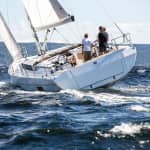
Stormy maiden voyage
Starnes is no chatterbox, which is why the listener takes his lively narrative, which literary aficionados may compare to Edgar Allan Poe's Maelstrom. "Arningali" was in a tricky position that had to be decided in binary terms: either it becomes an adventure story that you would still tell your grandchildren, or you continue your journey in a Coast Guard helicopter.
Starnes had previously practised heavy weather tactics on charter trips, but Cattle Pass was a first, as he was now skipper of his own yacht. Not only that, but he also had to get onto the bucking forecastle, on all fours, clipped into the safety lines on deck, to set the staysail so that there was enough speed in the ship. Meanwhile, Sally took the helm and steered the cutter with astonishing composure for a novice sailor. When asked if she had prepared for this in any way, she answered: "I'm a nursery school teacher, so yes."
The battle also led to the realisation that furling systems for the headsails had to be installed as quickly as possible to avoid trips to the foredeck in heavy weather. Starnes has already done this, a small milestone on the way to the adventure on the sea that has enticed him since his school days and for which he wanted to help his father Ned build a cruising yacht. "We dreamed of sailing around the world," Starnes told a local radio station. At home in the south of the state of Oregon, the two sailed small boats on the lake and only occasionally chartered in tropical waters.
Father passes on sailing dream to son
Ned, a vet, was planning to go cruising in his retirement and hoped Kevin, who was at the start of his career at the time, could join him in stages in between. They wanted to buy a hull shell so they could do the fitting out themselves, as was common in the 1970s and 1980s. "Joe Breskin from Seven Seas Boat Works in Port Townsend, Washington, placed a small advert in sailing magazines with a drawing of an Orca 38, which immediately got us excited," said Kevin. "So we went there and were fascinated by his workshop and the colourful jumble. As well as boats, there were pianos, loudspeakers, kayaks and people scurrying around. It was incredible." Kevin started making designs while he was still at school. Later, as a student of veterinary medicine, he helped his father as often as he could with the carpentry of the interior, while "dreaming of this and that and designing things for the boat".
In 1982, Breskin was commissioned to build an Orca 38 for Starnes, which turned out to be the last of this model series. It was a double-ender with a long keel, inspired by the designs of William Atkins. Attributes such as "solid", "robust" or "indestructible" are permissible, as peace of mind often depends on a subjective feeling of safety. A sandwich laminate was installed above the waterline, with a 1.27 centimetre thick PVC foam core, surrounded by 1.6 centimetres of GRP on the outside and 0.6 centimetres on the inside. The deck is similar, with a foam core covered with around one centimetre thick GRP layers on the outside and 0.6 centimetres on the inside. The underwater hull is made of 2.0 to 2.5 centimetre thick solid laminate. An armour.
Everything seemed to be on track until Ned was diagnosed with skin cancer in 1986. The then 57-year-old died within a few months, around the same time Kevin graduated. On his deathbed, Ned could rest assured that his son would take over the clinic, but his last wish was for Kevin to keep their sailing dream alive, which meant finishing the boat.
"I had the feeling that 'Arningali' had saved me"
This was not to be a failure of will, but for a 23-year-old who had a veterinary clinic to run and wanted a family, there were other priorities. The 800-kilometre journey to the waiting hull in Port Townsend was too inconvenient and lengthy, even if Breskin generously stored the hull in a boatyard. "I was sitting in this hull with no deck, and the lights were shining down from above," Kevin Starnes recalled of the day he had to decide the boat's future. "Everything was glowing red, almost like in the womb. It was as if I was being embraced by this boat. And I thought of my father, who had just died, and the burden of having to fill this empty shell."
Eventually, he transported the hull by lorry to southern Oregon to work on it in his garden. "It was a family project and an adventure playground for the kids," Starnes recalled. "They would run down the companionway, jump over the tools to climb out the hatch on the foredeck and swing off the bow - crazy!"
Work progressed slowly until he was diagnosed with a tumour in his head in 2009, which had to be surgically removed. However, the operation did not go perfectly. "I was in a coma and had a kind of near-death experience, but I recovered," he says. Kevin Starnes puts his recovery down to the love and support of his family, but that doesn't explain everything. "I was sort of walking towards the light because there was unfinished business. That's why I felt like the boat saved me. I had to finish it, not just for the family, but also for my honour, because I had started it as well." Starnes had no more time to lose if he wanted to take the family on a blue water cruise. So in 2019, he sent the boat back to Port Townsend, to Cape George Marine Works, where professional boatbuilders completed it, less than half a kilometre from where the shell of Seven Seas was built before the shipyard ceased operations. Cape George is still in operation with conversions and custom builds. The shipyard gained notoriety in the 1980s for its cutters, one of which was destroyed in the last Golden Globe Race by Kirsten Neuschäfer was steered to victory.
Launch after forty years
According to Todd Uecker, co-owner of CGMW, successfully continuing the work started by the owner was "a development process". "Kevin asked a lot of questions to make sure we finished 'Arningali' the way he wanted. The boat was basically built, style and details finalised, so we only had gaps to fill." These were: Plumbing, wiring, joinery, rigging and swapping the existing diesel engine for an electric propulsion system with a 30 kilowatt Elco engine and a total of 80 kilowatt hours of battery capacity for sufficient range. The original Saab built-in diesel had to make way for this system, as Starnes had developed an allergy to exhaust fumes as a result of the tumour operation.
After four years in the workshop, "Arningali" was launched in 2023 in picture-book weather in front of a cheerful gathering of guests in Port Townsend, styled and finished as a traditional cruising yacht, but with details that are second to none. There is the spiral narwhal bowsprit, which Starnes carved himself. There are massive deck fittings, some of which were supplied by Toplicht in Hamburg, such as a bronze anchor winch from Poland, and there is the "Tower of Power", an imposing stainless steel construction that rises above the narrow stern and is used to generate energy from the wind and sun. The solar panels have a capacity of 1,750 watts, and two wind generators contribute an additional 700 watts.
Visitors have plenty to marvel at below deck
Below deck, "Arningali" is both a museum and a cabinet of curiosities, peppered with memorabilia and artefacts from all corners of the globe. Two swordfish swords with scrimshaw art adorn the deck beam in the galley. Megalodon teeth hang above the navigation table, and an oval mirror on the forward bulkhead of the saloon reflects the light from sconces with wax candles. The enamelled wooden stove on the main bulkhead is adorned with a bronze dolphin coiled around a trident - once the ornamentation of a Venetian wedding gondola.
Towards sunset, the wind finally dies down a little, while Kevin and Sally let the philosophical reflections of their adventures fade away. The U.S. Coast Guard actually came into play. Not to help, but to check the equipment.
"People lack personal responsibility these days because we no longer have to rely on ourselves," notes Sally, "but an experience like this makes you proud and boosts your self-confidence. It's a good feeling." And skipper Kevin adds: "It taught me humility and that I have to be careful, because I'm now responsible for Sally too, not just for my boat and myself. But I didn't panic, and that makes me feel safe. It was exciting, I feel alive again." It is quite possible that Father Ned was pleased to hear this from the other side.
Technical data of the "Arningali"

- Boat type: Orca 38, identical in construction to Ingrid 38
- Design engineer: William Atkin, Joe Breskin
- Shipyard: Seven Seas Boat Works, Port Townsend
- Rig: High rigging
- Torso length: 11,60 m
- Total length: 13,40 m
- Width: 3,50 m
- Depth: 1,98 m
- Weight: 13,6 t
- sail area: 86,0 m²
- Sail load rating: 3,9
