


It was a grey September morning in Port Madison at the northern end of Bainbridge Island in the US state of Washington, but there was plenty of colour in the club harbour. "Like a box of crayons," commented one sailor, looking at the super-slim double-ender lined up on the jetty. Pointed at the front, pointed at the back, with either plywood or GRP painted in red, green, blue, white, orange or clear in between. A dozen of these unique boats have gathered to determine the champion of the US West Coast and celebrate the revitalisation of the local fleet, which has been dormant for years due to a lack of participants.
Other special boats:
- "Arningali": dream boat of two generations and museum under sail at the same time
- "Regentag": Hundertwasser ship bursts with the free spirit of its former owner
- "Andrillot": This Bermuda cutter founded Laurent Giles' legendary Vertue Class
- "Fram": Expedition yacht for the extremes achieves scientific milestones
- Retro classic performance cruiser "Best of": When skill meets passion
The International 110 was born in New England, where C. Raymond Hunt, who designed the boat in the late 1930s, was based. After years of economic depression, the incentive was to create a boat that would appeal to a wide audience thanks to its low manufacturing and maintenance costs. Licensed shipyards such as Lawley in Neponset and Graves in Marblehead produced the boats from the then revolutionary boatbuilding plywood. Later, 110s were also produced in the Midwest and on the West Coast, also from GRP. The total number is estimated at around 750 boats, of which around 75 are still active in the USA. Asking prices on the class website range from lukewarm to 10,000 US dollars, depending on condition.
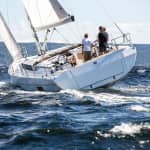
C. Raymond Hunt's affordable sailing boat concept
"I simply had the idea of designing boats that weren't so damn expensive," said designer Hunt, who also designed the Concordia Yawl, which was built by Abeking & Rasmussen on the Weser for the US market in the post-war period. He also designed the popular Boston Whaler.
The 110, often referred to as the ancestor of the sports boat, was an economy version of the 225, which at 10.7 metres long was significantly larger and faster, but also too expensive to build in large series. However, Hunt's design idea with a narrow, efficient folding frame hull, which consisted of a flat floor, almost vertical side walls and a tapered stern, could also be scaled down perfectly. Smaller meant both cheaper and more practical.
Short keel, narrow hull, good-natured character
The short iron keel of a 110s has a draught of just 84 centimetres, but at 300 kilograms it accounts for around three quarters of the total weight of 412 kilograms. Compared to modern performance boats, these 7.32 metre long and 1.27 metre narrow International 110s manage with a strikingly short rig. With a mast height of 6.70 metres and an upwind sail area of 14.6 square metres, they seem almost underpowered, but that's all the boat needs. This not only limits the procurement costs for sails, it also favours the participation of mixed teams.
Like many other vintage classes, the International 110s also had to adapt to the changing times. In addition to asymmetric spinnakers, various headsails, double bottoms and line routing into the cockpit, the approval of GRP hulls and the introduction of the trapeze were of decisive importance, but without ruining the boat's character. "The 110 has an easily controllable sail area and always remains good-natured," explains Brendan Meyer, one of the top skippers from California with experience on modern sports boats. The eventual winner sails a bright red, simple wooden boat that has been in the wake for several decades.
Seniors on the regatta course
The atmosphere at the Skippers' Meeting on the club terrace in Port Madison was also extremely relaxed. You could see sun-tanned faces divided into different age groups, from Master (45-54) to Great Grand Master (65+). The topics of conversation were not only adventures on the race course, boat trim and speed, but also hearing aids, artificial joints and pacemakers.
Then the moment of truth on the water. There was mostly a light wind like on an Alpine lake, plus a slight tidal current. In these conditions, the seniors had to crouch on the cross in the narrow cockpit or even use the leeward trapeze to create the desired heel to reduce the wetted area. Downwind, the 110s slid through the water seemingly effortlessly, with no recognisable stern wave, but heeled to windward with the spinnakers sheeting far to windward. Several teams loosened their shrouds with a flick of the wrist to tilt the top of the mast forwards to improve the flow of the mainsail. It was also noticeable how the mature teams threw themselves into the furling tack and dived under the low main boom, with no sign of rust.
Skip Allan - US champion at the age of 77
Especially not Skip Allan, the legendary blue water veteran, who was not only honoured for his sailing achievements, but also for saving two sailors from drowning. "The 110s have very good skippers and wonderful people in the class, who are all of a similar age and struggle with similar problems," he explained with a grin at the skippers' briefing. In 2022, Allan won the national championship as a 110 novice in a thrilling photo finish, which he practically decided in his favour on the finish line of the last race. He was 77 at the time, making him the oldest US champion in the class to date.
However, it took a few years to get this regatta up and running from practically scratch, as the foundations first had to be laid for the successful development of a sustainable fleet. The aim was to counteract the decline in the established skiff and dinghy classes, which were suffering from a loss of members due to escalating acquisition, material and maintenance costs and the resulting loss of young talent.
"You need boats and sailors that you enjoy competing against, but a suitable berth and access to the water are just as important," explains Zigmond Burzycki, a former dealer of Vanguard sailboats in the Seattle area and one of the two founders of the fleet. He was supported by James "Kimo" Mackey, owner of the historic second-rule six-metre "Saga", designed by Bjarne Aas in 1935 (see YACHT 9/2014). Mackey lamented the problem of finding suitable crew for his six-metre, which now sails beautifully as ever, but unsailed on its mooring.
So it was that during the Covid lockdown, Burzycki spotted an old International 110 on a boat tour in Puget Sound, which the owner was using as a daysailer. Further research revealed that International 110s were still sailing in good numbers on the East Coast and in California, mainly with people transferring from well-known classes who wanted to continue their sailing hobby, with the same amount of fun but without the hassle and expense. In addition, the former 110 fleet in Seattle was waiting to be kissed awake, and there were plenty of good & cheap second-hand boats available elsewhere.
Boat hunting on the west coast
The next step was to purchase these good and affordable boats, which Zig Burzycki and Kimo Mackey bought out of their own pockets to sell them later to motivated interested parties. Models still exist, but these boats had not been produced for some time. So Mackey and Burzycki travelled the western USA and also visited the Californian fleet in Inverness near San Francisco, where they found what they were looking for and purchased several new GRP boats with double bottoms and modern fittings, plus a well-preserved, naturally varnished wooden boat.
"Zig and Kimo contacted me out of the blue," recalls class president and surveyor Milly Biller, 72. She is a boat builder by trade and has been sailing 110s since she was a child. If someone wants to buy or get rid of a boat, she is the first point of contact. "One day, someone called me who had found a 110 on Google Earth in a storage yard in Los Angeles," says Biller. The boat had been pawned due to the owner's unpaid bills, so the owner of the site sold it to the searcher. He in turn turned up at the former owner's place at some point to pick up the sails and equipment - "just as the police were about to arrest him as part of a drug raid", she laughs.
Modern kits for a historic class
Since mass production of International 110s is not practical, Burzycki commissioned Brandon Davis of Turn Point Design in Port Townsend, Washington, to develop a kit for a GRP sandwich boat that was professionally built on site, with meticulous attention to class compliance to maintain compatibility with existing boats. "Traditionally, the hulls have been built from moulded plywood," explained designer Davis, "but getting ten millimetre sheets of plywood into the desired shape takes real power, a dozen straps, sturdy frames and a lot of perseverance." In the end, the hull floor and deck of the prototype were built from GRP sandwich and the sides from plywood.
Before developing a 110 plywood kit, Steve Clark was a successful sailor on the US East Coast who owned the Vanguard Sailboats shipyard in the 1980s, which built Sunfish and Olympic boat classes such as 470s and Finn Dinghies.
Serenity instead of commerce
The hull shape was taken from a GRP boat by a technician friend using a 3D scanner, before Clark edited the data on the computer to gradually refine the design. He then created cutting files for a CNC machine, which he sent to Chesapeake Light Craft, a company that sells kits for small plywood boats. The panels were cut there and then sent back to Clark, who used them to build his International 110. Such a project is too complex for amateurs, Clark noted, but anyone who really wants a new International 110 can now choose from two kits and commission a professional to assemble it.
However, this is not yet the case, as the used boat market satisfies the demand, partly because many sailors carry out restorations themselves. "The 110 class has talented sailors," said Kris Bundy, a former I-14 skiff world champion, "but despite their ambition, they remain relaxed." These days, he commutes from the Midwest to sail in regattas with the revitalised 110 fleet in Port Madison, where they have mastered the art of composure.
Technical data International 110

- Designer: C. Raymond Hunt
- Torso length: 7,32 m
- Waterline length: 5,49 m
- Width: 1,27 m
- Depth: 0,84 m
- Weight (min., without sail): 412 kg
- sail area: 14,6 m²
- Website class: 110class.com
