


The landlord knows no mercy: "You can't get anything from me!" he grunts and takes the menus away from us. A clear message, even if it comes as a big surprise to us. My Australian husband John looks at me questioningly as I stand up and push him and our daughter out of the Stralsund fish restaurant in full view of the other guests. My husband had just wondered why the rosé wine was only available by the glass and not by the bottle. Anyway, we eventually find a nice Greek restaurant with a terrace, where the empathetic waiter brings us an ouzo to calm us down. "I've never been thrown out of a pub in my life. Is it always like this in Germany?" Luckily, John can joke again.
We are on a voyage of discovery, which will first take us from Fehmarn to the coasts of Mecklenburg-Vorpommern. In summer 2019, we spontaneously bought a sailing boat here after a charter trip on the Baltic Sea. However, it then had to wait for us in a warehouse on Fehmarn for three years. Before that, we were not allowed to leave Australia, where we live, because of the coronavirus regulations there.
Hornet 32 on the Baltic Sea, Swan 46 in Australia
But now the time has finally come. On our pretty Hornet 32 "Dania" Born in 1979, John, our daughter Lizzie and I wanted to spend three weeks exploring the coast of eastern Germany, which was still quite unknown to us. During my childhood in Hamburg, my Danish father had always lured the family to his homeland with soft ice cream and hot dogs. And after reunification, I was soon drawn to the other side of the world.
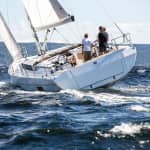
My own family's home port is now Sydney. I married there more than 20 years ago after meeting my charming Australian husband in a sailing bar at the Swan Cup in Sardinia. We have been sailing our Swan 46 "Senta" for almost 20 years now; during our children's primary school years we sailed with her in the Mediterranean and the Caribbean, now our cruises start in Australia's coastal metropolis. "Every boat serves a special purpose," my husband always says, depending on whether you want to sail inland, coastal or long-distance.
Beginners' mistakes happen even with 90 years of sailing experience
The small Hornet will therefore hopefully prove to be ideal for the often narrow harbours of the Baltic Sea, where we would like to spend the European sailing summers in future. The learning curve with the old boat, which is new to us, is steep. My husband can't read the German instruction manuals, I can't translate the technical stuff, it's a bit of a learning curve! Our combined 90 years of sailing experience don't help at all on the first day of sailing. There are plenty of rookie mistakes that I'd rather not list here. "Tomorrow, we'd better hit the main halyard before we set sail!" is the most harmless comment I can make.
Exhausted, we arrive in Stralsund on the first evening and don't dare enter the narrow pit lanes at first. "There's a green sign here," a nice sailor calls out to us; the mooring works. With our 1.5 metre draught, you can sail right into the last corner of the Baltic Sea marinas. The only problem with our "Dania" is that she only sails backwards in one direction, to starboard. Turning round in narrow pit lanes therefore needs to be practised.
Small harbours with good facilities are unknown in Australia
My husband is not familiar with the red-green mooring system. Mooring between piles is also a completely new concept for him. In Australia, you moor at mooring buoys, even in the harbours, or you anchor. The few marinas have large finger pontoons. However, the fact that you can sail into a pretty little town with historical significance every day after a few hours of sailing, moor at a jetty and then get electricity and water there, as well as access to restaurants, showers and shops, is completely different to Down Under.
Cruising in Australia either takes place locally, in natural harbours or bays near larger cities. Or it is long-distance sailing along the coast with long distances and often strong winds. At weekends, the huge and ramified bay of Sydney is teeming with boats: Motorboats of all sizes, sailors on day trips and dayboats taking part in regattas. Pleasure craft anchor off the beaches, or they sail into Middle Harbour to anchor in idyllic Sugarloaf Bay with friends.
Australians often enjoy swimming from their boats and don't worry about the danger that sharks could pose. In Sugarloaf Bay in 1963, a young actress was fatally injured by a shark. A long time ago? Not long enough for me! My teenagers, on the other hand, never think about the danger from below and are constantly jumping into the water from the pulpit. The statistics are on their side. It's more likely to be killed by a coconut or a cow than by a shark.
17 degrees water temperature- death by cold!
But now we're in Mecklenburg, nothing eats you. At most, you'll die of cold at a water temperature of 17 degrees. Most of my Australian friends don't go into the sea when the water temperature is below 25 degrees. But the beach in Hiddensee is a blast, regardless of the temperature, Lizzie and John plunge into the water. Lizzie doesn't know where to look in the face of all the naked people. Nude bathing is not allowed in Australia, and topless sunbathing is also not common.
In Lauterbach, we drink too many caipirinhas in a harbour bar and dance to the rock music of a local bard. The older crowd sings along to the East German songs and enjoys the holiday. We do too.
During our holidays in Australia, we regularly sail to Pittwater, a recreational area north of Sydney. It's 35 miles from our mooring, 25 of which are on the Pacific. We pass through the Sydney Heads and turn left, taking note of a reef on the way. 90 per cent of the time there is a considerable swell on the Pacific. You sail along the New South Wales coast, often accompanied by dolphins. You shouldn't go out here in a small cruiser. A boat for a purpose, as my husband says. "Senta" pounds good-naturedly through the sea.
Sailors see Australia as James Cook once did: without any civilisation
The harbours of the New South Wales coast are very widely scattered, and some can only be approached in good wind conditions and with little swell, as there are dangerous bars in the entrance. Pittwater, however, has a wide entrance, endless branches and bays, a labyrinth of waterways. We are moored at our mooring in Refuge Bay, a wide bay with a tiny beach. Here you can land with a dinghy or SUP, build sandcastles and take a shower under a waterfall. All around is dense, impenetrable forest and scrubland. Many of the bays and anchorages in Pittwater have no road access and there are no shops or restaurants.
Many of the bays and anchorages in Australia have no road access at all
All the boats are moored at murings, without electricity, and there is no mobile phone reception here either - wonderful when you have teenagers on board. You swim, read and doze. Or party. If you're unlucky on a cosy evening, the neighbours in the huge cabin next door, who have been partying to loud music in their cockpits since 3 o'clock in the afternoon, switch on all the diesel generators at 7 pm so that the family can shower and use the microwave. My husband then rows over in the dinghy and asks very firmly for peace and quiet. Sometimes you meet these people on the beach the next day and it almost comes to blows. Australians can be very temperamental and easily irritated. But they are also open-hearted, friendly, incredibly helpful and always funny.
And there is another way: a windless evening in neighbouring Smiths Creek between imposing cliffs, no light on land, the concert of cicadas, the untouched landscape - it's magical. In Queensland, you can sail for days along stretches of coastline that James Cook saw in exactly the same way on his voyage of discovery in 1770, without buildings, lights or telephone masts. Just nature.
But back to Germany. In Peenemünde we visit a Soviet submarine and the Nazi rocket testing station. We don't sail any further eastwards as the wind will shift. So instead we set course for Stubbekøbing, the land of my forefathers. Soft ice cream and hot dogs still taste good, and a trip to Copenhagen, albeit by train, satisfies everyone. The landscape here captivates us, all the historic towns make us rave. Our favourite is Hiddensee with its endless beach and relaxed, car-free atmosphere.
Sailing to the Great Barrier Reef: "Great, but never again!"
Australia is also an island, just a little bigger and fatter than Hiddensee. Sailing around Australia is a dream of many local cruising sailors, and some manage it. We're not that ambitious, but we did manage to reach the Great Barrier Reef in several stages a few years ago. This is only possible in cyclone-free winters and means travelling around 1,000 nautical miles. After all, once you have conquered the difficult coast of New South Wales, Queensland awaits with fantastic destinations on the mainland and on the offshore islands. The family trip to the legendary reef was a complete success with incredible experiences, landscapes and adventures, including highlights such as Frazer Island, Middle Percy Island and our time in the Whitsundays.
Saltwater crocodiles up to seven metres long have spread north of Frazer Island.
Afterwards, however, I said to my husband: "That was great, but we'll never do it again!" I have the constant, irrational fear that my children could have a leg or more bitten off by a shark while snorkelling halfway under control, and we all swim anyway. But saltwater crocodiles up to seven metres long have now spread as far north as Frazer Island. No reason for my family not to throw themselves into the water on a beach with crocodile warning signs in Mackay without hesitation - Australians! But even after 20 years, I'm still a sissy. How marvellously harmless the Baltic Sea is!
Two boats, two areas: Where is the sailing better? My personal conclusion is clear: off the German coast. The manageable routes, the exciting destinations and the marinas with all their services suit me better than endless sailing in bumpy seas to lonely bays. Fortunately, we don't have to make a decision. Thanks to two boats, we can now enjoy both the German and Australian sailing summers.
Lessons for long-distance sailors
My husband John and I have been sailing for what feels like an eternity: he started when he was at university, in Sydney Harbour, and I've been sailing since I was a child on the Elbe. Nevertheless, we are still learning. Our first post-pandemic cruise on our new, old boat was a rich learning experience.
Lesson 1: Documenting
We bought our Hornet 32 from 1979 on the spur of the moment. Due to the pandemic, she initially stayed in the hangar on Fehmarn for three years. A friend who had helped the previous owners with the last slip made no notes and only took a few photos. Unfortunately, the previous owner then passed away - and we were left empty-handed: no instruction, no documentation. As a result, the first week on board was extremely stressful because we couldn't find a lot of things and some things went wrong. That's why we took as many photos and notes as possible when handing over the boat and had the previous owner explain every detail in detail.
Lesson 2: Preparation
Leg Gedser to Vitte, more than 40 nautical miles ahead of us, woke up at 6 a.m., small breakfast. My father was a fan of good preparation for a trip while still in the harbour: take off the sails, attach the main halyard. My parents sometimes even reefed in the harbour. And they would pull the main up in the lee of the jetty when leaving the harbour. My husband, on the other hand, is more of a "get up and go" type. It's always worked out well so far. In this case, it was me on the tiller, he was on the phone to his office - for a long time. By the time we were able to set the main, we were in open water and the wind was blowing at 5 Beaufort. The main shackle promptly snagged, then the halyard blew behind the spreaders, twice. The halyard winch on the mast only has wire on a pulley, so gloves would have been a good idea. I preferred to ignore the shouting of my four-time Sydney Hobart competitor on the foredeck. Instead, I swore to myself: Establish routines! Prepare each leg in detail according to the conditions before setting off. So sails ready, charts and navigation equipment to hand, alternative route planned, sails set in wind protection, life jackets on!
Lesson 3: Stay flexible
We didn't make it to Vitte that day, the long counter-bolting was wearing us down. Without further ado, we set off for Warnemünde on the beam reach. We didn't make it to Usedom and Poland on this holiday either, as a typical westerly wind with strong winds set in. Instead, we called at Danish harbours such as Lolland, Falster and Nysted. However, I had left the new Danish harbour handbook at home as we wanted to go to Poland - a mistake. Cruising plans can change at any time!
Lesson 4: Obtaining a long-term weather report
My neighbours on the jetty in Lauterbach had pointed out the persistent westerly wind that was coming. I hadn't even analysed the weather that far in advance. The westerly wind would even have been good for our stages to Poland. But the way back would have been more than uncomfortable. We plan our sailing holidays roughly according to the one-third-two-thirds principle: turn around after a third of the time and head home, especially if you have to reckon with wind from the front on the way back.
Lesson 5: Power shortage
Haven't got your harbour handbook with you? No problem, you can look everything up online! And you can see all the shallows and shoals on the plotter anyway. So much for the theory. Our new old-timer has an echo sounder, nothing more! Our previous owner was an old hand. We ordered a new set of Baltic Sea charts for the trip and had navigation tools with us, but we also used two mobile phones and a tablet with Navionics charts. This worked until the charging of these devices plus our teenager's phone and laptop, the electric toothbrush, the camera battery and other devices caused the only power socket on board to give up. So never rely on just one navigation technology or even on the internet and telephone connection alone. The paper map should always be there as a backup.
Lesson 6: Keep it simple
"Why do you pee in the bucket at night?" our 17-year-old asked me in disgust after a few days on the boat. "Because your father often has to go out twice at night and I have to go out once, so you'd be disturbed three times in the foredeck." That hit home. I'm an old dinghy sailor and have no problem with a bucket. But what I want to say is that a cruising boat doesn't have to have the comforts of home. "Go small, go simple, but go now!" This also applied to our limited cool box capacity or the Primus cooker, which brought back childhood memories. Less is usually more!
Lesson 7: Choose your berth wisely
Our last Danish harbour was the idyllic Nysted on Lolland. Unfortunately, our old lady is not easy to manoeuvre backwards. And you don't want to turn in narrow pit lanes either. So we are happy to discover a free space in the front row in Nysted. In there and tied up! Only later do we realise that we are moored next to the petrol station. Every time a boat moors there for bunkering, it rumbles right up to us on board. You could have guessed that.
Lesson 8: Deploying lines cleverly
There are many ways of attaching lines to stern posts, and this is a matter of endless debate. Particularly as tying lines in boxes is not very common worldwide. So here's one last trick from my Danish father Einar, who is now in Valhalla: he always tied huge bowlines to the stern lines, which could easily be untied when pulling back without having to move the lines of other boats that might be thrown over them later. You can still learn something from old sailors today!
Text: Karin Eriksen
