


Journey: Morocco fascinates between the Atlas Mountains and the Atlantic Ocean
YACHT-Redaktion
· 24.03.2024


Text by Ulrike Potmesil
Water from above, from port, from starboard. Water over the bow and stern. We are approaching Africa, but we didn't imagine our arrival would be this wet. Coming from Portugal, we are currently in the centre of the Strait of Gibraltar, heading for Rabat, the capital of Morocco. Our Wibo 1100 is pounding through the waves. "Maha Nanda" is her name, "The Great Happiness". As far as the weather is concerned, she is giving the lie to her name: it is pouring with rain. And the south-west is storming.
The forecast had promised westerly winds of 5 Beaufort, peaking at 6 Beaufort, and later easing. Instead, it becomes increasingly difficult for us to keep on course. We have to sail with the wind - which is not "Maha Nanda's" thing. If she had her way, she would like to drop a little and head for the coastline east of Rabat.
The gusts now reach force seven, the waves form whitecaps, the ship turns its nose into the wind. Spray splashes over the sprayhood and into the saloon. Towards midnight, the gusts even increase to over 9 Beaufort and the waves begin to break.
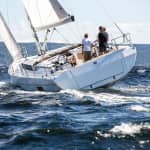
Difficult conditions for activation
Then I hear the beeping of our autopilot. Shit, "Maha Nanda" has gone off course! A glance at the steering gear leads to the realisation that the shaft pressure has broken a piece out of the auxiliary spider for the linear drive - a solid steel shaft on which the arm of the autopilot sits. "We'll be steering by hand from now on," my captain states succinctly, so I resignedly take the helm. Unfortunately, I discover a tear in the headsail just as I'm about to give up. It had twisted in the wrong direction when we were hauling in and formed a small belly, where a few shreds are now flapping happily. We reef the jib.
And so the night and the morning pass. At 1 p.m. we are finally two miles from Rabat - in front of us a grey wall of rain and grey walls. Christoph radios the Bou-Regreg marina, but we are not allowed to enter. When the tide is low and the waves are two metres or higher, the entrance is closed. In the prevailing conditions, a bar between the pier heads creates breaking swells. Nothing works here without authorisation and a pilot. We are sent on to Casablanca - apparently the harbour authority knows less than we do: namely that the marina there has been undergoing renovation for years and the planned opening is postponed from year to year.
Morocco welcomes bureaucracy
After a lot of toing and froing, the relieving radio message comes: we can go in after all. But now, of all times, the engine is causing trouble. The filter is clogged, a classic problem. My skipper decides that it's no longer worth changing the filter, so we crawl into the outer harbour with the engine spluttering over breaking waves. A jet boat driver approaches us from the mouth of the Bou-Regreg river, his uniform identifying him as a fireman.
He is grinning ear to ear. "Marhaba - welcome to Morocco!" he shouts and gestures for us to follow him across the river. As soon as we moor up at the customs jetty, police officers appear, then marina staff, representatives of the customs authority and finally the drug squad with a drug dog. The poor animal is obviously afraid of boats and can only be persuaded to board our "Maha Nanda" with gentle force. The procedure drags on. From now on, we will no longer complain about the excessive Austrian bureaucracy, we now know the Moroccan one.
Eventually it is done, the ship is moored and safe, and we find time for our first explorations. We quickly feel at home in Rabat, more precisely in the sister city of Salé to the north. There we stroll through the winding alleyways, which are lively and, from a European perspective, sometimes quite chaotic. The main street is only partially paved and the shops are crammed with everyday items. Which is good, because we need a sim card for our mobile wifi.
Insight into the tanneries of Fès
In the mobile phone shop, two young men explain to us that we have to buy a Moroccan card, insert it into a mobile phone and then unlock it with a pin, finally dial a Moroccan hotline and use it to activate the SIM card. The problem: they explain all this to us in Arabic! Luckily, we have a translation app on our mobile phone. We chat in English and the app translates it into Arabic and vice versa. The app doesn't always seem to find the right words, but the four of us are having a great time. The sim card purchase takes an hour. In the meantime, we nibble on pistachios, talk about our home country and our families and finally bid each other a fond farewell.
Change of scene. We hire a car for a tour into the centre of the country. First, we immerse ourselves in the souks of Fès. We walk through the labyrinth of the old town, where every stranger is guaranteed to get lost. That's not a bad thing, because there are exciting things to discover on every corner; Fès is a festival of colours and smells. The tanneries in the city are fascinating, but also frightening. In large courtyards, people stand in basins filled with chemicals and prepare leather. Some of them barefoot and without gloves. "They don't need protection, it's all natural colours made of saffron and indigo," a local tries to reassure us. But tanning is done with lime, pigeon droppings and cow urine.
There is also an unimaginable stench in the tanneries. We quickly learn that the little bunches of mint we are given are not intended as a decoration for the buttonhole. Billions of skins are prepared here every year, the tanneries are a UNESCO World Heritage Site and the people are proud of their craft. But those who toil here do slave labour.
Shore excursion to royal cities
From Fez we continue to the royal city of Meknes, where we get lost again and end up at a carpet auction. While toothless, chain-smoking sellers run up and down with rolls of carpet on their shoulders, the buyers screech no less loudly and wave banknotes. Unfortunately, our knowledge of Arabic is poor. They don't go beyond "marhaba - welcome", "shukran - thank you" and "bismillah - bon appétit". But even without really understanding the noisy auction, we are very impressed.
The road trip continues to Marrakech. Captain Christoph, a hobby artist, particularly enjoys the Jardin Majorelle, which is shielded from the hustle and bustle of the city. Created in 1923, the garden was later redesigned by French fashion designer Yves Saint Laurent. Then comes the counterpart: we are thrown from the magical silence into a cacophony of sounds - music from all directions, singing, whistling and drumming. We find ourselves on the Djemaa el Fna, the former executioner's square and now the marketplace of Marrakech. This is where jugglers, snake charmers, musicians, traders, storytellers and henna painters cavort. Especially in the evening, when the Djemaa el Fna seems to be bursting at the seams, it is an overwhelming spectacle.
Red houses on red rock against a blue sky, the white Atlas peaks glowing in the background
At the end of the shore excursion, we drive along winding roads into the central Atlas Mountains with their snow-capped peaks. We wind through Amazigh villages, Berber settlements, see terraced landscapes, red earth, snow-covered slopes and fertile valleys. As soon as we cross the pass, the landscape changes. Bare rock formations, coloured layer by layer in shades of red, characterise the picture. At the foot of the High Atlas, we stop at a riad, a house built in the traditional style, and have a thé à la menthe. Here the season changes seamlessly to summer, we sit in the orchard and hold our noses up to the sun.
We then wind our way around red stone cones, around rocks eroded millions of years ago that look like mountains of mud scooped up by a giant, through the Ounila Valley lined with date palms and over high plateaus to the town of Aït-Ben-Haddou: red houses on red rock against a blue sky with wispy clouds drifting overhead and the white Atlas peaks glowing in the background. This backdrop looks like something from another planet - and this remote corner of the world has indeed been the setting for numerous film shoots such as "Star Wars", "Gladiator" and "Game of Thrones".
But the real joy is and remains discovering Morocco from the seaside. Back in Rabat, we cast off. The Atlantic swell has subsided and the harbour authority has cleared the exit. We set sail and head south-west. We are tempted by the fishing harbours along the coast. Unfortunately, as soon as the protective harbour lies astern, the sea still shows its rough side: the surf at the harbour exit is not for the faint-hearted and weak engines. You have to step on the gas, close your eyes and keep going. With a lively wind, two metre waves and sunshine, we head towards El Jadida.
El Jadida presents itself in Portuguese
The harbour entrance is teeming with tiny, colourful fishing boats and floating tractor tyres that fishermen use to catch crabs. And there is actually something of a club here, a sailing school. A number of adolescents cavort in the harbour basin with lasers and surfboards. Raschid helps us tie up to the tiny jetty and then introduces us to a visibly important man in a white shirt and sunglasses: Monseigneur Berrazouk, president of the club.
We shake hands, express our pleasure at getting to know each other, express our appreciation of the beauty of the place, then the president and two companions stride gracefully away. The next official appears, the harbour master, also dressed in sunglasses and a white shirt. We clear in with him. "Welcome to El Jadida, the most beautiful port of Morocco!" he says as he hands us back our passports.
In El Jadida, we experience the Portuguese side of the country. In the 15th century, the colonial rulers built the Mazagão fortress. A huge cistern and eight metre high and equally wide fortress walls made of sandstone still characterise the image of the old town today. From the battlements, you have a magnificent view of the city, the harbour and our "Maha Nanda". It is the only boat here that does not have the Moroccan flag flying at the stern.
Sailors are rare in Morocco
Our next destination is one of the largest industrial and fishing harbours on Morocco's coast: Safi. Lots of helpful hands await us here too. Our arrival has been observed from the tower. We go alongside a former naval training boat. In fact, "Maha Nanda" is the only sailing yacht in the harbour here. The harbour is of economic importance because of the local phosphate industry. Accordingly, the area doesn't exactly look clean.
The harbour captain gives Captain Christoph an extensive tour of the control tower and is extremely courteous: "May I introduce you: Adil is your security man. So you can be sure that your boat is safe. Whenever you need anything, do not hesitate to ask me personally." The police chief also guarantees our safety and even calls us on one of our subsequent shore excursions just to let us know that our boat is in good condition.
The last Moroccan harbour town on our list is Essaouira. We set off at five o'clock in the morning with no wind. We definitely want to arrive in daylight, the swell in front of Essaouira's harbour entrance is notorious. The beaches there are known as a kitesurfer's paradise. In other words, there is rarely a gentle breeze here.
Shortly before entering the harbour, the already shallow water depth drops significantly. "Maha Nanda" lurches through a foamy, green, muddy Atlantic soup, over which the north-west, now blowing at 6 Beaufort, sends salty clouds of spray. In the harbour basin, we are overcome by a feeling of happiness: the sea calms down, the brightly shining fortress of the city rises above the piers and walled stone piers, where large trawlers and small, blue and red painted fishing boats lie crowded together.
Essaouira between the hippie era and commerce
We moor "Maha Nanda" to a sailing boat flying the Belgian flag, which has moored to a lifeboat, which has moored to a dredger, which has moored to a gravel pusher, which has moored to the quay. Anyone who can't climb obstacles will inevitably end up in the stinking harbour basin. There is no infrastructure in the fishing harbour of Essaouira. Neither electricity nor water are available. But what would Morocco be without special flavours?
If you feel an irrepressible desire for body care, visit a hamam. First you are rinsed from head to toe with hot water, then scrubbed with a goat's hair sponge. The husband at my side is still laughing when he hears my cries of suffering. He soon gets over it, the sponge removes what feels like ten millimetres of skin. Our washerwoman is clearly enjoying our torment. As a reward, we are given a heavenly foam massage, followed by a fragrant mask all over our bodies. We leave the hamam with baby-soft skin.
The medina of Essaouira was one of the major hippie destinations in the seventies. Jimi Hendrix & Co. were inspired by the music of the Gnawa, spiritual rhythms of an ethnic minority from West Africa, which were used to get in touch with spirits. Thousands make a pilgrimage to the Gnawa Festival in June.
There is little left of the hippie era in this enchanting city; it is a touristy and commercialised place. Nevertheless, there is an exciting story behind many a product that has long since been industrialised. Like argan oil, for example. It is extracted from the fruit of the argan tree, which only grows in southern Morocco, and is used as an edible oil and for cosmetics. As a number of farming families who had lived from argan oil production were threatened with impoverishment as a result of the switch to industrial processing, a women's initiative, the UCFA, was founded. It is made up of 22 cooperatives with over a thousand women. They preserve the tradition of hand-pressed oil. You can watch them at work in the souks in the south of the country.
Farewell to Morocco
On Christmas Day, we leave Morocco's coast in the wake of "Maha Nanda". After days of patient waiting, as all harbours on the North African Atlantic coast were closed for a whole week. With 50 knots of wind and six metre waves, not even the intrepid fishermen with their large trawlers are allowed out to sea. They lie in a packet in front of us in the harbour, and the swell makes them move rhythmically towards us like an armada, only to move away again at the stern.
We watch the seething masses of water on the rocks at the harbour entrance for hours. The Atlantic teaches us humility, and we spend Christmas Eve far away from our friends waiting for us on the Canary Islands. Finally, on 25 December, the sea calms down, the wind shifts to the north, we untie the lines and turn the bow of our boat towards Lanzarote. Surrounded by all shades of blue - from the sea to the horizon and beyond - we bid farewell to Morocco: goodbye - Maasalama!

Ulrike, 54, and Christoph Potmesil, 55, from Vienna set off on a long voyage in 2019. They sailed their 36-foot Wibo from Holland via England, France, Spain and Portugal to Morocco. Further information: sailing-mahananda.com
Tips for the trip
The harbours can be reached around the clock via channel 10. In an emergency, Mohammedia or Safi can be called at, Rabat, El Jadida and Essaouira are closed in bad conditions.
The best time to visit is April to October. This is when the winter storms begin, and from November the harbours are often closed for days on end. You have to clear in and out each time you enter and leave the harbour. The harbour staff speak a little English, but mainly Arabic and French.
The Atlantic ports of Morocco

1 Rabat
- Costs: 18 euros (for a 36-foot boat)
- Infos: 240 berths for boats with a draught of up to 4.0 metres. The harbour is closed from a wave of 2.0 metres and boats must anchor in front of the outer harbour. The harbour is located on the banks of a river and is well protected on all sides.
- Supply: Water, electricity, petrol station, travel lift, sanitary facilities
- Security: Guard posts at the entrances to the marina and on the jetties
2 El Jadida
- Costs: 28 Euro
- Info: There is space for two boats with a draught of up to 2.0 metres on the small jetty. In the high season (spring to autumn) you have to anchor in the harbour, as the ground is very muddy. Parts of the harbour fall dry at low tide. Breakwaters protect against swell
- Supply: WC and showers with cold water. There is electricity and water at the pontoon
- Security: Barrier and police check at the harbour entrance
3 Safi
- Costs: 28 Euro
- Info: The harbour is open to the north, but well protected by the bay. Can be called at in all weather conditions. There are no pontoons for pleasure craft. Mooring in a parcel at a training vessel is possible
- Supply: Very clean sanitary facilities are available in the control tower. There is also a petrol station and a travel lift on the site
- Security: The area is secured by a barrier and an additional gate. Security personnel have also been assigned to our boat
4 Essaouira
- Costs: 28 Euro
- Info: The harbour is open to the southwest, heavy swell. Mooring only possible in a packet at a lifeboat. Or anchor in front of the harbour for 25 euros. In bad weather conditions, anchormen must enter the harbour
- Supply: No water, no electricity, no petrol station, no sanitary facilities
- Security: The harbour is not closed, but access to the boats is difficult, especially at low tide. The rescue ship is manned around the clock
