


Read also the 2nd part of the district report "From Sjötorp to Mem: ups and downs on the Göta Canal"
The Göta Canal is undoubtedly one of the last adventures that can still be experienced on your own keel in our latitudes. For around 400 kilometres, it winds like a blue ribbon through the south of Sweden, through the forests, meadows and fields of the ancient cultural landscape of Götaland. The historic waterway not only connects the two coasts of the Scandinavian country, but also crosses two of Europe's largest lakes, Vänern and Vättern.
So it's no wonder that the entire route has become known as the Göta Canal. However, the section that actually bears this name only makes up the eastern half of the entire route: from Sjötorp on Lake Vänern to Mem, where the canal reaches Slätbaken, which is already part of the Baltic Sea.
Those travelling from the Kattegat and starting their journey in Gothenburg, on the other hand, first have the western half ahead of them: the Trollhätte Canal up to Lake Vänern and finally the lake itself. We present these two sections in detail on the following pages. The eastern section will be the subject of an article in the next issue.
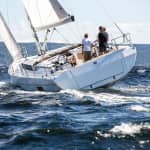
The Trollhätte Canal is also suitable for large ships
In contrast to the Göta Canal itself, the Trollhätte Canal has been developed as a modern large shipping route. It also allows seagoing cargo ships up to a certain size to pass through to Vänern. Three barrages with a total of six locks have to be negotiated.
Once the canal has been crossed, Lake Vänern opens up ahead. With an area of around 5,500 square kilometres, it is ten times the size of Lake Constance. 140 kilometres lie between Vänersborg in the south and Karlstad in the north. The coastline of Lake Vänern measures almost 2,000 kilometres if all the bays, sounds and islands are included. And the islands are a dime a dozen: there are said to be 22,000 of them - from the largest, Torsö, to the smallest, wave-washed, nameless rocky outcrop.
Impressive lake section on Lake Vänern
In the gallery of waterways from coast to coast, Lake Vänern forms the great contrast, the impressive piece of lake between the tranquil landscape paintings of the Trollhätte and Göta Canals. Given these dimensions, the Vänern is certainly more than just an area in its own right. If you have a few weeks to spare during the short summer, you can not only explore the lake itself, but also take a detour or two. For example to the equally beautiful Dalsland Canal.
Skippers travelling through, on the other hand, will limit themselves to the southern part of Lake Vänern. Even the shortest route between Vänersborg and Sjötorp, where the Göta Canal begins, measures around 150 kilometres - a stage for which you should allow at least three days. But let's start the journey from the beginning, on the Baltic coast.
From Gothenburg to Vänersborg

1 The archipelago
The first landfall when approaching Göta älv is not the mainland, but the archipelago off the coast, Göteborgs skärgård. The term "garden" fits perfectly, as many city dwellers have their summer homes on one of the islands. The main fairway divides the archipelago into a southern part with 20 larger archipelagos and a northern part about half the size. The latter includes the three popular excursion and holiday islands of Björkö, Öckerö and Hönö. They each have their own guest harbours.
2 Gothenburg
Like many other European seaside cities, this metropolis of millions has changed its waterfront face considerably over the past two decades. It was not the spirit of the times that was responsible for this, but economic necessity: on the sites that were once used for shipbuilding and the storage of general cargo, modern housing is now growing upwards. Joggers now run their laps where stevedores once handled cargo.
Like many other seaside cities in Europe, Gothenburg has changed its waterfront face considerably over the past two decades"
If you pass Gothenburg's "gate", the 107 metre high Älvsborgsbron, coming from the sea and head further upstream on the Göta älv into the city, you cannot miss this development on the north bank: The Eriksberg shipyard's gantry crane still stands there like a giant red portal. This industrial monument is all that remains of the glorious shipbuilding past. Office blocks and flat blocks now line the former dry dock. Opposite, the large ferries to Frederikshavn and Kiel have their berths. Harbour ferries cruise, pleasure craft and sailing yachts are underway.
Soon the ships of the Maritiman, the maritime museum, also come into view on the south bank (MARITIMAN.SE). The imposing destroyer "Småland", which was launched at Eriksberg in the 1950s, lies in the first row. It is followed by the modernist wedge-shaped building of the opera house (EN.OPERA.SE), and directly behind it, in front of the high stem of the four-masted barque "Viking", the largest cargo ship ever built in Sweden, the entrance to the harbour of Lilla Bommen opens up.
Guest yachts can be moored here on floating jetties with outriggers or murings (GOTEBORGSGASTHAMN.SE). The location couldn't be better: The neighbouring Nordstan shopping centre (NORDSTAN.SE) leaves nothing to be desired when it comes to catering, and restaurants can be found either there or directly at the harbour. Via Östra Hamngatan, Gustavs Adolfs torg in the city centre can be reached in ten minutes and Kungsparken, Gothenburg's green lung, in 20 minutes on foot.
Västtrafik is responsible for local public transport by bus or train in the city and the surrounding area (VASTTRAFIK.SE). Gothenburg is always worth a visit, and anyone who has never been there should plan at least two days. The mix of sophisticated elegance, relaxed Scandinavian lifestyle, culture and scene guarantees great experiences!
3 The Trollhätte Canal
The kilometres of the Trollhätte Canal begin immediately above Lilla Bommen with the passage of the Götaälvbron. The fact that the river has been shaped for large ships can be seen in the first few kilometres not only from the straight sections, but also from the radar reflectors on both sides and at regular intervals on long booms protruding above the water. They mark the fairway for ships, which can be up to 87 metres long and 4.70 metres deep. The Vänermax dimension is based on the size of the lock chambers on the 82 kilometres between Gothenburg and Vänersborg.
While at the beginning industrial areas and shopping centres on both sides indicate the conurbation of the city, the surrounding countryside soon becomes greener and hillier. The Göta älv now appears very natural, despite the fortified banks and lake markers. No wonder: only ten kilometres of the waterway had to be created artificially. The journey across Sweden has begun!
4 Kungälv
At the mouth of the Nordre älv, which is also navigable but less frequently used (see map on page 18), the towers and walls of a massive castle come into view on the port side around 15 kilometres north of Gothenburg: for centuries, Bohus fästning was of central strategic importance in the power struggles for dominance and influence between Denmark, Sweden and Norway (BOHUSFASTNING.COM). The impressive complex can be reached in a few minutes from the guest harbour of the small town of Kungälv on the fortress island (GASTHAMNSGUIDE.SE; > SEARCH: KUNGÄLV).
5 Lilla Edet
After around 50 kilometres, the first of the three barrages on the way to Vänern is reached: the Lilla Edet lock has a drop of six metres, with a total height difference of 44 metres along the entire route.
There are waiting areas for pleasure craft, and the lock staff monitor the arrival of every ship with video cameras. All locks and the movable bridges can also be reached via VHF channel 9. Further information is available on the Internet at Sjöfartsverket (SJOFARTSVERKET.SE; > SEARCH: TROLL CHANNEL). The guest harbour of Lilla Edet is located in the upper water of the lock on the eastern bank. There are floating and fixed jetties for yachts here. Mooring is alongside or with the help of a mooring ring (LILLAEDET.SE; > SEARCH: GÄSTHAMN).
6 The sluice staircase
The further north you go, the more the river valley becomes a gorge. At the same place where the Göta älv plunged over a waterfall in ancient times, it was tamed around 1800 with the first lock stairs. However, just half a century later it had to be replaced by larger, blasted-out new structures. Both lock staircases still exist, right next to the one used today from 1916. There are a total of four chambers at this point - three connected, followed by a single one - with a drop height of 32 metres. The last one also houses the lock office, where the fee for passage is paid (card payment). The current price is 1,100 Swedish kronor per boat, or just under 100 euros. If you don't want to continue your journey straight away, you can moor in the pretty guest harbour of Åkerssjö above the lock stairs. Information on these and the following two harbours can be found on the website of the West Swedish Tourist Board (VASTSVERIGE.COM/EN/TROLLHATTAN-VANERSBORG/ACCOMMODATION/GUEST-HARBOUR/).
7 Trollhättan
For a few kilometres, the canal now leads directly through the town of Trollhättan. There is a guest harbour right opposite the lively Strandgatan and the small town centre. It is located on the Spikön peninsula off the western shore.
8 Vänersborg
Before reaching Lake Vänern, the last lock in Brinkebergskulle has to be passed. You then enter Vänersborg, the administrative centre of the region and an important harbour town in the south-west of the lake, via the Karlsgraben. The full range of services is available here once again before the inland journey ends for the time being and you return to the open water. There is a guest harbour on both the canal and the lake side.
The further north you go, the more the river valley becomes a gorge. The Göta älv used to plunge over a waterfall into the depths here
From Vänersborg across Lake Vänern to Sjötorp

9 Lake Dalbosjön
The journey now continues on the southern part of Dalbosjön, which forms the western half of Lake Vänern. From Vänersborg, the lake opens up like a funnel towards the north-east in a bay around 40 kilometres long. The buoyage and lighting leave nothing to be desired, as there are also freighters travelling on the lake. Despite its large expanse, Vänern is shallow and rocky, especially in areas close to the shore, and there are numerous individual obstacles and reefs that should be avoided by those unfamiliar with the area, even in smaller boats. One particular obstacle of this kind is Hindens Rev, which sticks out into Dalbosjön like a stone needle for almost seven kilometres and continues underwater. It is the remnant of a terminal moraine that was formed during the last ice age.
The only two marinas in this part of the lake are in Sikhall (BATSIDAN.COM/HAMN/SIKHALL) and a little further north in Dalbergså (DALBERGSA.SE> GÄSTHAMN) on the western shore. After passing the narrow section between Hindens Rev and Hjortens Udde, Dalbosjön opens up further and the journey is free, either eastwards towards the island of Kållandsö and beyond to the Göta Canal or north-westwards to the Dalsland Canal.
10 The Dalsland Canal
The water system of the Dalsland Canal begins at Köpmannebro - certainly one of the most beautiful inland waterways in Europe. Because the name is deceptive: only twelve of its 250 kilometres are man-made with the help of 31 locks. If you include all the tributaries, the canal stretches 400 kilometres all the way to Norway. The historic Håverud aqueduct, opened in 1868, is also one of Sweden's most famous engineering monuments (DALSLANDSKANAL.SE).
11 The island of Kållandsö
The island is the second largest in Vänern, although the sound in the south is so shallow even in the navigation channel that it can only be navigated by very small open pleasure craft. The most attractive side is in the north anyway: The Gästhamn of Läckö is located right next to an imposing castle in a park-like landscape. The history of the baroque building goes way back to the Middle Ages. Opera performances are often held here in summer.
The Bronze Age rock carvings in the area are even older (LACKOSLOTT.SE/CAMPING-GASTHAMN). Alternatively, skippers can find a berth at Kållandsö Marina in Hörviken (WWW.KMBK.SE).
12 The maritime archipelago
North of Kållandsö, the transition between Dalbosjön and Värmlandssjön forms the waist of Lake Vänern. Just 20 kilometres lie between the island in the south and the tip of the Värmlandsnäs peninsula in the north. This is where you get that real Swedish feeling. It is so flat that two archipelagos protrude from the lake like a belt: Ekens skärgård in the south and Lurö skärgård in the north.
Both consist of hundreds of small and tiny islands, some forested, most bare. Almost all are uninhabited. A fascinating landscape of rock and water, formed under the pressure of former glaciers.
Both archipelagos are named after their respective largest islands, and Lurö not only has the only guest jetty in the area; you can also spend the night there in a former lighthouse building and bathe from the floating sauna. Booking recommended (LUROGAST.SE)!
13 Lake Värmland
After the shallow lagoons of the archipelago, there is now "open sea" again to the east; Värmlandssjön is even larger than Dalbosjön. There are almost 100 kilometres between north and south. In addition, the deepest part of Lake Vänern, at 106 metres, is about 25 kilometres south of Karlstad.
For skippers heading towards the Göta Canal, however, only its southern end is relevant. There is a northern and a southern route. On the northern route is the Djurö National Park, a small group of archipelagos with no jetties but several good natural harbours for anchoring. The best harbour, Malbergshamn on the main island, is approached from the north. From there, there are signposted tours ashore: a small paradise between "rattling stone beaches" of pebbles and pine forests - if you're lucky, you might spot roe deer (SVERIGESNATIONALPARKER.SE; > SEARCH: DJURÖ).
14 Lidköping
If you want to include a town in your route planning for a change or need to take care of yourself, you can definitely choose Lidköping. However, this is only at the very southern end of the almost 20-kilometre-long Kinnevik. From the guest harbour of Segelsällskapet Westgötarne, the centre is a good quarter of an hour's walk away (SSWLIDKOPING.SE > GÄSTHAMNEN).
15 Mariestad
Mariestad, named after a German princess, is the more attractive - and closer - option for a shore excursion with a stroll through the town: here, the guest harbour is located directly between the River Tidan and the old town with its cafés and bars in front of the boat (HAMNMAGASINETMARIESTAD.SE). But a few more steps won't hurt either. Then you can reach the Gamla Ekudden nature reserve or the Karlsholme Folkets Park with the "Sjöterrassen" restaurant, which is well worth a visit - highly recommended!
16 The island of Torsö
The largest island in Vänern has only been connected to the mainland since 1994: The Torsöbro elegantly spans the sound of the same name. For a last night on the lake, there are two attractive moorings to choose from: one is the small guest harbour of Laxhall on the picturesque Brommösund on the west side of the island, which even has a chic Hamnkrog with an exciting menu (LAXHALL.SE). Or you can opt for the magnificent Sandvik anchorage in the north. There is no restaurant there. But you will be rewarded with a beautiful sandy beach, rustic forest all around and an unobstructed view of the endless expanse of Lake Vänern.
17 Sjötorp
This is where the Göta Canal begins - or ends, depending on which direction you come from. The guest harbour, protected by piers, belongs to the canal company and is located below lock number one. You can buy your ticket for another highlight of our inland voyage in the harbour keeper's house - coming soon to yacht.de!
In YACHT 7/2024, we take you along the Göta Canal from Sjötorp to Mem on the east Swedish coast: How does canal travel in convoy work? How many locks are there along the way? Where are the ports of call? What are the most beautiful sights along the banks of the canal?
Information and tips for the cruise
Trollhätte channel
The canal is 82 kilometres long. A height difference of 44 metres is overcome via six locks. Commercial shipping has priority on the canal.
There is a charge for the lock stairs at Trollhättan. Payment is made on site. Please note that only credit cards are accepted.
When it is dark or visibility is poor, recreational boaters are strongly advised not to use the canal. Bridge and lock openings are announced via traffic light signals. The opening hours are usually from 9 am to 7 pm. Wear life jackets when passing through locks. If someone falls overboard, they run the risk of being pulled under by the suction in the lock.
Area guide & maps
- "Törnführer Schweden 1: Die Westküste mit Trollhätte-Kanal und Vänersee Südteil" by Gerti and Harm Claußen, Delius Klasing Verlag, 39.90 euros -> order here
- Up-to-date nautical and tourist information can be found in German on the Göta Canal Company website. The "Skipperguide" brochure for the current season can also be downloaded there as a PDF free of charge (GOTAKANAL.SE/EN).
- There is useful information about the Trollhätte Canal in particular at SJOFARTSVERKET.SE, > SEARCH: TROLLHÄTTE;
- DK sports boat charts, set 14: "Göta Canal with Vänern and Vättern - Gothenburg to Mem with Göta Älv and Trollhätte Canal". Single charts, 3 transatlantic charts, 23 area and detailed charts, area guide with harbour plans and canal charts; 79.90 Euro -> order here
Distances
- Gothenburg-Kungälv 19 km
- Kungälv-Lilla Edet 35 km
- Lilla Edet-Trollhättan 19 km
- Trollhättan-Vänersb. 15 km
- Vänersborg-Läckö 68 km
- Läckö-Lidköping 22 km
- Lidköping-Mariestad 50 km
- Mariestad-Sjötorp 20 km
Six top destinations in the region
Gothenburg
Walk with a visit to the Palmhuset (greenhouse), the Fiskekyrkan (fish market hall) and one of the countless cafés in the cosy, trendy Haga district
Kungälv
In summer, many events and concerts take place at Bohus Fortress. Otherwise, a picnic with a view over Göta älv will also do the trick
Trollhättan
The town is small, but car fans won't want to miss the Saab Car Museum. It exhibits almost all models of the iconic brand (SAABCARMUSEUM.SE)
Lurö
Sweat in the archipelago in the floating sauna - on a bright summer's night. Lurö Krog", the restaurant on the island, is open until one o'clock in the morning
Läckö
A walk through cultural history from the Bronze Age to the present day, in the most beautiful natural surroundings. Coffee and cake in the former stables of the castle
Mariestad
Perhaps the nicest place on Lake Vänern with a lot of flair attracts visitors. One of Sweden's favourite beers is also brewed here: Mariestads!
More on the topic:

Christian Tiedt
Editor Travel
