


Should I reef now, or can I wait a little longer? There are few questions that sailors grapple with as often as the question of the right time to reduce sail size when the wind picks up. There is the fear that the smaller sail area could cost you speed. And what will the other sailors think if you reef "too early"?
But contrary to popular belief, a boat with reefed cloths does not necessarily sail slower. However, it is easier to control because it not only heels less, but is also less greedy to windward. It therefore has less rudder pressure and the risk of a sun shot is reduced. Even if the thrill factor may suffer, the material and nerves of the crew are definitely spared.
More on the topic:
Sailing wisdom says that the right time to reef is always when you first think about it. In hindsight, this attitude often turns out to be correct, and the feeling of having been well prepared always prevails - even if the storm cloud didn't hit the boat after all.
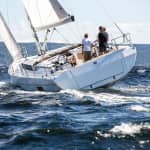
On the other hand, when delaying the manoeuvre in the hope that it won't freshen up any further, a small feeling of insecurity tends to settle in. And if it suddenly gets really rough and you have to reduce the sail area immediately, the stress is all the greater: start the engine and turn the boat into the wind.
The flapping sails test the crew's nerves as the ship pounds through the waves. The adrenaline level is at its peak and the manoeuvre may even have to be repeated because the ship is out of control and there is pressure in the headsail again. Even if everything goes well, the boat has come to a standstill and needs to be set in motion again. It is therefore not surprising that many a skipper shies away from such a reefing manoeuvre.
Relaxed and safe reefing downwind
There is a method for relaxed and safe reefing: underway on an upwind course. To practice the manoeuvre in practice, we boarded an X-382 at the Hanseatic Yacht School in Glücksburg. The deputy head of the school, Michael Dreyer, arrived with a full crew to demonstrate the reefing manoeuvre in moderate winds on the Flensburg Fjord.
Reefing the mainsail in this way is uncomplicated and is also suitable for small crews or soloists. The only requirements are a set headsail and sufficient free sea space in the direction of travel.
The first step is to set and maintain a course downwind. This can be done either by a person at the helm or with the help of an autopilot or wind vane. The next step is to ease the mainsheet until all the pressure has been released from the sail. The main now kills, but much more calmly than with wind and waves directly against it. The boat continues to sail stably with the power of the headsail.
To gain an advantage in the right of way rule, it may be worthwhile to perform the manoeuvre on port tack. With a furling mainsail, on the other hand, the choice of bow may depend on the direction of furling on the mast.
In our case, the main body is reduced conventionally with a binder reef. To do this, the boom vang must first be reefed. This is because the reefing rows of a mainsail are usually cut in such a way that the boom is slightly steeper when it comes in. "This is to prevent water from getting caught in the sail in strong winds," explains Dreyer.
The main halyard is then hoisted in a controlled manner until the reefing thimble can be hooked into the reefing hook on the luff fitting. As soon as this is done, the command "Hoist the mainsail!" is given and the halyard is pulled up again via the winch until the luff is under tension.
The next step is to pull the reefing lines through the leech. Even if reef two is not needed today, it is advisable to take out the slack to prevent the reefing lines from wrapping around the boom clew.
The first reef is now set, first by hand, then with the crank. As soon as the reefing thimble on the leech is on the boom, the new mainsail with a flat profile is under tension. The sail is ready to sail again and can be hauled tight. The boom vang is also put through again.
"We are fully manoeuvrable again and could immediately set off on our desired course. With more wind and waves, the loose cloth should still be tied together with Zeisingen to have a clear view and to prevent water from collecting in the sail. Of course, it also looks better!" says the DHH headmaster.
A stable sailing position is important for lashing the cloth together so that you can work safely on the boom. If necessary, tie in on the windward side of the boat so that you have a secure footing and cannot go overboard. A small but important tip for tying in: Do not tie the main around the boom, just pull the sailcloth loosely together with the toes. Otherwise, the sail could tear at the reefing thimbles in strong winds.
The manoeuvre could hardly have gone better or been more stress-free. The perfectionist Dreyer is also satisfied: "As we don't have much wind and want to sail, we can set sail again straight away." So roll backwards. But who knows how long - with the changeable winds.
Meeting the wind: the most important points at a glance
Preparation
- Head upwind and make sure there is clear sea in the direction of travel.
- Check that the reefing lines are running smoothly and that nothing else is unclear.
- Folding the tree feeder to allow the tree to rise.
- Furl the mainsail until it starts to kill due to the apparent wind.
Reefing manoeuvre
- Fold the main halyard until the desired reefing thimble is in the correct position to hook it onto the reefing hook.
- The mainsail is now raised again until the luff is tensioned.
- Now pull the reefing line through the leech until the aft thimble lies on the boom and a flat profile is created.
Final touches
- First tighten the main and then the boom vang. The sail is now ready for use again with less surface area.
- Ensure that the sail is in a stable position and tie the loose cloth loosely with pins, but not to the boom.
Photo tutorial: Reefing downwind - step by step
1. folding the tree felling beam

The boom vang prevents the boom from rising. As the reefing rows are cut in such a way that the boom is slightly higher when it arrives, it must be furled first.
2. ease the mainsheet until the sail kills

On the upwind course, the mainsail is furled until it starts to kill due to the apparent wind. The pressure is off and you can calmly start to reduce the sail area.
3. controlled folding of the large halyard

The halyard is lowered slowly and in a controlled manner on the winch until the desired reefing thimble can be hooked in. The hand is used to guide the line neatly so that the halyard cannot jam.
4. hooking the reefing thimble into the reefing hook

Depending on the wind strength, the reefing thimble of the first, second or third reef is inserted into the hook of the luff fitting.
5. enforcement of the major case

Immediately after the reefing thimble has been hooked in, the main can be hoisted again.
6. support at the mast when hoisting the mainsail

Before the main halyard is finally lowered using the winch handle, it is hoisted up the mast by hand and hauled aft. This can be tiring, but it is efficient and saves time.
7. haul through reefing lines

As soon as the reefing thimble on the leech is on the boom, the new main is under tension and has a flat profile. The cloth is ready to sail again and can be tightened at the sheet.
8. secure sail

For safe working, it is important that the sail is stable.
9. tying in the loose cloth

Do not tie the cloth around the boom, but only pull it together loosely with the points. Otherwise the sail could tear at the thimbles if there is too much pressure.
Reefing manoeuvre completed stress-free: Relaxed sailing

Whether with a full crew or as a solo sailor - arriving upwind has many advantages over shooting upwind or counter-bolting with the engine. Above all, it saves material and the crew's nerves.
"Learn to sail properly" at the DHH

The Deutsche Hochseesportverband Hansa e. V. (DHH) was founded a hundred years ago with the motto: "Learn to sail properly". The original aim of the association was to provide young men with naval training, i.e. to teach seafaring and sailing skills, combining military and sporting elements. The Hanseatic Yacht School (HYS) in Neustadt became the central training centre of the DHH, offering various sea voyages and seamanship training in the North and Baltic Seas.
After the Second World War, the DHH concentrated on setting up modern sailing training programmes. In 1951, the Hanseatic Yacht School in Glücksburg was reopened. Over the following decades, the DHH grew steadily and established numerous yacht schools. The focus was always on practical relevance through training cruises and theoretical courses at fixed locations such as the HYS in Glücksburg and the Chiemsee Yacht School. Subsequent reforms led to a reorientation with a more broadly accessible, sport-oriented sailing training programme. Today, the association has around 15,000 members and is one of the largest in Europe.

Morten Strauch
Editor News & Panorama
