


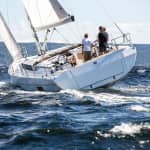
Even with the first reef in the main, the "Oke" is almost overpowered, at least in the gusts. If the wind speed rises well above 20 knots, the traveller must be driven completely to leeward, otherwise there is a risk of losing control of the rudder. The slim 30-foot hull sits very lean in the water, and the carbon mast is over 14 metres high, with over 57 square metres of cloth unreefed in the wind.
Even with a reduced surface area, the lugge can still travel between seven and eight knots through the water. The carbon fibre mast, rod rig and laminate sails do not give an inch, and the hull is also extremely rigid with a high carbon fibre content, nothing bounces. As a result, the "Oke" responds immediately to every gust and needs to be sailed very carefully. As we leave the shelter of the Dänische Wiek, the gusty easterly wind is joined by a short, rough Bodden wave.
Positive features of the "Oke"
But the water gets deeper, and to leeward there is free sea space extending into the Strelasund - ideal for dropping and setting the gennaker. However, the additional square metres need to be controlled first, and coordination between the owner Johannes Schlieben on the gennaker sheet and the helmsman is now crucial. In the first two gusts, it doesn't work, the result is a sun shot. However, the regatta yacht "Oke" shows that, even if she sails with a good gybe at the beginning, the 1.05 tonnes of lead ballast with a total weight of only 2.5 tonnes have a positive effect - the gust does not lay her flat on the water, only the gennaker rattles. After just a few seconds, the gennaker can be dropped and the ten-knot mark project can be tackled again.
Other interesting regatta yachts:
The short wave makes planing difficult; as soon as the boat parks in a wave, the pressure increases enormously and the flow around the rudder threatens to break off. The only way to counter this is to drop the boat immediately, and for this to work, the gennaker sheet has to be quickly fished. This works well on the third attempt and the "Oke" picks up speed in the gust. However, just before she can exceed ten knots over the ground, the rudder breaks and the boat shoots into the wind.
The rudder bearings on the transom, laminated from three layers of carbon tape, are torn. So we pull the rudder system into the cockpit and recover the sails. An attempt to lash the rudder to the aft cleats with lines and drive it towards the harbour using engine power fails, the forces are too great. The lines cut into the trailing edge of the blade and it is not possible to maintain the course.
The creation of the regatta yacht "Oke"
In the end, the only thing left to do is to sail slowly towards the harbour in the wake of a motorboat, with a barge in the wake to prevent it from listing. A great opportunity to ask Johannes Schlieben about the idea and production of the "Oke".
Schlieben was already fascinated by fast sailing boats during his shipbuilding studies in Bremen, which is why he wrote his thesis in Switzerland with Clemens Dransfeld, lecturer at the FHNW in Aarau, who was also involved in the construction of the America's Cupper "Alinghi". The job at composites specialist Gurit in Auckland then seemed the logical next step. Gurit is known as a supplier of materials and engineering for the construction of fast yachts, such as many Imocas; the company was also involved in the maxi-tri "Banque Populaire V". "I didn't want to design container ships; I was always more interested in sailing yachts," says Schlieben.
The idea of building something himself came to him and his former fellow student Ullrich Abel during a holiday in Sydney. "The expertise was there, the software, access to materials and CNC milling, and there was also a contact with yacht designer Greg Elliott." It was to be a boat for club regattas and sundowners in the bay and easy to handle by two sailors; all this for the prevailing winds of twelve knots in the Hauraki Gulf off Auckland.
No great demands on the regatta yacht
The requirements don't sound so special at first, but one premise had a decisive effect on the entire design: The regatta yacht had to fit into a cargo box. However, a 40-foot high cube container measures only 12.03 by 2.35 by 2.69 metres - the "Oke" had to fit inside, because a return to Europe was not out of the question in the long term, and transporting a sporty weekender over this distance on its own keel was out of the question.
A container ship after all. This premise also dominates the design of the 30-foot yacht visually: at 2.55 metres wide, it is very slim, which makes the freeboard appear quite high, and has no overhangs. It only reaches its full width in the rear third of the hull length, making the foredeck very narrow, almost like a wave piercer bow. This impression is further emphasised by the negative deck step, the lines of which are taken up again by the superstructure. It is much narrower at the top than on deck; the transition is formed by steps covered with teak veneer. According to Schlieben, the wood only serves visual purposes. The "Oke" was not intended to be a pure racer, and the natural material was intended to make the cruiser genes visible.
Unique paintwork makes the regatta yacht special
In combination with the hull paintwork in gold-brown metallic, the regatta yacht "Oke" is a special boat that is unique. Once the design plans have been drawn up, production of the 9.40 metre long hull begins as a single construction over a Mallen frame. After the first layers, the hull is turned upside down, supported from the outside and the shells removed. Foam is inserted into the shell and the inner sandwich layer is laminated by vacuum infusion.
The deck is manufactured in the same way, except that around 50 percent carbon fibre is used, with just 20 percent carbon and 80 percent glass being used in the hull. The bulkheads are milled from sandwich panels, and all parts such as companionway steps, cup holders and ceiling panels are laminated from milled carbon fibre moulds. Only the rod deck in the cockpit, the rubbing strake and the teak covering on the edge of the superstructure are concessions made in favour of appearance and to keep the weight as low as possible. The galley corner and the wet cell also cost around 300 kilograms.
The production is mostly carried out by boat builders, but in 2010 the budget runs out and the "Oke" is far from finished. Abel, who had been living in Germany until then, then moved to New Zealand and, together with Schlieben, now lent a hand himself. They finish the boat to the point where it can be painted.
Difficulties with the "Oke" project
But in 2012, the project was on the brink of completion: the effects of the economic crisis were now also being felt in the New Zealand yacht building industry. Schlieben loses his job at Gurit; he then applies for a job in Germany.
The regatta yacht "Oke" arrives in Europe as an unpainted shell in a container, the carbon fibre mast is split in the middle and is later assembled using a sleeve. The paintwork is carried out in Bremen at Yachtwerft Meyer, and the teak covering in the cockpit and the rubbing strake are only then fitted to the ship. Completion will therefore be delayed until 2016.
The realisation alone took over seven years and, according to Johannes Schlieben's estimates, consumed at least 6,500 working hours. Together, the two friends invested around 140,000 euros in the project, of which around 20 per cent was spent on logistics and infrastructure, such as renting the small hall in Auckland, equipment and finally the costly transport to Europe, even in a container. The most difficult part was putting the design into practice, says Schlieben. "The big task was to make sure that it turned out the way it was designed. I now have a huge amount of respect for building a boat myself."
Schlieben now works as a project manager at Hanseyachts in Greifswald; for him, this practical experience in boatbuilding is an important addition to his expertise from his studies and time in the design office.
Experience and knowledge flow into the construction
The enthusiasm for the two areas and also many of the lessons learned during the construction phase are reflected in the boat itself: the mast, for example, stands on a two centimetre wide stainless steel stay, which in turn is bolted to a double T-beam structure made of carbon fibre. Only the upper part of the beam is visible on deck, while the other half can be seen below deck, which is connected to the main bulkhead and ring bulkhead fore and aft. In the bilge, the bulkheads are connected to the floor assembly and thus form a high-strength unit between the rig and keel; the bulkheads also transfer their forces to the ring bulkhead. This was retrofitted when the deck was already connected to the hull. "A stupid idea," comments Schlieben, remembering the difficulties of fitting it. "I would certainly have solved it very differently now."
The designer has also gained a lot of practical experience with the drinks holders, storage boxes for stretchers and padeyes embedded in the deck: All of these visually appealing parts require a water drainage system that runs through the locker like a spider's web of small hoses. "Keeping this clean and free of blockages is really time-consuming. You don't think about it when you're planning."
Completion of the project
During the second sailing session, the rudder is back in its place on the transom, this time secured quite conventionally with bolted stainless steel fittings. In seven knots of wind, the "Oke" makes 5.5 knots through the water with the 27 square metre Code Zero. We cross out of the Dänische Wiek with it, the large foresail allows quite small tacking angles of around 95 degrees. On the Greifswalder Bodden, the wind drops further. At only 5 knots, the gennaker goes up and we can still manage 4.5 knots through the water. In these conditions, the "Oke" plays the trump card of its low weight.
The owner is satisfied, but apart from the transfer from Bremen to Greifswald, he hasn't sailed much with his creation. So far, only short trips with family or friends have been possible, and the boat has not yet been sailed in a regatta as planned.
Happy end to the "Oke"
A broken rudder can cast doubt on such an elaborate regatta yacht project. But now that the "Oke" is gliding across the mirror-like Bodden with the slightest breeze, Schlieben is at peace with himself and her again. After all, mistakes are there to be learnt from.
Back at the berth, the spotlights on the underside of the Park Avenue tree illuminate the cockpit; and with a beer in his hand, Schlieben reviews some of the stages of the lengthy development process. Now, at the latest, the story has a happy ending.
This article first appeared in YACHT 12/2018 and has been revised for this online version.
Technical data regatta yacht "Oke"

- Designer: Johannes Schlieben
- Hull length: 9.40 m
- Total length: 10.01 m
- Width: 2.55 m
- Draught: 2.15 m
- Weight: 2.55 tonnes
- Ballast/proportion: 1.05 t/41 %
- Mainsail: 35.0 m²
- Jib (105 %): 22.7 m²

Michael Rinck
Redakteur Test & Technik
