


Tried out: Ronstan's new Orbit winches with Quicktrim function in practice
Hauke Schmidt
· 12.07.2023


The Orbit winches come in three sizes - 20, 30 and 40 - and are all self-tailing. The two large models have a function called Quicktrim, which allows the sheet or halyard to be fished without removing the line from the winch. To activate the Quicktrim, the upper winch cover is turned slightly in the opposite direction to the winding direction, which disengages the selftailer and the sheet can be fished by hand. When the winch head is released, the clutch snaps back into place and the winch works normally - so much for the theory.
Practical test on a J/88
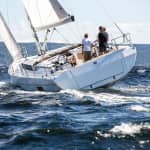
To test how the design performs in practice, we mounted a 40 orbit winch on a J/88 instead of the standard Harken superstructure winches. The biggest obstacle here is the different bolt circle between Ronstan and Harken. Fortunately, we were able to use a universal adapter plate manufactured by Ronstan for the test. Unfortunately, the adapter will not be available as a standard product. For space reasons, the winches can only be attached to it with M5 bolts, but M6 bolts are provided to utilise the full working load. This means that you will not be able to avoid drilling new holes for permanent replacement.
Once the winch was fitted, the Quicktrim function had to be activated. The clutch of the selftailer is fixed at the factory and the winches work like conventional two-speed versions. However, in order to be able to furl with the winch, only the arm of the selftailer needs to be removed and a small screw unscrewed.
Orbit winches: Ideal for halyard and sheet
As the power reduction of the 40 mm Orbit winches is almost the same as the standard 35 mm Harken-Performa winches, we didn't notice much difference when setting the sail. It was just a little easier, which meant that we promptly cranked too much pull on the halyard. So we tested the Quicktrim straight away: one turn of the cap and the halyard can be furled a few centimetres and the excess tension released. The good news is that when you let go of the cap, the selftailer grips almost instantly. So there is hardly any risk of too much line slipping through.
Relieving the halyard tension once is one thing, but when used on the genoa or gennaker sheet, the mechanics are put under much greater strain, as the sail is trimmed much more often and with longer paths. We were particularly sceptical about how the Quicktrim system would perform in combination with the gennaker. In fact, the function proved to be even more practical than on the halyard.
As neither the sheet has to be removed from the selftailer nor the crank removed for furling, there is a very smooth flow between releasing overpressure and sealing winches. The direct first gear of the Orbit winches is also an advantage. With a light load, the sheet can be hauled in quickly without anyone having to pull off the winch.
Proven technology, rethought
The Quicktrim clutch is the most outstanding innovation, but the rest of the design is also very promising. Ronstan utilises Andersen's experience in the design of the drum and the layout of the gearbox and bearings. The Danish manufacturer is known for its extremely efficient and durable stainless steel winches and has been part of Ronstan since 2010. It is therefore no surprise that the Orbit winches are also assembled in Denmark. Unlike the Andersen models, the base and drum are milled from aluminium, making the winches very light. The 40 version is said to weigh just 3.1 kilograms, which is 700 grams less than a Harken Performa 40.
To ensure that the drum turns easily even under load, the winches are not only equipped with roller bearings, but also have additional ball bearings that absorb the axial forces caused by ropes running in from below. The surface of the drum is similar to that of the Power-Rips known from Andersen and is said to be very gentle on the ropes. A further advantage of the vertical ribs is that the line windings can easily slide upwards, which increases the efficiency of the winch and ensures even hauling.

Convenient maintenance of the new winches
To open the wipers, all you have to do is press a small slider, after which the Selftailer arm can be unlocked and removed. In this way, the position of the arm can also be adjusted without tools. Once the arm has been removed, the drum can be lifted off and the gearbox and bearings are accessible. The only thing to look out for is a cover disc. The bearing consists of a large ball bearing to support the axial loads and a roller bearing, both of which are designed to prevent balls or rollers from falling out. For further disassembly, the main shaft is pulled upwards, the pawls are located in the shaft and cannot be lost. The remaining gear wheels can then be removed from the base. It is pleasing to note that the design is very simple and consists of just ten individual parts in addition to the drum, so there is practically nothing that can go wrong during subsequent assembly.
E-drive can be retrofitted
Ronstan is currently hiding the information in the FAQs, but according to the German importer Peter Kohlhoff, who already has the Orbit winches in stock, there will also be electric drives for the 30 and 40 models, which can be mounted under the winch as with Andersen. The 20 mm Orbit winch costs 709 euros, while the 40 mm model costs 1,325 euros.
Other special winches and cranks
Harken Rewind: Fieren via toggle switch

With the electrically driven Harken Rewind, the direction of rotation can be changed using a toggle switch, allowing it to also be driven under load. The whole thing is electric, the drive is located under the winch. Harken 46 2-Speed Rewind price: 7,850 euros.
msm PowerSailwinch:Integrated motor

The power winch has a motor integrated into the drum and a maintenance-free planetary gear. The German manufacturer MSM also has a model in which the sheet can be fiddled at the touch of a button. Price on request.
Ronstan Quick-Lock winch handle:With one hand

The Ronstan crank lock can be operated with one hand, a function also offered by Harken and Lewmar. The model is very well made and the switch works intuitively. Price from 170 euros.
Easysea Flipper:Folding

The Flipper winch handle from Italian manufacturer Easysea can be folded thanks to two joints. This means it does not have to be removed from the winch during manoeuvres and can generally remain on the winch without getting in the way. Price 250 euros.
This might also interest you:

Hauke Schmidt
Test & Technology editor
