


Wind force four was his limit; if it blew stronger, the owner would no longer want to sail anyway. The boat that he commissioned from master boat builder Nicolaus Tamas based on this premise therefore had a very clear focus: a light wind racer.
On the day of the test trip, the conditions are borderline. At 15 knots, almost 20 in gusts, the wind rushes through the reeds at the natural harbour of Krummin on Usedom, small waves ripple across the Achterwasser. However, the fact that this trip ends with a broken mast is not due to occasionally exceeding the self-imposed wind limit.
Other interesting sailing boats:
But first things first. In addition to its light wind qualities, the owner wanted the boat to be easy to steer and not require many lines; space for sunbathing and sporty sailing fun were further keywords. It also had to be easy to maintain, safe and beautiful to look at. These were the basic conditions for the construction of the retro classic "Lia". Let's see what Nicolaus Tamas has made of it.
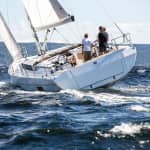
The owner has precise ideas
Paddling out of the box and out of the harbour, the Torqeedo remains in its storage space in the bench seat. The boat is light, weighs 350 kilograms with ballast and is easy to paddle. The mainsail goes up in the harbour entrance. The mast is almost at the front of the boat, the main is the only sail on board apart from the gennaker and is extremely exposed.
The Harlekin sets off immediately - and brakes again straight away: grounding, touching down, directly on the buoy line. The feeling of sitting in a dinghy is deceptive. The towing keel provides plenty of stability, but with a draught of 1.20 metres, you have to navigate like a yacht, especially in the shallow waters of the Bodden.
So we cast off the lazyjacks again. The mainsail on the whipped steep gaff falls back into the lazyjacks. Nicolaus Tamas releases the downhaul tackle from the mast, lifts a small floorboard and shackles the tackle to the keel. Now the main boom, held by the dirk, becomes a crane and lifts the keel out of the mud. The wind drives the retro classic "Lia" off the flat. Keel down again, sails up again.
The "Lia" is a lively retro classic
We head out onto the Bodden with half the wind, the Harlekin shoots over the small waves and spray flies all over the boat. Control at the helm is excellent, at least as long as the huge mainsail is trimmed well. Dropping off in the gusts without fiddling the mainsheet doesn't work. The "Lia" sails very well upwind, the boat finds the wind edge almost by itself and is greedy to windward, but only until the course is right. Although the rig does not require a headsail, the Harlekin quickly makes room to windward.
Change of course. The ship is calm before the wind, it sails dry and glides down the small waves in the gusts, there is hardly any pressure on the sheet. Nicolaus Tamas takes the opportunity to talk about other secrets behind his creation.
In addition to the specifications mentioned above, the retro classic also had to fulfil an unusual idea of the owner: It had to look like a Chiemsee flatboat. This is quite unusual, as it means that he wanted a very sporty daysailer with the look of a type that had emerged from old workboats - a racing flatboat.
The "Lia" is at home in the Bodden waters
On the other hand, this suits the area for which the "Lia" was built, the Achterwasser. The owner comes from Mainz, as he says, "the worst place for sailing there is". He is all the more taken with the Bodden waters and wants to spend his sailing holidays exclusively here on the Achterwasser. He spends the nights in his holiday home and only uses the boat as a daysailer.
The realisation of all these special owner wishes made the planning phase with the boat builder quite challenging. For a boat less than seven metres long, it lasted from autumn 2017 until the spring of the following year. Lengthy discussions centred on the keel weight and boat width in particular. The owner wanted plenty of space, unobstructed by a centreboard or keel box. However, as the keel was to be designed so that it could be raised for easy slipping and towing, the idea arose to integrate the load-bearing structure into a double floor. Incidentally, this floor also enables self-bailers for the cockpit - and makes the boat unsinkable.
The retro classic is divided by a transverse bench seat, which also serves as storage space: Aft of it is where the boat is steered and the sheet is trimmed, and in front of it is where the sun is shining.
The retro classic is a dinghy with a keel
Initially, 70 kilograms of ballast were discussed for the keel, but in the end the owner and boat builder agreed on a modified draught keel. The fin is slightly narrower and one metre long, which together with the lead bomb adds up to a draught of 1.20 metres. The bomb weighs 125 kilograms, while the boat with rig and rudder system but without floorboards weighs just under 160 kilograms, according to Tamas. The 100-kilogram difference is accounted for by the gratings in the cockpit and, for the most part, the keel fin. The Harlekin 20 therefore has a very high ballast ratio, which, together with the dimensional stability due to the large width, means that the designer has ruled out capsizing despite the considerable sail area.
Nicolaus Tamas realised the owner's wishes, which were certainly unconventional in combination, in his workshop on the Schlei. He made the underwater hull from plywood, which was sawn in such a way that it could be bent into shape using moulds. It was then given a coating of glass fibre and epoxy, and the cuts were filled. This modern moulded composite underwater hull ends above the waterline in a classic clinkered hull, also made of plywood. The clinkered construction is not only aesthetically pleasing, the overlapping also stiffens the sides.
Advantages of the underwater hull
The extremely stable floor assembly, consisting of the underwater hull and cockpit floor, is divided into two chambers and completely sealed thanks to the frames and stringers; this ensures buoyancy even if the boat fills up. And as the cockpit is therefore above the waterline, the cockpit can be fitted with bilge pumps at the stern. The advantages of the modern underwater hull are not only a higher speed potential and better control, but also less maintenance. The floor assembly is completely watertight, so nothing has to swell, as is usually the case with wooden boats.
The visible khaya mahogany from sustainable forestry has a clear lacquer finish. Two-component polyurethane lacquers were used for this, which preserve the wooden surfaces in the long term and require little maintenance. Damage can be repaired without any problems. Even spot varnish renewals can be almost seamlessly levelled by polishing.
As expected, there was a lot of discussion about the rig: The owner wanted a cat rig because he had already had good experiences with it, and the Chiemsee rig also only has a mast that is positioned far forward in the boat. This is also unsupported, which the client also wanted for his Harlekin. Master boatbuilder Tamas had to do a lot of convincing to convince his customer of the advantages of shrouds and a forestay; he used Dyneema for both. Without these rigging components, the mast would have been far too strong in view of the enormous mainsail. The owner decided against the spreaders recommended by the boatbuilding expert, arguing that they would make rigging and de-rigging easier and quicker.
The retro classic cannot capsize
Nicolaus Tamas gave the Harlekin a bowsprit that rises 50 centimetres above the stem and serves as an attachment point for the gennaker neck. After all, what would a boat designed for fast sailing be without a powerful space wind sail?
In the meantime, the retro classic has sailed the Krumminer Wiek from one end to the other several times. Confidence in the Harlekin's great righting moment has grown - even if she looks and feels like a dinghy and the urge to bring weight to windward by riding out was initially great. It really does seem as if capsizing is impossible.
The wind has dropped a little, the gusts in particular are less frequent and much weaker; time to get out the gennaker. The first attempt ends in a tangle, tackline and gennaker sheet are twisted several times. The colourful space windsail has not yet been set, which is why nobody has noticed the wailing of cloth and batten. Everything will now be cleared and shorn properly. Then the gennaker will go up as it should.
The gennaker makes the "Lia" fast
As soon as the sail gets wind, the Harlequin leaps forwards. This is no surprise, as the sail area has more than doubled in one go. The small boat planes directly and the pressure on the gennaker sheet is noticeably reduced. From now on, the "Lia" only surfs over the slightly pronounced Bodden wave, and the water splashes away from the hull in a high arc at the bow. All of a sudden, the Bodden seems far too small for this boat. And then, from one moment to the next, the trip is over: mast breakage!
The topsail and gaff splash into the water, but are immediately fished out again. Fortunately, the electric outboard motor is still on board. It is quickly rummaged out of the storage space and attached to the stern. Then he pushes the "Lia" back into the harbour where, after clearing the Wuhling, the investigation into the cause begins.
In the end, the result only confirms the warning of master boat builder Nicolaus Tamas. He concluded from the course of the breakage that a pair of spreaders and wire shrouds, which he had been in favour of from the outset, would actually have absorbed the load better. The dyneema stays had stretched so much that the shroud tensioners had already reached the end of their adjustment travel. The result: too little tension. The owner and boat builder chalked up the mishap as a lesson.
A high-quality finish has its price
As far as Tamas is concerned, the consequences will immediately flow into his next racing boat. It will have a jib with a sail area of seven square metres, and the bowsprit will be longer and protrude 50 centimetres more, i.e. a total of one metre, over the stem. Then, according to the calculations, the gennaker can be even larger.
Even the broken mast cannot spoil the positive overall impression at the end of the day. A lot of work has gone into the beautiful details or is hidden under the cockpit floor: the toggles in the cockpit that hold every grating in place, the leathering where the mast is guided through the thwart, the lifting keel mechanism with the double-use downhaul and the folding rudder, the marvellous lacquer finish. Of course, all this comes at a price: the Harlekin costs 27,500 euros; ready to sail, the total comes to 30,200 euros.
Just a few weeks after the trial run, the news arrives: the retro classic has a mast again. It is now not only made of wood, but has been reinforced with a carbon fibre inlet. Tamas has also added a pair of spreaders - it was the better idea after all. Nothing should now stand in the way of great, unbridled sailing fun.
Technical data "Lia"

- Designer: Nicolaus Tamas
- Hull length: 6.30 m
- Lüa (total length): 6.80 m
- Width: 2.00 m
- Draught/recovered: 1.20/0.35 m
- Weight: 350 kg
- Ballast: 125 kg
- Mainsail: 16.0 m²
- Gennaker: 20,0 m²
This article first appeared in YACHT 19/2019 and has been revised for this online version.
