


In autumn, the Strait of Bonifacio, which separates the southern part of Corsica from the north of Sardinia, can get very rough. Even in summer, the sea can roar due to the mistral wind. At such times, the area, which is known for its clear turquoise-coloured bays and is considered one of the most magnificent sailing areas in the entire Mediterranean, turns into a veritable cauldron. Today, however, on this day of the first test run for a boat that heralds a new era for the CNB brand, there is no sign of it.
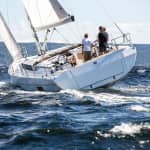
It is construction number 1 of the CNB 78, and that is also the name of this beauty in elegant black metallic: "One". Her imposing hull measures almost 25 metres from bowsprit to stern. The performance rig from Hall Spars made of clear-coated carbon fibre towers 34 metres above the sea. A sculpture that captivates passers-by from afar.
The flanks of the ship designed by Philippe Briand are formed by two chines, giving it a mixture of strength and elegance. The deck, which rises slightly towards the bow, creates a captivating tension, especially in contrast to the elongated window line of the superstructure. The harmony of the design is so perfect that no hull paint is needed to emphasise its beauty. Even in white gelcoat, the CNB 78 looks simply breathtaking.
Foreship of the CNB 78 remains unobstructed
Her foredeck remains completely unbuilt from the mast to the cutter stay fitting. The skilfully crafted Solimar hatches, the retractable Harken mooring winch, the track of the self-tacking jib - everything is flush with the light-coloured teak deck, as is customary in this category of boat. The halyards are run on the mast, around which up to four winches can be grouped to simplify line management in the aft working cockpit.
The real characteristic of the CNB 78 - its panoramic glazed deck saloon - extends from the centre of the ship almost to the main boom. Seen from the side, the superstructure also encompasses the guest cockpit, effectively concealing its height visually. Philippe Briand, this grand master of exquisite taste, has once again worked his magic. The graceful competence and power that his design radiates conceals a volume and spaciousness below deck that is less comparable with yachts of the same length, but rather with calibres in the 85- to 90-foot class.
Offering more space, more performance, more creative freedom
This, among other things, was the focus of the new development - the first since Solaris Yachts took over the CNB brand in 2021. The CNB 78 is a statement, so to speak, a current positioning for the entire line, which will one day range from 60 to 88 feet. It should offer more space, more performance, more design freedom - but without compromising its DNA.
With this, the strategy that Marc Giorgetti outlined in Cannes a good two years ago is being realised. The Luxembourg-based partner is establishing an entire premium group for sailing and motor yachts around the core brand Solaris, which stands for upmarket performance cruisers. In order to also cover the luxury long-distance segment, Giorgetti took over the Beneteau Group's established high-end brand CNB, which, despite its success, never really fitted in with the world market leader's high-volume business.
Solaris and CNB complement each other almost seamlessly in terms of orientation, says Vincent Arnaud, Brand Director of the French-based company for almost ten years. He sees an analogy with the automotive industry: the two brands and their products are "like Maserati and Range Rover".
CNB is now fully integrated into production in Aquileia in northern Italy. The "One" therefore not only embodies the realignment under the direction of Solaris, it is also the first boat to be built at the expanded and modernised site since the acquisition.
What the CNB 78 is conceptually designed for
When we go on board, not a drop of night dew covers the cabin roof and the spacious cockpit. Skipper Adonis Vlachopoulos and his wife Nadia are usually up before six o'clock to keep the boat in top condition. The two of them look after the "One" as a permanent crew. The CNB 78 is designed for this, better than many others of its kind.
In the given specification, it could also be operated by an experienced owner couple because all manoeuvres can essentially be carried out at the touch of a button. However, the necessary systems require a level of expertise, maintenance and care that makes professional hands, if not mandatory, highly recommended.
The sun is still so low this morning that part of the harbour, which is lined with high limestone cliffs, is in the shade. The weather forecast promises a picture-perfect day, initially with 7 to 10 knots from the west, then 12 to 15 knots from the early afternoon. Time to set sail!
Adonis starts the 3.7-litre four-cylinder Volvo Penta diesel engine, which is installed under the saloon floor, close to the yacht's centre of gravity. But nothing stirs: no quiet humming, no subtle vibration. In the quiet post-season idyll of the Port de Bonifacio, not even the burble of the exhaust can be heard in the cockpit.
Is the starter motor on strike? Is the start button in the switch panel defective? The captain notices the irritation and smiles. "All good!" he assures us, pointing to the rev counter. Indeed, the engine is running!
The Greek steps aside, makes an inviting gesture towards the steering wheel and removes the aft mooring line to starboard from the cleat. At least he stays close enough to be able to intervene if necessary. Of course, this is not necessary, as the CNB 78 makes it easy for the helmsman.
On the one hand, there is the moment of inertia of around 50 tonnes displacement in a clear-sailed, well provisioned and equipped condition. On the other hand, this mass can be steered with extreme precision, almost with care. And so the black ship, its pigments sparkling in the sunlight, glides silently and effortlessly from the pier in the far east under the attentive gaze of a small crowd of onlookers.
CNB 78 can manoeuvre on a small scale
From the helm of a 24.85 metre long and 6.10 metre wide yacht, almost every harbour basin seems narrow at first. However, the CNB turns via its twin rudders to barely more than one and a half boat lengths. And, on request, it can be equipped with extendable bow and stern thrusters, which enable even smaller-scale manoeuvring.
Like many other extras - such as electric primary winches, hydraulic genoa furlers, teak deck or sprayhood - they are not part of the standard equipment. This may come as a surprise, as they are actually included on boats of this size. However, CNB deliberately does not pursue an inclusive pricing strategy, but leaves the configuration largely up to the owners. They have a lot of design freedom here; those who are not stingy can easily top the base price by 50 per cent or more in this way.
The bulkheads remain immovable, as usual with a semi-custom concept. Within these limits, however, the shipyard offers several possible layout modules, four different woods for the interior alone, dozens of equipment options and an almost immeasurable range of upholstery fabrics. Even if these are not taken into account, the list of options comprises almost 200 items, not including special requests. It is therefore practically impossible for two CNB 78s to leave the production halls in the northern Adriatic in even remotely similar configurations.
The first of its kind comes with very sophisticated, almost complete equipment with a noticeable performance plus. In addition to the carbon mast, which is two metres higher than the standard aluminium rig, with a matching Park Avenue-style furling boom, the "One" has a three-metre deep performance keel and a set of the finest, yet highly durable 3Di Ocean membrane sails from North Sails.
The main measures 175 square metres, the genoa 152 square metres. In relation to the displacement, this results in a sail load factor in the sporty range: 5.0. At 82 square metres, the self-tacking jib guided on the permanently rigged stay is only about half the size of the genoa and acts as a kind of first reef (sail load factor 4.4). On request, the inner stay can be ordered with a hydraulic tensioner and furler from Reckmann - a highly recommended option, as this allows the optimum forestay tension to be used at all times, which provides more speed and height, especially when tacking.
Earn miles, but efficiently
Due to a lack of thermal support, the breeze initially weakens as expected. And so we motor south-east towards the Maddalena archipelago in Sardinia, towards the onset of the thermals. With its long waterline of more than 22 metres, the CNB 78 can make very efficient miles. Her hull speed is 11.5 knots, cruising speed corresponds to around 9 knots. As in the harbour, she remains pleasantly quiet at idle speed. In the owner's cabin forward, the roar of the water drowns out the well-muffled sound of the Volvo; even in the saloon, under the floor of which the four-cylinder engine rotates, you hardly have to raise your voice. Only aft in the galley does it hum more audibly.
But the CNB is not a powerboat, it's a sailboat. And she proves this impressively when the wind picks up. Just 3 Beaufort is enough to put her in a good mood. At between 10 and 12 knots, she consistently logs a speed of around 7.5 to 8 knots at the cross and already conveys a feeling for the pressure conditions at the helm. Of course, this hardly needs any active support; once properly trimmed, the imposing yacht holds its course almost all by itself.
As it freshens up to 15 knots, little changes in the pleasant balance. The CNB 78 only leans a little more to leeward, accelerates to 9 to 9.5 knots and otherwise remains calm. She feels most comfortable when you let her run instead of pinching out to the last degree. Her optimum tacking angle is between 96 and 100 degrees. She can also be forced closer to the wind, but with a true wind angle of 45 degrees you lose more speed than you gain upwind.
The joy of running the CNB 78
It is a pleasure to steer her - something that cannot be said of every yacht of this size. The overview from the helm stations is perfect, as are the ergonomics - both standing and sitting. The helmsman's bench is designed as an extension of the coaming and curves inwards in a gentle arc; a design feature that is also repeated below deck. From here, it is only a step to the winches that separate the helm station from the guest cockpit.
This in turn impresses with its lounge-like character. Because the companionway is offset off-centre, the cockpit offers two areas: To starboard, the crew will find a bench that can also be used as a sun lounger, while to port is the seating area with the cockpit table that can be lowered hydraulically on request. Even with chairs added, there is enough space to reach aft unhindered.
Beneath this extremely comfortable open-air arrangement, a veritable dinghy rests in a large longitudinal garage. The CNB 78 can accommodate a Williams Sport-Tender 395 in its rear garage, the ultimate mooring speedster. With its jet propulsion based on a Rotax engine, it runs at speeds of up to 46 knots, offers space for six people and is also suitable for water skiing. To make launching and retrieving easier, CNB has developed a launch system with an electric winch, which is one of the highly recommended extras. This means that the dinghy can be launched or stowed away again in a matter of minutes.
Convincing room concept
The fact that almost four metres of hull length are sacrificed for this is not noticeable below deck - on the contrary. Instead, the CNB impresses with a spatial concept that surpasses its predecessor as well as most of its current competitors. The key to the interior design by interior designer Jean-Marc Viaton lies in the clear lines of sight from the saloon to the outside. Those who take the wide, pleasantly flat companionway downwards find themselves in a completely acoustically isolated world, but never lose contact with the sea.
The large window areas are flush with the deck at the bottom, which visually merges the interior and exterior and visually expands the space. Unlike its predecessor, the CNB 76, which sold extremely well with 32 units, this effect is now also available aft. There, an additional window widens the glazed companionway to port. The furnishings appear lighter, more elegant and also more airy thanks to the omission of the navigation system. This has been moved to the crew quarters, where it adjoins the centre galley line.
Towards the front, there are two points that make the difference: The CNB 78 offers two equivalent guest cabins with double or optional single berths - a gain due to the increase in width in the hull. The 76, on the other hand, only had berths arranged one above the other to starboard. The plus is even more evident in the owner's cabin, which takes up the entire foredeck and is more reminiscent of a hotel room.
The curved edges, a kind of signature of the ship, can be found here in the room divider made of solid wood bars, which stands behind the desk and acts as a privacy screen when the door to the passageway is open. They can also be found in the longitudinal bulkhead of the guest cabin on the starboard side, seamlessly veneered and perfectly stretched - just one of the many details in which the boat builders at Solaris show what they can do.
Manufactured using traditional construction methods
Their art is not limited to carpentry. The CNB 78 also shows substance behind its chic surface. Unlike under the aegis of the Beneteau Group, the successor to the 76 is no longer built using semi-industrialised methods, but traditionally. This means that large modules with their own floor seat are not prefabricated and glued in. Instead, the new CNB is built in series: first the hull, floor assembly, bulkheads, then the interior. This is better suited to semi-custom models, where the owners want their individual wishes to be taken into account within a given layout. And it goes hand in hand with even greater solidity and strength. Despite the wide saloon, the 78 sails with remarkable torsional rigidity and virtually no creaking or crackling.
And even if owners will rarely ever stray into her engine room: It is also a model of practicality and perfection. The saloon floor can be removed for major maintenance work - all relevant systems are then neatly and clearly arranged in the open. If the floor remains closed, all components can still be accessed without any major dislocations.
Arno Kronenberg, who, as before, is responsible for sales in Germany, Austria and Switzerland, cites this "even higher level of quality" as one of the key advantages that the brand's new home will bring. Under the aegis of Solaris, the experienced ocean sailor believes that CNB can further strengthen its most important unique selling point: "Building boats that offer comfort and performance on the water, but are also flawless blue water yachts for worldwide cruises." The CNB 78 is just the beginning, but what a beginning!
Technical data

- Length over everything: 24,85 m
- Length (hull shape): 23,25 m
- Width: 6,10 m
- Draught/opt: 3,50/3,00 m
- Displacement (empty): 47,9 t
- Material: GRP
- sail area: 304 m²
- Motor: Volvo D4
- Motor power Std./opt: 130/170 kW
- Speed (cruise/max.): 11.5/9.0 kn
- Generator: 17.5 kW
- Fuel: 2.500 l
- Water: 1.500 l
- Construction: Philippe Briand Design
- Interior design: Viaton Design
- Class: CE "A"
- Shipyard: CNB, 2023
- Starting price: from 4.1 million euros
This might also interest you:

Jochen Rieker
Herausgeber YACHT
