


There are various daysailers, at least according to their designation. Many manufacturers like to attach the coveted label to their boats. However, not all of them get to the heart of the matter. One that could hardly be better characterised as a daysailer is the new Lago 26 Speedster from Austria. The concept: uncomplicated, less elaborate and yet active sailing fun for in between, reasonable dimensions and therefore suitable for trailers, reduced on-board technology and easy handling, especially for soloists.
The Lago 26 is not a new boat. In 2012, Austrian top sailor and multiple Olympic participant Hans Spitzauer (Finn, Starboot) presented his modern interpretation of the classic dinghy cruiser. Designed by Juliane Hempel in Radolfzell on Lake Constance, the original Lago presented itself as a universally usable travelling boat with a retractable centreboard, gennaker and a very powerful profile. Later, the Lago 26 was also presented in a version as a sports boat, with a lifting keel and lead bomb. And in 2018, Spitzauer made his boat fly in a lightened version with foils on top.
More YACHT tests:
- Small cruisers: Seven in one go - which fun box performs best in comparison?
- Jantar 21: A trailerable hot box in a used boat test
- Sunbeam 22.1: Modular small cruiser compared with predecessor model
- The Woy 26 from Germany: radical, visionary, sustainable
- Deltania Mini: The smallest sailing yacht in the world put to the test
With the new Lago 26 Speedster as an additional version, the Championships Yachting shipyard in Vienna has now completely redesigned the boat once again. The hull remains unchanged, but the rig on the new model is about half a metre further aft to allow for a self-tacking jib of a reasonable size. Accordingly, the position of the keel has also been moved further aft.
These modifications also made it necessary to redesign the deck. The comparatively high and striking cabin superstructure of the original version was almost completely lost during the conversion work. Only a short, flat canopy over the companionway remains. Visually, this is definitely an enrichment for the new boat. Overall, the Speedster version looks prettier and more elegant than the basic version. The design comes from the Moodley Design studio based in Graz.
Easy to trailer, uncomplicated launching and retrieval
Until recently, the boats in the Lago series were built by the Mader boatyard in Upper Bavaria, known for its fast racing dinghies (Flying Dutchman, Zugvogel, Tempest, Finn). Spitzauer has now handed over production to a plastics processor in Bosnia. The hulls and decks are built there as GRP sandwich constructions with a foam core made from recycled PET bottles in hand laminate and are then sent to Vienna for finishing and outfitting.
As with all versions of the Lago 26, the steering gear is attached to the stern and can be raised. Thanks to a flexible lifting device with winch, the T-keel can be raised by more than 1.20 metres. This allows the draught to be reduced to 36 centimetres. This is particularly advantageous for uncomplicated transport on the trailer. The Lago Speedster is also very easy to launch and retrieve via the ramp.
Assembly and disassembly on the trailer is quick and easy because the rig is very light. The carbon fibre mast from the manufacturer Compotec is part of the standard equipment and can be easily set by hand using a hinge on deck.
Get going quickly with just a hint of wind
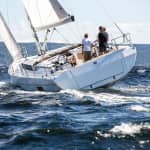
Hans Spitzauer brings his new Speedster to Lindau on Lake Constance for a test with YACHT. In very light winds, the boat has to prove its qualities as a daysailer. The lively Austrian passes this test with flying colours. The boat gets going quickly with just a hint of wind, even upwind with the standard sails of a main and self-tacking jib. The Speedster manages 4.8 knots at an angle of 45 degrees to the true wind. And with half the wind under gennaker, it can still reach almost 6 knots. These performance figures are remarkable because neither the rig is particularly high nor the sail area unusually large.
Of course, regatta racer Hans Spitzauer already has plans for a performance version Speedster RS in his pocket. This version of the boat will be aimed at ambitious regatta sailors with a crew. The rig will be higher and carry more sail area. And the keel will be lighter with less ballast, with two trapezes for the crew to provide additional righting moment. And the bowsprit will be extendable and longer than on the basic version with the fixed trunk.
Handling under sail is easy and works well, especially for solo sailors. The high-quality basic equipment with good fittings from Harken facilitates the processes, and the layout is well thought out. What is missing in the cockpit, however, are storage spaces or small lockers, for example for fenders or mooring lines. There would be enough space for these under the cockpit floor. However, these items have to be stored openly in the small cabin.
Prices of the Lago 26 Speedster
Championships Yachting wants around 80,000 euros for the Lago 26 in the simplest version. In addition, buyers will have to shell out at least 10,000 euros for a set of sails (main, jib, gennaker).
- Base price ex shipyard: 80.640 €
- Price ready to sail:96.880 €
- Guarantee/against osmosis: 2/2 years
Status 2025, how the prices shown are defined, read here!
On top of this, there is another 5,300 euros for the electric pod motor in the weakest version. In total, this quickly adds up to around 100,000 euros or more - depending on the equipment.
YACHT rating of the Lago 26 Speedster
Pretty daysailer from Austria with many modern design features. The trailerable boat shows great sailing characteristics in the light wind test. The price is competitive.
Design and concept
Versatile boat
Well thought-out layout
Moderately high rig
Sailing performance and trim
Sails stiff and balanced
Easy handling
Good trimmability
Living and finishing quality
Also habitable with upholstery
Flexible storage pockets made of fabric
Partially rough processing
Equipment and technology
Electric motor in two variants
Lifting keel with crane system
Little storage space on deck
The Lago 26 Speedster in detail

Technical data of the Lago 26 Speedster
- CE design category: C
- Torso length: 7,95 m
- Total length: 8,75 m
- Waterline length: 7,66 m
- Width: 2,50 m
- Draught (lifting keel): 0,36-1,60 m
- Mast height above WL: 10,55 m
- Theoretical torso speed: 6.7 kn
- Weight: 980 kg
- Ballast/proportion: 370 kg/38 %
- Mainsail: 16,0 m²
- Self-tacking jib: 11,0 m²
- Gennaker: 50,0 m²
- Code Zero: 33,0 m²
- machine (Pod Drive): 1/3 kW
Hull and deck construction
GRP sandwich constructions, built up in hand laminate with PET foam core.
Motorisation
Electric pod motors with 1.0 or 3.0 kW power from the manufacturer ePropulsion are available. The drive is not included in the basic price. The surcharges are 5,285 euros and 10,180 euros respectively.
Sail as desired
A set of laminated sails (main and jib) from North Sails (NPL Tour black) costs an additional 6,500 euros gross. The price for a gennaker is 2,900 euros, for a furling Code Zero 4,460 euros.
Rig
The carbon fibre mast from the manufacturer CompoTech is standard equipment from the shipyard.
Shipyard and distribution
Championships Yachting GmbH, 1010 Vienna (Austria); www.lago26.com
From dinghy to foiler: no other boat is so versatile


Hans Spitzauer's company Championships Yachting has built and sold more than 50 Lago 26 boats to date. Many of them sail in the Sword version on inland waterways as modern dinghy cruisers with ballast centreboards or in the Keel version as sports boats with lifting keels. The Lago 26 is one of the fastest and most successful regatta boats, especially on Lake Neusiedl in Austria.
In the foil version, Hans Spitzauer has also built his Lago 26 as a foiler with laterally extendable wings. With a professional team, it was even possible to get this heavily slimmed-down version, built with a high proportion of carbon fibre, to fly. However, this boat is not offered in series production.
Technical data Lago 26
- CE design category: C
- Torso length: 7,95 m
- Width: 2,50 m
- Draught Sword: 0,20-1,60 m
- Draught Keel: 0,40-1,80 m
- Draft Foil: 2,20 m
- Sword weight: 780 kg
- Weight Keel: 780 kg
- Foil weight: 580 kg
- Sail area Touring: 28,8 m²
- Sail area regatta: 35,8 / 39,0 m²
Wide range, attractive offers: A market overview
There are many small daysailers like the Lago 26 Speedster. The common denominator of all boats is the uncomplicated sailing pleasure for in-between.
A27

The sporty fixed keeler from Austria scores points with its harmonious overall package. The boat remains empty below deck. Click here for the detailed test!
Cape Cod 767

Smart all-rounder from the Rosewest shipyard in France. Easy to trailer with integral swivelling keel and attached rudder blade. Read the test here!
Code # Black Pepper

Exclusive platform for individualists from France. The pretty boat is equipped with a swivelling keel. Unfortunately expensive. Read the test here!
Flaar 24

Very lightly built carbon fibre sports boat with swing keel from Hungary. With four berths below deck, the Flaar 24 is also suitable for touring. Read more about the Flaar 24 in the YACHT test!
J/7

Raise the sails, go out, have fun. The extremely simple fixed keel boat from the USA is now set to gain a foothold in Europe.
Pointer 22

Attractive and affordable all-rounder from Holland. With a retractable swivelling keel, the boat is easy to trailer and slip. Read more about the Pointer 22 here!
Saffier Se 24 Lite

The smallest boat from the Saffier shipyard in Holland offers dinghy-like characteristics. Two people can sleep inside. Click here for the test!
Tofinou 7.9

The canting keel Frenchwoman reduces sailing pleasure to the essentials and represents the daysailer theme without compromise. Find out more about the Tofinou 7.9 in the detailed test!
ADVERTISEMENT

Insure your Lago 26 from 662.87 euros per year* - liability and hull. Many options available, for example: participation in regattas included. Simply calculate and take out insurance online: yachting24.de
* Yachting24 offer valid for a sum insured of 81,000 euros (with current value cover), excess of 800 euros, liability cover of 8 million euros.
