


Swan 51 in the test: Luxurious equipment and excellent performance to rave about
Michael Good
· 21.02.2026


This test report starts where many others end: with the price. Around 1.72 million euros for a sailing yacht with a hull length of 15.50 metres is more than just a figure on a price tag. It is a statement, a clear message to the market, customers and competitors - and at the same time an unequivocal commitment to its own brand values. Nautor Swan has built up this exclusive claim over decades. For over 60 years, the yachts from the Finnish manufactory have marked the top end of what is possible in yacht building. The new Swan 51 fits seamlessly into this tradition.
More from the shipyard:
What leaves the shipyards in Pietarsaari is not comparable, not arbitrary, not interchangeable. A Swan is a Swan. Full stop. That is why the price at Nautor never stands alone. It is the result of a building philosophy that clearly distinguishes itself from industrial series yacht building. Investments are made where others begin to calculate: in structure, materials, vertical integration, quality and equipment.
Equipment and prices
- Base price ex shipyard: 1.725.500 €
- Standard equipment included: Engine, sheets, railing, navigation lights, battery, compass, sails, cushions, galley/cooker, bilge pump, toilet, sailcloth, anchor with chain, fenders/mooring, fire extinguisher, electric cooler, holding tank with suction, clear sailing handover.
- For an extra charge: Sails (main and genoa) € 62,060, antifouling coating € 12,080
- Price ready to sail: 1.799.640 €
- Guarantee/against osmosis: 2/2 years
- Surcharge for comfort equipment: Line adjustment Holepkt. 15.290 €; Traveller not available; Electric windlass incl.; Tube kicker incl.; Backstay tensioner incl.; Spring cleats incl.; Sprayhood incl.; Teak in cockpit incl.; VHF radio incl.; Log and depth sounder incl.; Wind gauge incl.Autopilot incl.; charger incl.; electrical package incl.; shore connection with RCD incl.; 230-volt socket (one) incl.; 12-volt socket in the sat nav incl.; heating € 14,520; pressurised water system incl.; hot water boiler incl.; shower WC room incl.; cockpit shower incl.
- Comfort price: 1.829.450 €
- Included in the price: Twin rudders, retractable bow thruster (Sleipner), two teak cockpit tables, three-blade folding propeller, aluminium mast with rod rig, etc.
As of 2026, how the prices shown are defined, read here!
A look at the equally exclusive competitive environment of Solaris, Grand Soleil, X-Yachts or the upper First segment of Beneteau shows: They also produce excellently built, high-quality equipped yachts - albeit at prices that are sometimes only about half as high as those of the Swan 51, leaving potential buyers and critical observers with only one meaningful benchmark: practical experience. How does the Swan 51 sail? How does it feel on the water? How consistently has the concept been realised? And above all: Where exactly is the added value that justifies the significant price difference to the competition? To find out, the YACHT test editorial team travelled to the south of France, where the construction number one was available for an extensive test run.
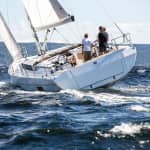
The conditions are restrained. The late-onset thermals only provide around ten knots of wind. Nevertheless, these conditions provide a revealing impression of the sailing characteristics. The Swan 51 gets moving quickly, accelerates well and reacts immediately and precisely to steering impulses. The boat appears agile and very well balanced right from the start. These are characteristics that are by no means a matter of course, especially in light winds, and indicate a harmonious interplay of hull, appendages and rig - ultimately even in stronger winds. The construction of the Swan 51 once again comes from the studio of Nautor's in-house designer Germán Frers. The Argentinian is responsible for all current models in the Swan line (51, 55, 58, 65) as well as for the larger yachts in the Swan Maxi programme (80, 88, 98, 108 and 128).
Measured values of the Swan 51


The measured performance data underpins the positive initial impression. Upwind, the Swan 51 sails with the short overlapping (106 per cent) standard genoa at a speed of 6.1 knots over the ground. Remarkable is the tacking angle of only around 80 degrees, which can be categorised as extremely good under the given light wind conditions. The beautiful Finn also shows her potential on rough courses. At half wind (90 degrees true wind angle) and with the Code Zero furled out, the Swan 51 accelerates effortlessly up to 8.3 knots. The boat remains balanced and easy to control at all times.
However, the twin rudder control seems a little stiff. This is probably due to the extremely complex mechanism installed. This comes from Jefa and works via two separate chain hoists that act individually on the quadrants of the two rudder blades. These in turn are connected to each other via a trimmable and adjustable push rod so that the angle of attack of the rudder blades can be finely tuned. The steering system has a fully redundant design. In addition, the autopilot directly accesses one of the quadrants, which provides additional safety in the event of a fault.
Different keel variants
Double rudder blades are one of the trademarks of designer Germán Frers. The advantages are obvious: more control with increasing position, a constantly energised rudder blade and a high degree of safety and precision in all conditions. The concept is complemented by a modern, efficient cast iron T-keel with a hardened lead bomb. The Swan 51 is available in versions with a draught of 2.45 metres (standard) or 2.05 metres (short keel), which cover different areas and operating profiles with adapted ballast proportions. The shipyard even offers an optional hydraulic telescopic keel with a draught variation of 2.00 to 2.75 metres.
Compared to the only slightly shorter predecessor model, the Swan 48, the usable area in the cockpit has increased by around 35 per cent. This is an increase that is due in particular to the new hull shape with a significantly wider stern. Two separate cockpit tables are also new, allowing unobstructed access through the cockpit. Both tables can be lowered and converted into sun loungers with inlay cushions.
However, the coamings are flat, which favours the elegant, flowing lines, but entails noticeable compromises in terms of seating comfort and protection. In terms of the cockpit layout, the Swan 51 has a well thought-out arrangement. All halyards and sheets are concealed below deck and led aft into the cockpit and run on two generously dimensioned 60 cm sheet winches on the coamings. The distances between the stopper batteries and the winches are chosen so that all relevant functions can be operated either via the forward or aft winch, depending on the sails or crew size. Soloists can also cope well with this arrangement, especially as the four large winches are already equipped with electric drives from the shipyard.
The mainsheet is operated via a so-called captive winch, which is installed under the cockpit floor and can be operated from the helm at the touch of a button. This device is part of the standard equipment from the shipyard. However, the shipyard does not offer a traveller for the mainsheet guide.
Below deck of the Swan 51
Below deck, the Swan 51 follows a clear, functional layout. In the standard version, the yacht is designed as a three-cabin yacht and has two extremely generously sized heads compartments, each with separate shower areas. The general layout is based on the previous Swan 48 model, but is noticeably more spacious in all living areas. The new 51 benefits from around 80 centimetres more hull length and significantly more width, especially in the rear of the boat. The freeboard has also been increased slightly. The shipyard calculates an additional volume in the hull of no less than 22 per cent.
Nautor offers design freedom for the aft cabin on the starboard side. As an alternative to the large double bed, this area can also be equipped with two full-size single berths of a reasonable size. To make this possible, the starboard cabin is wider than its counterpart on the port side. The rear cabin can also be used in different ways if required, for example as a walk-in storage space, an office or a workshop. These configuration options emphasise the possibilities for individual design as part of the semi-custom concept. The shipyard demonstrates a high degree of flexibility here in order to fulfil special customer wishes.
The owner's cabin in the foredeck also follows the clear lines of the overall concept. The centrepiece is an almost completely free-standing island bed with a rectangular design, which is an explicit requirement of the Nautor boss. In practice, this means clear lines and good accessibility, even if the width of 1.50 metres is not exactly generous. Compared to the previous Swan 48 model, the area of the forward cabin has increased by around 16 per cent. This also benefits the wet room in particular, which is significantly larger and offers comfortable freedom of movement. However, Nautor is not following the increasing trend in large yachts of separating the toilet and shower. Instead, the company is sticking with the classic, integrated solution.
Diesel drive can be replaced by electric hybrid system
The Swan 51 also sets standards in its class when it comes to storage space. There is an exceptionally large amount of storage space below deck, which is very well organised and consists largely of high-quality pull-out drawers. To make another comparison with the Swan 48: according to the shipyard's calculations, the total storage capacity has increased by around 35 per cent compared to the previous model.
Nautor Swan relies on a conventional diesel drive for propulsion under engine. An 80 hp built-in engine from Yanmar is installed. Under full load, the Swan 51 achieves a solid 9.0 knots. Alternatively, the shipyard offers an electric hybrid system from Oceanvolt. The electric drive has an output of 30 kW and the power is supplied by a Fischer Panda generator.
Nautor's remarkable construction and finishing quality is exemplary. The structural workmanship, the installation of the on-board technology and the many detailed solutions are at a level that is rare even in the upper end of the market. In addition, the standard equipment is unusually comprehensive: autopilot, navigation electronics, anchor winch, hydraulics for boom vang and backstay, bow thruster and numerous other expensive comfort components are already included as standard.
Of course, the Swan 51 is not for bargain hunters, but for owners who prioritise substance, consistency and value retention over sheer numbers. It delivers convincing arguments in the test.
YACHT review of the Swan 51
Even the smallest yacht in the Swan programme remains uncompromisingly true to the upmarket brand values. The boat has a straightforward appearance and the quality is among the best the market has to offer. The high price is nevertheless painful.
Design and concept
High-quality construction
Exciting look
Confident price announcement
Coaming flat and uncomfortable
Sailing performance and trim
High performance potential
Very good height upwind
Functioning handling
Controls somewhat sluggish
Living and finishing quality
Best fit-out standard
High degree of customisability
Easily accessible storage spaces
Narrow double berth at the front
Equipment and technology
High-quality basic equipment
Electric hybrid as an option
Redundant control
No Traveller available
The Swan 51 in detail

Technical data of the Swan 51
- Design engineer: Germán Frers
- CE design category: A
- Torso length: 15,55 m
- Total length: 16,90 m
- Waterline length: 14,67 m
- Width: 4,85 m
- Draught/alternative: 2,45/2,05 m
- Draught telescopic keel: 2,00-2,75 m
- Mast height above WL: 20,70 m
- Theor. torso speed: 9.3 kn
- Weight: 18,0 t
- Ballast/proportion: 6,3 t/35 %
- Mainsail: 80,0 m²
- Furling genoa (106 %): 67,1 m²
- machine (Yanmar): 59 kW/80 hp
- Fuel tanks: 2 x 325 litres
- Fresh water tanks: 2 x 250 litres
- Holding tank: 2 x 50
Hull and deck construction
GRP sandwich with foam core and vinyl ester resin. Constructed using the vacuum infusion process.
Sail
The sails are not included in the basic price. The cost of a set of windward sails (main and genoa) is at least 60,000 euros gross.
Motorisation
A four-cylinder diesel engine from Janmar with Saildrive drive and an output of 80 hp will be installed from the shipyard. An electric hybrid system with generator is also available as an option.
Rig
Standard: Aluminium mast with two spreaders, painted white with rod shrouds. Hydraulic adjustment (combi) for backstay, boom vang and outhaul. A carbon fibre mast and/or furling boom from the manufacturer Mainfurl is available as an option.
Shipyard
Oy Nautor AB, Nautor Swan, 68600 Pietarsaari (Finland); www.nautorswan.com
Distribution
Nautor Swan Germany, Hamburg; www.nautorswan.com
Noble, chic, fast: the competition in the premium segment
Arcona 50

The design for the Swedish shipyard's flagship comes from Niels Jeppesen. The well thought-out concept, the good build quality and the attractive level of equipment set high standards in the class. Read the test here.
Beneteau First 53

The First 53 from Beneteau impresses in the test with its excellent sailing characteristics. The cockpit with walkaround layout works well and allows sporty handling for the crew. You can read the test here.
Grand Soleil 52 Performance

The high-performance fast cruiser from Cantiere del Pardo in Italy is slightly larger than its competitors, but still fits in well with the group. The boat is available with a choice of two layouts for cruising or racing.
Solaris 50

Visually exciting and strong under sail. The beautiful Gran Turismo from yacht builder Solaris features many exciting details on and below deck. The build and finishing quality is in the top league. Read the test here.

Michael Good
Editor Test & Technology
Michael Good is test editor at YACHT and is primarily responsible for new boats, their presentation and the production of test reports. Michael Good lives and works in Switzerland on the shores of Lake Constance. He has been sailing since childhood and, in addition to his professional activities, has also been an active regatta sailor for many years, currently mainly in the Finn Dinghy and Melges 24 classes. He is also co-owner of a 45 National Cruiser built in 1917. Michael Good has been working for the YACHT editorial team since January 2005 and has tested around 500 yachts, catamarans and dinghies in that time.
