


Lagoon 38: Sales endurance burner is replaced - more volume, more comfort in the test
Michael Good
· 28.03.2026


The new Lagoon 38 is not an easy successor. The predecessor model, the Lagoon 380, was an exceptional bestseller and long seller for the industry leader from Bordeaux. The compact model remained in the programme for more than two decades and more than 1,000 units were built. Its success was based on a coherent concept: manageable dimensions, easy handling, an attractive price structure and configuration options with three or four cabins, which made the boat interesting for both private owners and the charter market.
More from the shipyard:
Even after the introduction of the innovative Lagoon 40 in 2018, the 380 remained on offer due to persistently high demand. But now it's finally over. Lagoon is retiring the long-serving 380 and introducing a direct successor in the form of the new Lagoon 38. However, the bar has been set very high for the newcomer right from the start.
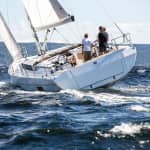
Studio VPLP Design is once again responsible for the design of the new Lagoon 38. The unusual hull shape in the foredeck area is particularly striking: a lot of volume far forward, combined with strikingly pronounced chine edges, which nevertheless ensure slim waterlines there. What we know from modern monohulls as a design feature, especially in the design of the aft section, has obviously been moved forwards here. A topsy-turvy world perhaps - but in terms of design, it makes perfect sense.
The actual purpose of this design lies less in the spectacular appearance or possible hydrodynamic advantages and more in gaining space below deck. The additional volume in the foredeck creates noticeably better space conditions, especially in the forward cabins. The new 38 thus adopts a design principle that has already caused a stir in the larger Lagoon 43: The spacious owner's cabins have been moved forward, where there is now more space than aft. This is a real novelty in the world of catamarans and at the same time brings advantages previously known from monohulls: more privacy when sleeping forward, greater distance from noise sources aft and better options for light and ventilation, as more and larger hatches can be installed on deck.
The conditions during the test off Barcelona are anything but easy: a very unstable wind of between 4 and 5 Beaufort, plus a high swell of 1.50 to 2.00 metres. The performance data must be evaluated with corresponding caution. The Lagoon 38 achieves a maximum of 6.0 knots at an angle of at least 55 degrees to the true wind. This is decent at best, but by no means inspiring. The reason for this is probably the very small self-tacking jib that Lagoon supplies as standard - unfortunately without the option of a larger, overlapping genoa.
Measured values of the Lagoon 38


From about 80 degrees true wind angle, the Lagoon 38 runs much better with the Code Zero unfurled. Only in this configuration does the sail plan look coherent, even in stronger winds. The Code Zero is therefore actually part of a coherent sail wardrobe for this catamaran, even if it is only available at extra cost. Without an additional light wind and room wind sail, the performance drops quite significantly, especially on rough courses.
All halyards, sheets and trim lines run back into the raised steering cockpit. In practical terms, however, the layout remains incomplete. There is only a single 40 mm winch at the helmsman's workplace, which is clearly too small for the loads involved. Although the mainsheet guide with two separate tackles instead of a traveller is trim-efficient, it requires both sheets to be tracked during manoeuvres. This is where it becomes clear that at least one additional manoeuvring winch is missing. As part of the optional equipment packages for Code Zero or gennaker, winches for the sheets are installed on the side of the outer cockpit. But even these are too small for the high loads on the lines in windy conditions.
In the owner's version with a large cabin in the foredeck, Lagoon consistently utilises the new volume distribution. The berth is built across the entire width of the hull and offers an impressive 1.80 metres of sleeping space in the shoulder area. This is unprecedented in the small class of cruising catamarans with a hull length of less than twelve metres. The sleeping area, which has been moved forwards, also benefits the wet room, which is now located aft in the hull and is therefore also unusually spacious. The separate shower area in particular offers a surprising amount of space for a boat of this size. In between, there is an additional living area that can be used flexibly as an office, dressing room or open storage space.
In the starboard hull, the co-sailors share two very spacious double cabins and a large wet room in the centre with a separate shower area. The charter version with four cabins then mirrors this layout in the port hull. The increase in living volume and living space is generally one of the strongest arguments in favour of the new Lagoon 38.
The saloon itself, on the other hand, is rather short and compact. Its strength lies less in its generous dimensions than in the functional connection with the exterior cockpit. The seating groups in the saloon and cockpit can be arranged flexibly and can also be used in combination when the sliding door is open. This means that up to ten people can sit comfortably at the two tables, which is particularly interesting for use on yacht charters. The galley also scores highly in terms of functionality. It offers large work surfaces and easily accessible storage compartments. However, there is no space left in the saloon for real navigation with a work surface. In its place there is only an open shelf, which at best can take on the function of an improvised standing desk.
Prices and equipment of the Lagoon 38
In the entry-level class of cruising catamarans under twelve metres in hull length, the competition remains manageable. The length segment is particularly demanding, and correspondingly few manufacturers set themselves the task of accommodating sufficient space, comfort and utility in a limited length. This also explains why there is hardly any movement in terms of price.
- Base price ex shipyard: 406.980 €
- Standard equipment included: Engine, sails, sheets, railing, navigation lights, battery, compass, sails, cushions, galley/cooker, bilge pump, WC, fire extinguisher, electric refrigerator, waste-holding tank.
- For an extra charge: Sailcloth €1,140, anchor with chain €1,770, fenders/mooring €1,010, antifouling and clear delivery €23,670.
- Price ready to sail: 434.570 €
- Guarantee/against osmosis: 2/5 years
- Surcharge for comfort equipment: Genoa haul points not available; Traveller with line guide incl.; Electric anchor windlass incl.; Tube kicker not available; Backstay tensioner not available; Jumping cleats incl.; Sprayhood not available; Teak in cockpit € 8,570; VHF radio Nav package; Log and echo sounder Nav package; Wind measuring system Nav package; Autopilot Nav package; Navigation package € 14.950 €; Charger Essential-Package; Shore connection with RCD incl.; 230 volt socket Essential-Package; 12 volt socket in the Navi incl.; Heating (air conditioning) 17.255 €; Pressurised water system incl.; Hot water boiler Essential-Package; Shower WC room incl.; Cockpit shower incl.
- Comfort price: 475.345 €
- Essential package: Battery charger, 220 V power circuit, additional battery capacity, electric manoeuvring winch, Davids, hot water boiler, etc., price: 52,360 euros gross.
As of 2026, how the prices shown are defined, read here!
With comparable basic equipment, the offers of the competition from Bali or Excess also level off at around 400,000 euros gross.
The Lagoon 38 consistently reinterprets the concept of the compact cruising catamaran - with a surprising amount of space, clever fittings and a high level of comfort. Whether this will be enough to build on the success of the Lagoon 380 remains to be seen.
New variants for owners in modules

Cruising catamarans are in high demand in the international charter business and are often sold to owners later for a second or third life cycle. For this case, Lagoon now offers flexible solutions with additional furniture for retrofitting. These modular components are now available for the Lagoon 38 (photo) as well as for the larger Lagoon 43 model (read the test here) is offered.
YACHT review of the Lagoon 38
Exciting new edition of Lagoon's entry-level model. The extremely voluminous hulls of the VPLP design in the foredeck area allow a completely new concept for the extension below deck. The range is attractively priced and competitive.
Design and concept
Compact format
Additional volume in the forecastle
Competitive price
Little sail area downwind
Sailing performance and trim
One-handed handling
Efficient mainsheet guidance
Little potential with jib
Only one winch in the cockpit
Living and finishing quality
Owner's cabin in the foredeck
Modular design
Good ventilation
Lack of holding options
Equipment and technology
Machines easily accessible
Responsive control
Technology properly installed
No genoa possible
The Lagoon 38 in detail

Technical data of the Lagoon 38
- Design engineer: VPLP Design
- CE design category: A
- Torso length: 11,38 m
- Total length: 13,12 m
- Waterline length: 11,38 m
- Width: 6,65 m
- Depth: 1,26 m
- Mast height above WL: 18,48 m
- Theor. torso speed: 8.2 kn
- Weight: 10,2 t
- Mainsail: 50,2 m²
- Mainsail (Squaretop): 55,7 m²
- Self-tacking jib: 22,0 m²
- machine (Yanmar): 2 x 21 kW/29 hp
- Fuel tanks: 2 x 200 litres
- Fresh water tank: 300 l
- Holding tanks: 2 x 80 litres
- Batteries: 3 x 95 AH + 2 x 50 AH
Hull and deck construction
GRP sandwich with foam core. Vacuum infusion for the hull, vacuum injection for the deck.
Rig
The aluminium rig with two spreaders comes from the French manufacturer VMG. Variants are not planned.
Sail
A set of Dacron sails (main and self-tacking jib) is included ex shipyard. A Code Zero with deck equipment and furling system costs 6,260 euros gross. An additional 3,770 euros are due for a gennaker.
Motorisation
Two Yanmar built-in diesels (3YM30AE) with an output of 30 hp each are installed ex shipyard. Propulsion is provided by saildrives and three-blade fixed pitch propellers. The fuel tanks, each with a capacity of 200 litres, are installed in the rear of the hulls.
Shipyard
Lagoon Catamarans, 33702 Bordeaux (France); www.catamarans-lagoon.com
Distribution in Germany
ADVERTISEMENT

Lagoon 38 insurance from 2414.93 euros per year* - liability and comprehensive cover. Many options available: fishing and diving equipment also insured. Simply calculate online and take out insurance: Yachting24.de
* Yachting24 offer valid for a sum insured of 407,000 euros (with current value cover), excess of 1800 euros, liability cover of 8 million euros.

Michael Good
Editor Test & Technology
