


- Passive safety of the Kraken 58
- Measured values of the Kraken 58
- Timeless appearance
- Moderate temperament under sail
- Weaknesses in manoeuvrability
- Pleasant expanse awaits below deck
- Prices of the Kraken 58
- At its core, Kraken 58 fulfils the highest demands
- YACHT review of the Kraken 58
- The Kraken 58 in detail
To call Richard Beaumont a man of conviction would not do the 72-year-old entrepreneur justice. The man looks like the Hollywood cliché of a rough but lovable sailor: blue eyes, stubbly beard, a facial expression somewhere between humorous and fiercely determined, a wide-brimmed Southwester with straps on his head. He describes himself as a "shipyard owner with a passion". And that sounds like a gross understatement. Dick, as everyone calls him, is a missionary.
Talking to him about his boats usually turns into an entertaining sermon. Duration: hardly ever less than an hour; he even fills an evening effortlessly. Between terms such as "alpha rudder" and "zero keel", the Brit masterfully weaves in the experience of a good 200,000 nautical miles on his own keel. He now also has his own YouTube channel with this repertoire.
At an age when others would rather leave the stage than build a new one, he is driven by his passion to build the best blue water yachts on the planet - "without compromise", as he says.
Also interesting:
The Kraken 58 is the latest product to follow his philosophy. The shipyard's programme also includes a 50 and plans for a 44. He himself has been sailing the 66-foot one-off "White Dragon", designed and built according to the same principle, for ten years. "I couldn't find what I was looking for on the market. That's what prompted me to set up a shipyard in the first place," he says.
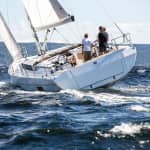
Passive safety of the Kraken 58
What makes Kraken yachts so different, so special, is their constructive, one could also say passive, safety. This applies above all, but not only, to the keel design. Instead of simply bolting the fin and bomb underneath, as is done on 99 per cent of all production boats today, here they are part of the hull. The ballast in the form of lead balls, mixed with resin and hardener, is poured into the hollow keel made of solid laminate after demoulding.
"In the Kraken 58, a matrix of 20 layers of glass and aramid fabrics makes the hull bulletproof," emphasises Dick Beaumont proudly. In order to withstand the shear forces during lay-up and peak loads in the event of a collision, the floor assembly of frames and stringers extends all the way to the keel sole. And it is not glued in place, but elaborately laminated by hand.
Now this solves a problem that seems de facto negligible. Other yachts in the luxury class that are suitable for long journeys also have very proven and highly resilient keel constructions. Instead of an integral keel, ballast bodies are usually bolted to solid GRP stubs, which reduce the leverage effect in the event of a collision and also enable a deep bilge.
Measured values of the Kraken 58


But the zero keel is not Kraken's only unique selling point. The 58 has three watertight partitions - two in the bow and one aft of the quadrant - which makes it virtually unsinkable. Her rudder is also not free-standing, but is guided by a full bow. The front edge of this runs diagonally downwards so that towing lines, nets or other rubbish cannot get caught in the sea and slide off.
The entire boat appears to have been consistently designed according to what-if exercises. For example, the 2.8-litre Yanmar is not supplied directly from the two midships tanks as usual, but from a third tank whose fuel is pumped through an elaborate filtration unit beforehand. This significantly reduces the risk of contamination or diesel fouling.
Timeless appearance
The design of the Kraken 58 also breaks away from current trends. Its freeboard is not as high as is usual today, its stem is slanted, the frame shape is less flat and the hull tapers in width towards the stern. This is intended to ensure pleasant movements in rough seas.
It also gives her a timeless appearance, but you can also find her a little retro. Her comparatively small, high-set hull windows, for example, visually date the design by New Zealand designer Kevin Dibley back two decades. Dick Beaumont, however, believes that this is the only way to go for safety reasons. He can also argue passionately about this.
And when you talk to him about the unconventional bimini, which looks as powerful as a hardtop but is only made of tarpaulin fabric, he counters with the story of a typhoon he once had to weather in South East Asia. "We dismantled everything that could be dismantled to reduce the area exposed to the wind - including the canvas panels."
Moderate temperament under sail
So is the Kraken an armoured cruiser built for the extreme - or does she also sail? If you look at her key figures and the impressive sail plan, it quickly becomes clear that Dick Beaumont's endeavours to ensure safety have certainly left room for a certain longitudinal dynamic.
Due to its over-complete standard equipment and solid construction, it displaces a whopping 29 tonnes empty - as much as the Amel 60, significantly more than an Oyster 565 or Hallberg-Rassy 57 - but it carries considerably more sail area in relation to its weight on the higher rig.
In fact, she gets going at 8 to 10 knots of wind. At the cross she then reaches respectable speeds of 5 to 6 knots, whereby it is almost irrelevant whether you are travelling with the tightly sheeted cutter jib or the 140 percent genoa, whose hoisting point is on the foot rail. With the larger headsail, more speed is possible, but with less height and more arduous manoeuvres, because the cloth has to be largely rolled away when tacking.
With a fresher breeze and more waves, the Kraken 58 doesn't gain that much more speed. At the cross she logs an average of around 7 knots, peaking at 7.5 knots - a good half a knot less than the designer's polar data. To keep rudder pressure and position within limits, she needs a reef in the main even at 15 knots of wind, and at 20 knots the shipyard crew rolled the cloth almost halfway up the foot of the mast during the test.
Weaknesses in manoeuvrability
Like everything else on board, this can be done effortlessly at the touch of a button. However, it also shows that the Kraken requires compromises, at least in terms of performance. The frictional resistance of the flat appendages noticeably slows down her temperament, and the skeg-guided rudder shows less grip and sensitivity than a well-balanced free-standing spade rudder. As a result, she is unable to realise the full potential of her sailing plan.
On the following day, however, she impressed with her almost sedan-like behaviour in rough seas. With waves of up to two metres and a good 25 knots of wind, she went through the breakers as if on shock absorbers. No other current design of this size is so soft.
On the other hand, the Kraken 58 proved to be less manoeuvrable when manoeuvring in the narrow harbour during the test. Aft, she needed a lot of space and speed before she responded to the rudder. And even the bow thruster, which is fitted as standard from the shipyard, was unable to keep the foreship in position against 6 Beaufort.
Pleasant expanse awaits below deck
When you step below deck from the comfortable, well-protected centre cockpit, the yacht, which costs almost 3 million euros, welcomes you with a sense of solidity. The four metre wide panoramic window of the deck saloon superstructure provides plenty of light and a pleasant sense of space.
Prices of the Kraken 58
- Base price ex shipyard: 2.754.850 €
- Standard equipment included: Engine, sheets, railing, navigation lights, battery, compass, sails, 60 kg anchor with 100 m chain, cushions, galley/cooker, bilge pump, toilet, fire extinguisher, electric cooler, holding tanks with suction, fenders, mooring lines, antifouling, clear sailing handover
- Price ready to sail: 2.754.850 €
- Guarantee/against osmosis: 2/5 years
- Surcharge for comfort equipment: Adjustable anchor points incl., traveller with line guide incl., electric anchor winch incl., tube kicker incl., backstay tensioner incl., spring cleats incl., sprayhood incl., teak in cockpit incl., VHF radio incl., log and depth sounder incl., wind gauge incl., Autopilot incl., charger incl., electrical package incl., shore power connection with RCD incl., 230-volt socket (one) incl., 12-volt socket in sat nav incl., heating incl., pressurised water system incl., hot water boiler incl., shower WC room incl., cockpit shower incl.
- Comfort price: 2.754.850 €
- Included in the price (extract): bow thruster, electric winches, electric furler, air conditioning, generator, watermaker, diesel filtration system, plotter, davits, dinghy
There is no standard yacht with more extensive standard equipment. Even a 15 hp outboard engine, life raft and induction cooker are among the standard "extras". Total value: a good 250,000 euros.
As of 2026, how the prices shown are defined, readhere!
Although the seating area appears rather small, the Kraken makes an imposing impression. Minimal gaps, finely lacquered surfaces, creak-free floorboards veneered with real wood characterise an ambience of distinguished luxury. Compared to the competition, it may lack finesse and modernity in terms of interior design, but not in terms of practical detail solutions.
There is an oil locker on the port side, between the galley and saloon, so that nobody has to walk halfway round the boat with dripping clothes. The raised navigation system allows a clear view forwards and to the sides.
At its core, Kraken 58 fulfils the highest demands
Nevertheless, there are a few kinks in the otherwise mostly convincing layout. The steep companionway is one of them. It can only be negotiated reasonably safely with your back to the direction of travel, as the steps are not deep enough and are also heavily undercut. This doesn't really fit in with Dick Beaumont's postulate of uncompromised safety. At its core, however, the Kraken 58 fulfils high, if not the highest demands.
Originally, the shipyard boss wanted to manufacture his yachts in China. Because the customs policy there was too restrictive, he initially moved production to Turkey, where the test ship was also built. Due to horrendous inflation and the resulting sharp rise in wages, Kraken Yachts is now based in Gdynia, Poland.
Dick Beaumont assures us that the move will not have any impact on quality. On the contrary, he has refined the specification of his models even further. In the underwater area, for example, he now has clear, uncoloured gelcoat sprayed into the hull mould. "This allows us to see and eliminate any air pockets after demoulding."
Even if you don't agree with him on every point, you simply have to love his almost inexhaustible drive for perfection, and his stories of the sea anyway. Boatbuilding would undoubtedly be poorer without makers like him.
YACHT review of the Kraken 58
With its sloping stem, moderate freeboard and tapered ends, the Kraken 58 has an almost classic look. You can't expect top performance under sail, but you can expect high seaworthiness and robustness.
Design and concept
Consistently geared towards long journeys
High passive safety
/(-) High but fair price
Sailing performance and trim
Very smooth movements in rough seas
Variable sail plan
Trimming at the touch of a button
/(-) Moderate temperament
Living and finishing quality
High material and manufacturing quality
Lounge seating area somewhat cramped
Berths midships and forward too short
Steep descent, short steps
Equipment and technology
Over-complete equipment
Fully accessible machine room
/(-) Comfortable, but aft cramped cockpit
The Kraken 58 in detail

Technical data of the Kraken 58
- Design engineer: Kevin D. Dibley
- CE design category: A
- Torso length: 17,67 m
- Waterline length: 15,83 m
- Width: 5,20 m
- Depth: 2,30 m
- Mast height above WL: 30,00 m
- Theor. torso speed: 9.7 kn
- Weight: 29 t
- Ballast/proportion: 10,1 t/35 %
- Mainsail: 109 m²
- Furling genoa (140 %): 121 m²
- Cutter jib (100 %): 72 m²
- machine (Yanmar): 112 kW/150 hp
- Fuel tank (3): 1.600 l
- Fresh water tanks (2): 950 l
- Faeces tank (2): 240 l
- Batteries (8): 960 Ah/24
Hull and deck construction
GRP hull with integrated keel and lead ballast; aramid-reinforced full laminate up to 40 cm above the waterline. Sandwich deck.
Collision protection
The Kraken has two watertight bulkheads forward and one aft. The rudder is guided on an aramid-reinforced skeg and has three bearings.
Weather protection
The fixed bimini overhangs the entire cockpit. It can be closed forward to the windscreen, aft and sideways to the cake stand.
Shipyard
Kraken Yachts Ltd, Gdynia/Poland, Tel. +48 668 88 54 00; krakenyachts.com
Direct sales
Tel. +35 056 02 09 65; sales@krakenyachts.com

Jochen Rieker
Herausgeber YACHT
