


Glückstadt is a small idyll on the Lower Elbe. The small town with its picturesque harbour lies directly behind the dyke, nestled between historic brick houses to the south of the town centre. Today, there is little to suggest that a small revolution in German boatbuilding took place here in the early 1960s.
But just a few hundred metres from the water, master carpenter Willy Asmus built the first boats made of glass fibre-reinforced plastic in his workshop. What started out as a hobby project soon became one of the first series-produced plastic boats in Germany.
This might also interest you:
That was a novelty. However, Asmus was familiar with working with the new material. After all, he was already producing plastic refrigerator doors in his company. Now, however, they were to be turned into veritable sailing yachts.
Success of the shipyard produces 16 Hanseat models
The passionate sailor created the design after work. It was based on his 30 dinghy cruiser, a self-built boat with which Asmus had already had several successes on the Elbe. But instead of wood or iron, the hull was now made of synthetic resin, hardener and fibreglass mats. The fittings were made by hand; there was no off-the-shelf boat equipment at the time. After three years of construction, the first Hanseat was completed in 1963. Four more were to be built, two for his brothers and two for friends who helped Asmus build the boats.
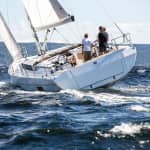
The era of the Glückstadt Hanseatic League

The project proved to be a great success. The plastic boat caused a sensation on the regatta courses of Germany. In a newspaper article, Asmus enthused: "At the Kieler Woche, in a good six-strong wind, the Hanseat shot out of the field like a rocket. Under spinnaker, the ship was almost unstoppable." Something similar happened again during a race at the North Sea Week. Even before the timekeepers arrived at the finish line, Asmus was already there with his Hanseat. "They came chugging along at a very leisurely pace and probably thought we were a touring skipper," he is quoted as saying.
At the time, Willy Asmus could hardly have imagined that the first five boats would be followed by more than 370 others. From the foundation of the Asmus shipyard in 1965 until its insolvency in 1985, the company produced 16 different models. They ranged from the ten-foot Hanseat Junior to the slip-rigged motor sailer (Hanseat 35 MS) and the Hanseat 42.
Pioneer in German GRP boatbuilding
The majority of the designs came from Willy Asmus' pen. Some also came from external designers such as the American Doug Peterson (Hanseat 40). At peak times, almost 100 employees worked in the company; at times, the shipyard was one of the largest training centres in the region.
Asmus led the way in German GRP boatbuilding. Only after him did shipyards such as Dehler, Bavaria or Esslinger and Abt come onto the market with yachts of this size. The material, which was still uncommon in boatbuilding, was nothing new in itself. Glass fibre reinforced resin was already being used in the USA in the 1930s to replace plywood or metal parts on warships. It was also used in aircraft construction, as the material was not only lightweight after curing, but also extremely robust.
Hanseat is a child of the plastics revolution
Originally, the composite material had to be cured under heat and pressure. But in 1943, the first two-component polyester resin came onto the market. This allowed the material to harden at room temperature. This simplified the application considerably and led to a boom in plastics after the war - including in boatbuilding. In 1951, twelve years before Asmus' debut, the 12.80 metre long "Arion" was launched, the world's first large sailing yacht made of GRP. The slim double-ender with a centre cockpit was developed by Sidney DeWolf Herreshoff. His brother, L. Francis Herreshoff, had referred to the new boat building material as a "frozen snot" shortly beforehand.
But from then on, the frozen snot was to open up the once exclusive sport of sailing to the masses. It offered a whole range of attractive properties: fibreglass-reinforced plastic is not only robust and durable, but also lighter and cheaper than traditional building materials such as wood or steel. It is also waterproof, resistant to acids and alkalis, non-conductive and not susceptible to corrosion.
The Hanseat is one of the children of this plastic revolution. Even today, the brand, named after Willy Asmus' first ship made of GRP, is synonymous with solid and well-sailing cruising boats for many sailors.
New details tried out from type to type
Hans Hinrich Westphal (79), the former master boat builder at the Asmus shipyard, is one person who can provide more information about the development of the Hanseaten than almost anyone else. "While other shipyards only worked with simple fibreglass mats or the spraying process, we used roving fabric for the Hanseaten," says Westphal.
"At the Kieler Woche, the Hanseat shot out of the field like a rocket. Under spinnaker, the ship was almost unstoppable." Willy Asmus
This textile-reinforced material consists of parallel fibre bundles, known as rovings, which can absorb loads particularly effectively. "Everything was rolled, compacted and finally annealed by hand. This made the material very strong and optimally dimensioned."
In addition to the solid construction, the yachts from Glückstadt are also characterised by the many practical details that Willy Asmus has devised. One example is the different heights of the dents in the cockpit. The helmsman sits slightly higher than the crew and is also spatially separated by a wide, solid traveller rail. Another detail is the characteristic superstructure of the first models. They characterise the striking appearance and earned the ships the nickname "armoured scout yachts".
New paths in design too
The subsequent 70 series was an even greater success. The boats are still in demand today due to their good substance. Between 1970 and 1981, more than 200 of these yachts were built and further developed. In addition to the Hanseat 70, recognisable by its wooden foot rail, there were the 70B, 70 MKIII and 70 BII. The most noticeable changes from type to type were in the skeg. While it was initially made of particularly solid iron, it disappeared completely on the later models.
It was this versatility that characterised Willy Asmus as a designer, says Margit Ziegler, 77, who was born Asmus and is the daughter of the former shipyard boss. "He was constantly designing new things and had ideas that he immediately put down on paper," she says. This was not only true of the 70 series. Many of the shipyard's other designs could also be ordered in different versions: whether with a centreboard or fixed keel, in racing or cruiser design, as a sailor or motor sailer, such as the Hanseat 35.
At the same time, Asmus always liked to break new ground - not only in terms of materials, but also in terms of design. Some of the boats built were quite unusual. This certainly includes the "Pinguin", which was launched in 1977. "If the new build lives up to the promise of the model, we can almost speak of a small revolution in boat building," wrote YACHT at the time. The Pinguin was to be trailerable and combine what was considered incompatible: chine keels with centreboards. The idea was to make it dry without sacrificing dimensional stability or living comfort. It was designed by Carsten Wagner and built until 1985. However, the Pinguin did not succeed in building on the success of the 70s series.
Cruising sailors appreciate the Hanseat
It is mainly cruising sailors who still appreciate the details and robust construction of this timeless GRP classic. Helge Aßmann and Asha Reich sailed around the world for ten years on their "Gegenwind", a Hanseat 70. The boat was put to the test several times - including after colliding with a reef. "Other ships would certainly not have survived that," says Asha Reich. However, the robust construction and the thick material made it possible for the ship to survive the situation without suffering total damage. A full ten centimetres of the keel heel was lost and there were a few scratches on the hull. However, there was no leak. And although the ship is often referred to as a "tank", says Helge Aßmann, it still sails well and quickly - even in light winds.
It's a phrase you often hear when talking to Hanseatic enthusiasts. Fifty years ago, during the Hanseatic's heyday, speed was considered one of its hallmarks. In 1978, Günter Milowsky even caused a sensation when he single-handedly crossed the North Atlantic in just 22 days with his "Pommern", a Hanseat 70.
Today, it is other characteristics that are convincing. As moderate long-keelers, the older models in particular sail very steadily, yet react sensitively to rudder movements. They are easy to handle and functionally equipped. The number of halyards and outhauls is manageable and Hanseats in their original condition can still be operated at the mast.
"He was always designing new things and constantly had new ideas that he immediately put down on paper." Margit Ziegler (née Asmus)
Hanseat is stable in price and value
This is also the case on board the "Pajoti", a Hanseat 69, which Hans-Heinrich, 67, and Karin Jürgensen, 65, have made available for a test trip. Like their boat, they also come directly from the Elbe. It was the classic and robust design of the Hanseat that convinced the former folkboat sailors to buy the boat in 2020. "You simply can't break it," say the Jürgensens.
The condition of their Hanseatic also played a role in the purchase decision. Like many other owners, the previous owner had carried out a comprehensive refit. The Jürgensens report that this involved re-laminating the cockpit, renewing the superstructure windows, refreshing the paintwork and treating the osmosis. Today, more than 55 years after it was built, the boat is still in excellent condition. It is rigid and visually appealing thanks to the new paintwork. Even when walking across the deck, no cracking or crackling can be heard. "Boats like this retain their value. Perhaps not necessarily financially, but certainly materially," says Karin Jürgensen.
Use in the navy
But not only cruising sailors are enthusiastic about the yachts from Glückstadt. Six Hanseatic Type 70Bs are still used intensively by the German Navy, reports Frigate Captain Michael Hufnagel, Head of Seamanship at the Mürwik Naval School, when asked by YACHT. For almost 40 years, the cadets have been learning their first nautical and seamanship skills on the boats during their training. "They should come into contact with the elements and the stresses and strains - for example in bad weather - at an early stage," says Hufnagel. This experience should benefit them later on the grey warships. Hufnagel estimates that the boats are used for military sailing training around 100 days a year. The Hanseat is ideal for this: "No boats are built like this anymore."
Hufnagel emphasises that the good design is also reflected in the fact that they are still in good condition even after 40 years of intensive use. "But yes, their time will soon come." They will then probably be auctioned off by VEBEG, the federally owned trust company. In 2020, the first new boats, seven Sunbeams 36.2, were added to the fleet of the Mürwik Naval Academy. If you compare the two, the moderate long-keeler sails rather sluggishly and as if on rails. In contrast, the Sunbeams luff faster in stronger winds and require more active mainsheet management.
1989 The Asmus shipyard closes
While the Hanseatic ships of the Bundeswehr are still in service, the Asmus shipyard era ended in 1985, with debts piling up and the company going bankrupt. The reasons for this are not entirely clear, so that one hears and reads different explanations when searching. These include high material costs, international competitive pressure, the decline of the dollar in the mid-1980s, problems with bank loans and rising non-wage labour costs. An insolvency administrator eventually took over the business and tried to pass on the Asmus legacy to a successor in the following years - but without success. "I was the last person to switch off the lights in 1989," says Westphal. Some negative moulds were still sent to Denmark, he says. "But we don't know what happened to them."
However, there was one last attempt. Just over ten years after the end of the Hanseaten shipyard, the son, Heiner Asmus, founded Hanseat-Yachtservice. He was also able to win over Hans Hinrich Westphal for this idea. With a new concept, they initially built a new hall a little away from the harbour and offered painting, osmosis treatments and the refitting of Hanseats in addition to the classic shipyard work and winter storage. "We did everything, but not a new building," says Westphal.
"The shape, this classic style and the solidity convinced us. You simply can't break the boats." Hans-Heinrich & Karin Jürgensen
This offer particularly appealed to owners of ageing Hanseatic ships. This is certainly one reason why you can still find well refurbished examples in harbours along the German coast today. Although the business got off to a promising start, Westphal explains, success gradually tailed off. In 2009, the master boat builder retired. And in 2013, thirteen years after the death of Willy Asmus, Heiner Asmus also passed away. It marked the end of the Hanseatic era.
Today, there are few reminders of the golden age of the Hanseatic League in Glückstadt harbour. On the former site of the Asmus shipyard, behind the Glückstadt barrage, a new sign has long been attached to the entrance. This is because the Glückstadt yacht shipyard moved in there back in 1992.
However, if you look carefully through the rows of boats in the harbour basin, you will notice the many Hanseatic ships scattered along the jetties. This is what still delights Willy Asmus' daughter today when she goes down to the harbour. "His life's work continues to float - and that's the most important thing," she says.

Fabian Boerger
Editor News & Panorama
