


Excess 13: Cheeky in appearance, strong under sail - the cat for the Gen Z in the test
Michael Good
· 10.01.2026


On display in Hall 16, Stand C39
Almost seven years ago, in spring 2019, the Beneteau Group surprised everyone by announcing a new catamaran range under the name Excess. The brand was intended to appeal to a modern and sporty clientele and complement the established Lagoon line. The concept: more power thanks to performance-orientated equipment, less weight thanks to a consistent reduction in interior fittings and a sportier sailing feel thanks to two side steering positions at the stern.
The Excess 12 and Excess 15 were presented together as the first models in the new range. On closer inspection, both boats essentially turned out to be sportily modified offshoots of their counterparts from the comfort-oriented Lagoon programme. Only with the Excess 11 the shipyard presented its first catamaran in 2021, which had been developed entirely according to the new concept.
More on the topic:
In the meantime, the new shipyard has added the models Excess 14 and, most recently, the Excess 13. At the same time, the two Lagoon derivatives 12 and 15 have disappeared from the portfolio. This means that Excess has now definitely established itself as an independent brand. The connection to Lagoon now only exists through the joint affiliation to Groupe Beneteau.
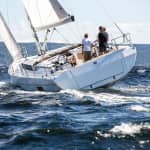
New approaches to construction design
With the brand new Excess 13, the French shipyard has also surprisingly announced a change of design partner. Instead of VPLP, which designed the previous Excess models, the Marc Lombard Yacht Design studio has been engaged for the new boat. This move is remarkable in that Lombard also works for Excess's only real competitor: Nautitech Catamarans. With their boats, both brands are positioning themselves in a niche that many manufacturers tend to avoid. It is the sporty middle ground between the comfort-oriented cruising catamarans and the sporty performance boats with long, slim hulls, catchable centreboards, powerful rigs and sometimes radical weight optimisation.
Measured values of the Excess 13


The designers at Lombard have clearly put their own design stamp on the Excess 13. Compared to the earlier VPLP models, the new model now has an even more pronounced, positive deck step - a typical feature of Lombard designs, and not just for cats. In addition, the keels are now shorter but significantly deeper. And the keel step is also more emphasised. This gives the new 13 a more compact and powerful appearance overall. The hulls feature low-set, continuous chines with sharp edges on the outside and inside. The design maximises volume, particularly at the stern, while the waterline remains slim. The curved kinks in the hull not only conceal the high freeboards, but also provide more structural rigidity.
The hulls are created as a continuous component from a mould as a GRP sandwich construction, built using the vacuum infusion process with osmosis-resistant polyester resin and a core of balsa wood. For the deck, including the cockpit tub, the shipyard is using a new manufacturing process for the first time, which is intended to reduce weight and increase structural strength at the same time. The process, a combination of vacuum infusion and resin injection, is new and the technology is still a shipyard secret.
Nominated for European Yacht of the Year 2026
The Excess 13 has been nominated for European Yacht of the Year 2026, and the YACHT editorial team was also on board as part of the tests with the expert jury off Barcelona - in top conditions of around 5 Beaufort and a challenging swell of up to two metres.
First of all, the Lombard design surprises with a very good performance upwind and, above all, with an impressive height. The bipod runs at 6.8 knots against the wind, at an angle of 45 degrees to the true wind. For a catamaran, these are already remarkably good performance values.
The Excess 13 also shines with its excellent seakeeping behaviour in fairly large swells. The noticeably stiff and low-torsion structure enters the waves smoothly and also shows less of the often very unpleasant rolling motion commonly associated with catamarans in rough seas. This is very pleasant, especially on longer journeys.
Fast and sporty under sail
The Excess 13 really gets up to speed on the beam. The 76 square metre Code Zero provides the necessary performance booster. The cat accelerates immediately to speeds of around 12 knots and more. In surfing with wave support, 16.6 knots was recorded as the record value on the test day. This is surprisingly fast even for a sporty cruising catamaran. The bipod remains stable on course and is easy to control. From a speed of eight knots, however, the test boat suddenly experienced clearly noticeable vibrations, despite the locked folding propeller. The cause of this could not be determined quickly, but could have various triggers.
The steering works flawlessly and with absolutely no play. Compared to many other catamarans, the Excess 13 is extremely manoeuvrable, which helps the boat to turn quickly. The twin-hulled boat also reacts quickly and immediately to steering movements. What's more, the helmsman can even feel a slight rudder pressure in the wind, which makes it easy to steer the cat with a lot of feeling and fun in the wind.
At the two steering positions, the helmsman has plenty of room to manoeuvre and a good view forwards and into the sails. The two wheels also prove to be extremely practical for harbour manoeuvres: the helmsman can change sides and thus has a view of both hulls right up to the bow tips. If required, throttle levers can be installed on both sides for engine control. The concept with two helm stations also has the advantage that the main boom can be driven close above the deckhouse. This is good for performance, but also for handling when hoisting the mainsail into the lazy bags. There are easy-to-use steps at the front to access the coachroof.
Line handling with advantages and disadvantages
All halyards, sheets and trim lines run bundled over the running deck on the starboard side into the cockpit, where they are operated by Harken via two powerful 46 mm winches. However, no fewer than twelve lines come together there, which requires discipline and an overview from the crew, especially during manoeuvres. The winches are also very close together. This makes handling the sheets and stoppers even more difficult. And: from the position of the trimmer under the protruding bimini, the sails can only be seen to a limited extent.
The traveller, which is generally important for catamarans, runs on the rear beam and can also be operated in the cockpit at an ergonomically good height via the winch. Electric drives are also available for all winches. The quality and size of the fittings on deck are also impeccable right from the shipyard. As the loads on the sheets and halyards are still relatively high, it is definitely worth fitting Dyneema lines, which are available in the "Pulse Line" performance package together with a higher mast and better sails, for more efficient trimming.
The Excess 13 scores points below deck
The usual class variety is offered for the interior fittings in the hulls. The owner's version with three cabins and three heads is standard. The entire starboard hull is designed as a spacious, continuous and open-plan living area. The sleeping area and a large office room with plenty of storage space and open bookshelves are spatially linked - there is no door. Further forward, the owners can look forward to a walk-in wardrobe, which is installed like a kind of airlock between the living area and the wet room. And the bathroom in the foredeck also leaves nothing to be desired with a very comfortable shower compartment, large double washbasin and WC.
The port hull is always equipped with two cabins and two heads. Excess has come up with a smart idea for the use of the two toilet rooms: they share a shower cubicle, which is installed in the centre between them and is accessible from both sides. The size of the double berths in the hull with two cabins is also remarkable. With a width of 1.90 metres at the shoulders, the berth in the foredeck in particular sets new standards in terms of comfort. Here, Excess utilises the entire width of the very voluminous hulls, especially in the foredeck. At the rear, on the other hand, an island bed with a width of 1.60 metres is installed, as on the starboard side.
What is missing in the saloon are handrails, recessed grips or edge mouldings on the furniture. You will look in vain for support here in rough seas. On the other hand, the Excess 13 scores points with its excellent ventilation options. Several openings are available in all living areas for perfect cross ventilation. The quality of the fittings and the workmanship in detail are generally good on the test boat. The technical installations for the electrics, electronics and water supply on board are also neatly designed, easy to reach and clearly laid out. Only the very rattly shower partitions and the sometimes fragile and cheap-looking fittings, such as door handles and taps, can somewhat spoil the overall very good impression in terms of quality standards.
Price of the Excess 13
With a base price of 553,350 euros, the Excess 13 is positioned at a competitive level. Its main competitor, Nautitech, is currently building a new boat of a similar size and design (Nautitech 41 Type S) and remains within a similar price range. The direct comparison between these two competitors will therefore also be exciting beyond the price classification.
- Base price ex shipyard: 553.350 €
- Standard equipment included: Engine, sails, sheets, railing, navigation lights, battery, compass, sails, cushions, galley/cooker, bilge pump, toilet, anchor with chain, fenders/mooring, fire extinguisher, electric cooler, holding tank with suction, antifouling paint
- For an extra charge: Sailing dress (lazy bags) € 1,605, clear sailing handover € 26,200
- Price ready to sail: 581.155 €
- Guarantee/against osmosis: 2/2 years
- Surcharge for comfort equipment: Line adjustable anchor points incl.; Traveller with line guide incl.; Electric windlass incl.; Tube kicker not available; Backstay tensioner not available; Jumping cleats incl.; Sprayhood not available; Cork in cockpit € 8,210; VHF radio package; Log and depth sounder package; Wind gauge package; Autopilot package; Battery charger package; Shore power package; 230 volt socket (one) package; Sail Away package € 31,355; 12 volt socket in navi incl. with RCD package; 230-volt socket (one) package; Sail Away package € 31,535; 12-volt socket in the sat nav incl.; Heating € 9,700; Pressurised water system incl.; Hot water boiler incl.; Shower WC room incl.; Cockpit shower incl.; Comfort price € 630,600
- Included in the price: Bowsprit (GRP composite); flush-mounted deck hatches, two steering positions, cockpit table (GRP), swim ladder (one), eight cleats.
S2025, how the prices shown are defined, read here!
Anyone interested in sporty cruising catamarans of a manageable size must have the Excess 13 on their radar. There will be an opportunity for an in-depth inspection in January at boot in Düsseldorf, where the cat will be on show for the first time.
YACHT review of the Excess 13
The Excess 13 shows its best sailing side in the test in windy conditions. The sporty concept, the good handling and the upscale equipment ex shipyard are convincing. At the same time, it remains cosy below deck with an attractive layout.
Design and concept
Moderately sporty boat
Two control stands
Weight-reduced design
Vibrations under sail
Sailing performance and trim
Sensitive control
Good behaviour in the wave
Central sheet guide
Little visibility into the sails
Living and finishing quality
Attractive interior design
Generous berth dimensions
Fittings appear rickety in places
Hardly any holding options
Equipment and technology
High-quality equipment
Cleanly installed on-board technology
Bathing platforms as an option
Hybrid solution in preparation
The Excess 13 in detail

Technical data of the Excess 13
- Design engineer: Marc Lombard Yacht Design
- CE design category: A
- Torso length: 12,38 m
- Total length: 12,99 m
- Waterline length: 12,38 m
- Width: 7,25 m
- Depth: 1,48 m
- Mast height above WL: 19,05 m
- Theor. torso speed: 8.6 kn
- Weight: 10,6 t
- Mainsail: 71,0 m²
- Furling genoa (110%): 42,0 m²
- Code Zero: 76,0 m²
- machine (Yanmar): 2 x 40 hp
- Fuel tanks (PVC): 2 x 200 litres
- Fresh water tank (PVC): 300 l
- Holding tanks (PVC): 2 x 80 litres
- Batteries: 2 x 50 AH + 2 x 95 AH
Hull and deck construction
Hull GRP sandwich, vacuum infusion; deck GRP sandwich, vacuum infusion/injection.
Rig and sail
The aluminium mast with two spreaders is standard, along with a fully battened mainsail with square head and the genoa with overlap (110 percent).
Pulse Line" package
In the Performance package, the Excess 13 is equipped with a higher mast and better and larger laminate sails. Dyneema lines and optical upgrades are also included. The surcharge is 22,500 euros gross.
Motorisation
Two three-cylinder Yanmar engines with 40 hp each (3JH40) will be installed ex shipyard, plus saildrives with three-blade fixed propellers. The option of an electric hybrid drive is in preparation.
Shipyard
Excess Catamarans, F-33702 Bordeaux Cedex (France); www.excess-catamarans.com
Distribution
BM Yachting, 24937 Flensburg; www.bm-yachting.de
Sporty, powerful, but cosy - the competition
Dragonfly 40

The lightweight and powerful alternative on three hulls comes from Denmark. Thanks to retractable side hulls, the width of the Dragonfly 40 can be reduced to a size suitable for harbour use. Read the detailed test here.
Nautitech 41 Type S

The new model from Nautitech in France is characterised by a sporty focus and a versatile, modular design. The boat is best compared with the Excess 13.
Neel 43

The innovative Neel combines the performance potential of trimarans with the luxurious living space of catamarans. The Neel 43 is the smallest boat in the programme of the yacht builders in La Rochelle. Read the test here.
Vaan R4

Vaan Yachts in the Netherlands builds catamarans from recycled aluminium. The R4 impressed us in the test with its good sailing characteristics and modern, light-coloured interior. You can read the test here.
