


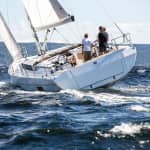
The design was created by Felci Yacht Design - as is usual for Esseboats. The hull is manufactured in a modern sandwich construction using the vacuum infusion process, which promises high rigidity at a comparatively low weight. With a length of 8.90 metres, the Esse 890 only weighs around 1600 kilograms when fully equipped, 780 kilograms (49 percent) of which is ballast on the T-keel with lead bomb. Like all of the shipyard's boats, the new 890 has a slim design line: the high aspect ratio of 3.6 is well above average. Thanks to a width of just under 2.50 metres, the Esse 890 should be easy to transport on a road trailer.
Simple yet fast and sporty
With around 50 square metres of sail area on the wind and an 85 square metre gennaker, the Esse 890 promises sporty sailing characteristics. The standard equipment concept includes a carbon fibre rig with self-tacking jib and a lifting keel that can be raised hydraulically by 40 centimetres for transport and, if necessary, in port. For the gennaker or code zero, an approximately 1.50 metre long carbon fibre gennaker pole can be extended from the side of the hull.
The keel is optionally available with a draught of 2.10 metres (standard) or in a short version with a draught of 1.90 metres. The further developed hull, the finely tuned rig and a clearly structured cockpit layout should enable effortless handling - even with a small crew or in single-handed operation.
Further links on the topic
Three variants, three prices
Below deck, Esseboats relies on a modular expansion concept. Depending on its use, the Esse 890 can be configured as a purist daysailer, a sporty racer or as a weekender with simple overnight accommodation. The boat is therefore aimed at sailors who are looking for performance without sacrificing flexibility. What certainly catches the eye is the lounge above the keel box, which is arranged asymmetrically and thus leaves the passage to the bunk in the foredeck free.
The Esse 890 will be available in three versions. In the simple version as a daysailer, the boat comes ready to sail with a self-tacking jib, mainsail and gennaker as well as a simple extension below deck. The boat is also provided with an antifouling coating straight from the shipyard. The basic price is 145,000 euros (net) or 172,550 euros gross including 19% VAT. In the Racer version, the shipyard equips the boat with a complete set of high-quality laminate sails, including a short overlapping genoa with line-adjustable centreboards on the cabin superstructure. The prices for this performance boat are 150,000 euros (net) or 178,500 euros (gross). In the weekender version, the new Esse has a more attractive and high-quality interior below deck and also has hull windows for more light and transparency below deck. This touring version costs 155,000 euros (net) or 184,450 euros (gross).
Technical data Esse 890
- Designer: Felci Yacht Design
- Hull length: 8.90 m
- Waterline length: 8.30 m
- Width: 2.48 m
- Draught with lifting keel (standard): 1,70 - 2,10 m
- Draught with lifting keel (short): 1.50 - 1.90 m
- Weight: 1.6 tonnes
- Ballast/proportion: 780 kg / 49 %
- Sail area downwind: 50.0 m2
- Sail carrying capacity: 6.04
- Gennaker: 85.0 m2
- Motorisation: outboard or shaft motor
Esse - a success story
When the Swiss Josef Schuchter began to think about his own sports boat around 20 years ago, it was hard to imagine such a success story. However, the Esse 850 developed into a benchmark boat in the segment faster than expected: in the very first year, Schuchter himself sailed to numerous regatta successes with build number 1, while demand significantly exceeded expectations. The young shipyard received international attention at the latest when it was honoured as "European Yacht of the Year 2005".
To date, no fewer than 185 units of the Esse 850 have been delivered - a remarkable number for a small Swiss manufacturer. This success formed the basis for the systematic expansion of the model range. Together with long-time design partner Umberto Felci, further models were created: the smaller Esse 750, a carbon fibre boat for ambitious regatta sailors that is consistently designed for performance, and the Esse 850 LE, a somewhat tamed version of the standard Esse 850 class.
At the other end of the scale came the Esse 990, which retained the sporty signature but was designed more as an exclusive daysailer. However, it was slow to take off on the market. With the Esse 330, the concept was finally completely revamped two years ago. Based on the hull of the Esse 990, a boat was created that offers significantly more room for manoeuvre and, for the first time, its concept is clearly moving in the direction of a weekender with a fully-fledged, homely interior.

Michael Good
Editor Test & Technology
