


"Angela IV": Special class yacht combines old virtues with ambitious regatta sport
YACHT-Redaktion
· 22.02.2026


- Almost a new building after restoration
- "You need a firearms licence for this boat"
- Special class "Angela IV" is completely overclocked
- Promotion of German-English regatta sport
- Extreme buildings are being built at top speed
- "Angela IV" is a floating experimental laboratory
- Technical data of the "Angela IV
Text from Anette Bengelsdorf
The clouds hang low over Lake Attersee, their frayed ends touching the water in places, which shimmers turquoise green through the veil of grey. Lined up between the starting boat and the pin end, 13 special classes wait like greyhounds for the starting signal. As soon as the wind takes hold of the sails, the historic racing machines lean to leeward and extend their waterlines by almost double, depending on the rip. The blatant yachts, which were far ahead of their time, celebrated their 125th birthday during the Attersee Week.
Also interesting:
Included: a yacht from Lake Constance, the "Angela IV". Wolfgang Leuthe, a passionate sailor, wanted a sporty, fast boat to complement his family yacht. In 2010, he saw an exciting specimen at Josef Martin's shipyard in Radolfzell. He had bought it in a desolate condition in Austria in 1994. "I didn't know what I was looking at and the lines initially made my family shake their heads," Leuthe recalls. Nevertheless, he made the purchase decision on instinct. Martin actually wanted to keep the racer for himself, but eventually gave in to his friend's insistence.
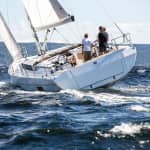
Almost a new building after restoration
The frames and deck beams initially appeared to be intact, but this proved to be a mistake during the course of the restoration. And right at the start of the work, Wolfgang Leuthe began to have serious doubts about the wisdom of the endeavour. The bad news kept piling up. The more paint, dirt and patina were removed, the more obvious the decay became. "What are we actually doing here?" he asked himself more than once.
Once the deck and deck beams had been dismantled, the boatbuilders stripped the old paint from the hull. 150 frames were replaced, while others could be shafted. After sanding, the steel floor cradles were hot-dip galvanised and reinstalled. The keel sole, part of the stem and the stern beam were red. The planks in the underwater area and many of the deck beams could no longer be saved. A new rudder blade and a completely new deck were needed. To summarise, Leuthe says that in the end it was a new build. With copper rivets, a deck that is reminiscent of the historic canvas decks of the time and a decorative galley inlaid with gold leaf, which the designer would also have enjoyed.
But for all the frustration and endless effort, the eccentric had compensation in store: When the white paint on the mirror was peeled off, it revealed its original name: "Angela IV". The yacht of Crown Prince Friedrich Wilhelm of Prussia. The Hamburg designer Max Oertz had designed her in 1907 and built her at his shipyard.
"You need a firearms licence for this boat"
The proud owner can still remember the maiden voyage like it was yesterday. The Untersee lay before him like lead. Not even the poplars wanted to move their leaves, there was not a breath of wind to be seen on the water. Only his special class sailed through the Markelfinger Winkel as if pulled by an invisible thread. Where it got the wind from would remain its secret.
She showed her limits shortly afterwards at her first regatta at the International Lake Constance Week off Constance. The wind in the funnel was gale force. Against the advice of Josef Martin, who did not want to immediately sink the noble piece that he had just painstakingly brought back to life, the two young crew members were keen to set sail. With only a genoa and the main still hoisted, the boat immediately demonstrated the madness of the endeavour in around 7 Beaufort.
While battling with the wind and waves, Wolfgang remembered boiling hot that he hadn't even christened the boat yet. Fortunately, he had champagne on board. Cut plastic bottles - not quite in style, but better than the fizz from the bottle - had to replace the glasses, and the emergency christening of the "Angela IV" was saved. The eccentric then shot into the harbour in Kreuzlingen. A return journey to Constance was not even on the cards. "For this boat," says Leuthe, "you need a firearms licence."
Special class "Angela IV" is completely overclocked
2016 was the last time the dark blue beauty took part in the Atterseewoche. This year's anniversary event to mark the 125th birthday of the special class therefore seemed like a good opportunity for Wolfgang Leuthe to tackle the long journey once again. Eckhard Kaller will be at the tiller for the fourth time. The multi-class sailor and North Sails man is surprised at how the field has changed over the past nine years. Today, the boats are equipped with the best material and the most modern sails and the teams also seem much more professional to him than before. The experienced regatta sailor has never experienced being turned round and "put down" at the start of a special class regatta.
The way to the windward mark is paved with wind fields of ten to twelve knots. This alone causes overload in the genoa. With a sail area of 51 square metres, these constructions quickly reach their limit.
Like all special classes, "Angela IV" is completely over-rigged for her length of 10.30 metres. Although she has a sensational speed in light winds, she becomes quite poisonous when the breeze picks up. As the wind increases, her design waterline lengthens by a full four to five metres. It takes a lot of experience to keep the boat in balance with the help of the sails, says Kaller.
Promotion of German-English regatta sport
What was once conceived over sparkling wine at breakfast and decided a year later, in 1899, over a beer in Travemünde, was to become a success story in regatta sport the following year: The English yachtsman Cecil Quentin and Kaiser Wilhelm II toasted the promotion of German-English regatta sport and that very evening a revolutionary and inexpensive racing yacht - it was not allowed to cost more than 5,100 Reichsmark - was launched.
The commission agreed on the following formula: The sum of the length of the waterline plus the maximum width plus the maximum draught could not exceed 32 English feet, i.e. 9.75 metres. The maximum sail area of 51 square metres was also stipulated in the building regulations for the first time. To prevent the boat from immediately filling up at sea with its low freeboard, the cockpit was kept very small with a maximum length of 2.44 metres and the total weight for transport was set at a minimum of 1,830 kilograms. This meant that for the first time in the history of sailing, it was possible to compete against each other without being penalised. Whoever crossed the finish line first was the winner.
At that time, only amateurs who were members of a European yacht club and did not earn their living with their own labour were allowed to sail. This rule set the gentlemen sailors in club suits apart from a paid crew and thus from "uncouth" boat builders or fishermen. As this first construction class with its limiting dimensions did not fit into any previous measurement and was unique, it was called a special class.
The Kaiser himself, allegedly a miserable regatta sailor, had his own special class built by Max Oertz, which he christened "Samoa". However, the intended Anglo-German races never took place due to his constant sabre-rattling.
Extreme buildings are being built at top speed
As expected, the best designers of the time competed for the fastest crack, fuelled by extreme designs from the USA. As only the design waterline was limited, but not the overall length of the ship, the overhangs became longer and longer over time and doubled the waterline when heeled according to the motto "length runs". By 1910, the speed potential of the special classes was approaching its peak. However, gone were the days when the Baltic Sea could be crossed in a special class. On the other hand, highly specialised extreme boats delivered top speeds.
While the Hamburg designer Max Oertz relied until the end on cracks with round frames and harmonious lines, which proved their worth on the cruise, the American playfulness resulted in shapes that were closer to a barge than a sailing yacht. These scows were as wide at the front as they were at the back. As much as they shone on downwind courses, they had no chance against the Oertz boats on the cross, especially in rough water. During the German-American encounter off Kiel in 1907, the Americans had to learn the hard way with their one-way boats in gusts of 8 Beaufort and a steep, short wave.
"Angela IV" is a floating experimental laboratory
A wide variety of designs can still be seen on the Attersee today. Until 1906, the German special classes were built with a free-standing balancer rudder. The Americans, on the other hand, feared the seaweed in their area and attached the blades directly to the keel fin. The German designers, always orientated towards the Americans, adopted this.
Experimentation continued not only under water, but also above it. The gaffs were made longer and steeper in order to adapt the shape of the sails to the latest findings in aerodynamics. And as early as 1913, "Angela IV" is said to have been fitted with a Marconi rig. The special class was a floating experimental laboratory that drove designers and sailmakers to peak performance.
The boats are not easy to sail. One owner says: "A special class is not a Rolls-Royce in which you glide along comfortably, but a Ferrari with an unsynchronised gearbox."
Technical data of the "Angela IV
- Shipyard: Oertz/Hamburg
- Year of construction: 1907
- Restoration: J. Martin
- Torso length: 10,30 m
- Width: 1,97 m
- Depth: 1,56 m
- Displacement: 1,98 t
- Sail area verm: 51,0 m²
- Sail carrying capacity: 5,7
