


Folding, pivoting, sliding: Which trailerable trimaran offers the best solution?
Cati Erdmann
· 25.10.2026


Corsair folds, Dragonfly and Tricat pivot, Astus slides: the four boatbuilders have adopted different solutions to transform their trimarans from wide sailing boats into narrower harbour or trailer-friendly packages. The models differ significantly in terms of handling, sailing performance and living comfort. The Corsair 760 and the Dragonfly 25 have a distinctly sporty character. The Astus 26.5 and Tricat 8.50 offer more space for short or longer cruises. In terms of interior layout, the spectrum ranges from camping-style functionality to a separate toilet compartment with over 1.80 metres of headroom in the saloon.
Corsair 760: fast and functional


The Corsair 760 is a modern trimaran from Vietnam, whose tried-and-tested centre hull has been combined with new, more voluminous side floats. These have negative rudders, provide plenty of buoyancy and ensure the bow does not dip into the water until quite late, even in strong winds.
In tests in gusty winds with peaks exceeding 20 knots, the Corsair effortlessly surpassed the ten-knot mark. The log recorded a top speed of 14.6 knots. With the mainsail and jib, the boat handled well; under gennaker, it was fast and stable. On a reach, the tacking angle was around 100 degrees. Occasionally, creaking noises could be heard from the bolted beam connections.
To reduce the beam, the side hulls are partially folded under the centre hull using a lever mechanism. To do this, four bolts and the shrouds must be loosened. The boat does not become any longer as a result, but loses stability during harbour manoeuvres when in its narrow configuration. Access to the hatches on the floats is then restricted.
Below deck, the trimaran remains functional. The lifting roof provides approximately 1.90 metres of headroom in the companionway area. A mobile galley, a sliding storage box and a convertible sleeping area are sufficient for short trips, though the living comfort is similar to that of camping.
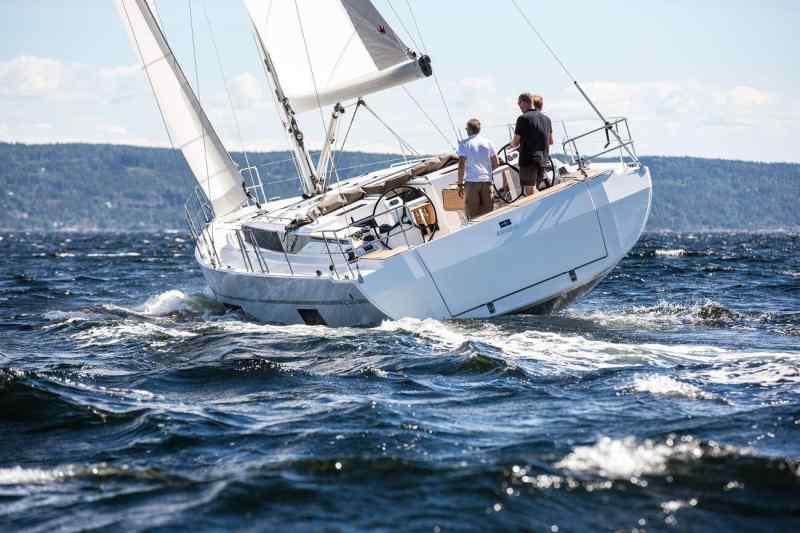
Dragonfly 25: rigidly constructed and finished to a high standard


At the Dragonfly 25 This is where the long experience of the Danish shipyard Quorning Boats really shines through. During testing, the connection between the centre hull, beams and floats remained rigid even under sail. There was no visible flexing, nor were any creaks or squeaks audible. Even in very light winds, the trimaran accelerated with every gust. The log recorded a maximum of 9.9 knots. The Sport version tested featured a carbon mast, a taller rig, 41 square metres of sail area when sailing close-hauled and a twin-rudder system. The more moderate touring version comes with an aluminium mast, a smaller sail area and a central rudder blade.
The tried-and-tested Swing-Wing system swings the side hulls aft. The beam decreases from 5.80 to 2.30 metres, whilst the overall length increases to 8.95 metres. The mechanism can be operated from the cockpit. The rudder and centreboard can be stowed away for shallow waters.
The interior is compact, but with its wooden surfaces, lighting and coloured upholstery, it feels more homely than the Corsair. The seating area can be converted into a 2.00 by 1.38-metre sleeping area. For longer trips, two adults and one child is a realistic crew size. Storage space and galley facilities remain limited.
Astus 26.5: a simple system, a versatile concept


The Astus 26.5 was designed by VPLP Design. The French shipyard’s largest model combines a low weight with ample space for hassle-free family sailing trips. Astus does away with joints and folding mechanisms. The beams consist of staggered aluminium tubes that slide into larger tubes integrated into the central hull. On the water, sheet tension and the winch take over this function. The beam reduces from 5.80 to 3.10 metres. On land, the floats can be pushed up against the central hull to a width of 2.54 metres for road transport. The system worked in the Review of the Astus 26.5 Simple and reliable, but it does require extra work. Before moving the trampolines, they must be loosened and then retensioned.
In winds of eight to twelve knots, the trimaran reached speeds of more than eight knots under gennaker. Close-hauled, speeds of just under six knots were possible; with the overlapping genoa, the turning angle could hardly be reduced below 110 degrees. Nevertheless, the boat handled tacks easily and swiftly. Criticisms were levelled at the short tiller, the high rudder pressure and the somewhat cramped seating position behind the beams.
Up to four people can sleep on board. Two optional galley units accommodate a hob and sink, whilst a portable chemical toilet fits under the forward berth. The interior fit-out is simple and functional. With the centreboard and rudder raised, the draught is reduced to 35 centimetres.
Tricat 8.50: plenty of sail area and more living space


The Tricat 8.50 It is the largest boat in this comparison. Its side hulls pivot aft via hinges. A cable system assists with manoeuvring. This allows the width to be reduced from 6.50 to 2.95 metres. With 52 square metres of sail area when sailing close-hauled and a weight of 1.95 tonnes, the French trimaran is designed to be performance-oriented.
Below deck, the Tricat offers more than its smaller competitors. Up to five berths, a split galley, a separate toilet compartment and more than 1.80 metres of headroom in the saloon are designed with longer cruises in mind. The companionway steps can also serve as a seat at the navigation table or as an armchair at the saloon table.
The centreboards and rudder blade can be stowed away. This reduces the draught to 45 centimetres. With the side hulls stowed in, the boat fits into many standard harbour berths. Road transport is also provided for, but due to the boat’s weight, it requires a suitable towing vehicle and a trailer designed for the load.
Which trimaran is best suited to which sail profile?
- The Corsair 760 is designed for sailors looking for high speed, low weight and a functional layout.
- The Dragonfly 25 combines sporting performance with high-quality workmanship and a sophisticated swivel system.
- The Astus 26.5 offers the simplest system for reducing the beam and provides great value for short family sailing trips.
- The Tricat 8.50 has the largest interior and the largest sail area, but it is also the heaviest and most expensive boat in the comparison.
Book recommendations
Sail and rig trim explains how to set the headsail, mainsail, spinnaker, gennaker and rig. This is particularly relevant for light trimarans, whose speed depends heavily on correct trim. More than 150 colour illustrations make the aerodynamic principles and the most important manoeuvres easy to understand.
A Practical Guide to Cruising is aimed at beginners and experienced sailors who wish to prepare for cruises on small or large boats. The book covers boat types, equipment, choosing a sailing area, the weather and safe boat handling. It thus complements the comparison by addressing the practical questions that should be clarified before purchasing a trailerable cruising boat.
Folding, pivoting or sliding: which trimaran design appeals to you most? Join the discussion.

Cati Erdmann
Content Producerin Digital