


The range on offer is not extensive. Small, trailerable yet habitable trimarans form a relatively small niche market shared by just a few manufacturers. Among the established suppliers are Corsair Marine, Dragonfly, Tricat and Astus Boats. They are benefiting from growing demand, as these manoeuvrable trimarans combine good sailing performance and plenty of fun with great flexibility. At the same time, they are suitable for short trips and even family cruises: a cross between a sports boat and a small cruiser on three hulls.
Whilst competitors such as Dragonfly are also applying the trimaran concept to larger vessels, the French brand Astus Boats has, since its inception in 2004, focused exclusively on smaller and compact models with hull lengths ranging from four to just under eight metres. The new Astus 26.5 now marks the top end of the range offered by the Breton trimaran specialists.
From 5.80 to 2.54 metres in width
A key feature of small three-hulled boats is the ability to reduce their beam. Astus employs a principle that is as simple as it is characteristic of the brand: the beams consist of staggered aluminium tubes fitted into larger-diameter sleeves integrated into the centre hull. On land, the floats are pushed parallel and close to the centre hull; on the water, they are retracted using a sheet and a winch. This allows the width of the Astus 26.5 to be reduced from 5.80 to 3.10 metres in the harbour and to 2.54 metres for road transport. In testing, this system proved simple and reliable.
This simple and cost-effective solution sets Astus apart from the competition. On the Corsair, the floats are folded in, whilst on the Dragonfly and Tricat they are swivelled backwards via hinges. These solutions are more convenient, but require complex hinges, sturdy joints and reinforced hull structures. The disadvantage of the Astus concept is that the trampolines must be loosened before moving the boat and retightened afterwards. For those who regularly adjust the width, this involves more effort than with the competitors’ folding systems.
The Astus 26.5 was designed by the renowned firm VPLP Design. Compared to the smaller Astus 22.5 Both the central hull and the two floats have been made even more voluminous. At the same time, the underwater sections of the hulls have been designed to be flatter. The rudder blade is housed in a cassette mounted on the outside of the stern and can be retracted. A carbon-fibre-reinforced swivel centreboard in the central hull counteracts drift. Its offset box is integrated into the base of the saloon bench; this keeps the interior free of intrusive fittings. With the centreboard fully lowered, the draught is a maximum of 1.80 metres; when raised, it is just 35 centimetres. This allows the Astus 26.5 to be sailed right up to the beach and makes it easier to slip onto the trailer.
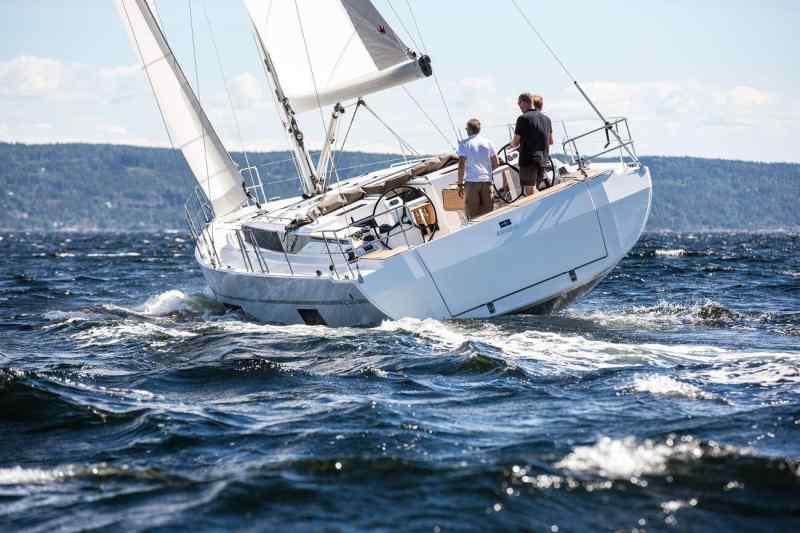
Agile through the turn, with plenty of pressure on the tiller
The test conditions off La Trinité-sur-Mer in Brittany are fairly mild, with winds of between eight and a maximum of twelve knots. Nevertheless, the Astus 26.5 is able to demonstrate its full speed potential. With Gennaker On a half-wind course, the trimaran accelerates to a speed of more than eight knots.
Tacking is not one of the strong points of small multihull boats. Even on the Astus 26.5, it is difficult to get the tacking angle below 110 degrees with the genoa just slightly overlapping. Close to the wind, the boat reaches speeds of just under six knots. The trimaran moves lightly and nimbly and comes through the tacks swiftly, even without holding the headsail back. This is where the advantages of the new hull shapes are clearly evident. However, a relatively high amount of rudder pressure builds up on the very short tiller. This becomes uncomfortable when sailing close-hauled over time and also reduces steering feel; a slightly longer tiller would be advisable. Furthermore, the helmsman is somewhat cramped behind the aluminium tubes of the beams. On the other hand, the sheet winches are easily accessible from his position. And the halyards or genoa sheets could also be routed onto the winches using additional blocks.
Four berths for short family sailing trips
Below deck, there is enough space for short, hassle-free family sailing trips. Up to four people can sleep on board. Two galley units with a small hob and sink are also available as an option, just as on the test boat. And a portable chemical toilet fits under the forward berth. This measures 1.36 metres across the shoulders and offers just enough space for two people. The saloon sofas also serve as sleeping areas. Ingenious extensions increase their sleeping width from 54 to 64 centimetres. The interior fit-out is generally simple, functional and unpretentious.
Just under 100,000 euros is still not enough to cover all the sails
The base price for the Astus 26.5, including the standard sails, is just under 100,000 euros. Of course, this does not mean the boat is fully equipped. For gennakers or Code Zero surcharges apply. Without these additional sails, the sporting potential of the trimaran design can only be utilised to a limited extent. Seen in this light, they are an integral part of the design. A suitable road trailer is also almost essential for a boat of this calibre.
- Base price ex-shipyard: €98,075
- Price, ready to sail: €105,140
- Warranty/against osmosis: 2/2 years
For information on how the prices shown are defined as at 2026, please see here.
Nevertheless, given its unique design, variable width and versatility, the price seems reasonable. The Astus 26.5 combines impressive sailing performance, trailerability and suitability for cruising into a well-rounded package. Not every detail is outstanding, but this compact trimaran really doesn’t put a foot wrong.
Read more at YACHT: In the Review of the smaller Astus 22.5 The concept had to prove itself in significantly stronger winds and higher waves.
YACHT review of the Astus 26.5
A sporty, towable small cruiser with three hulls and a well-thought-out width design. It sails well and is good value for money.
Design and Concept
Wide range of applications
Suitable for trailers and easy to manoeuvre
Sailing performance and trim
Can be operated with one hand
A lot of oar pressure when sailing close to the wind
Housing and build quality
Simple, functional design
Kitchen units are optional only
Equipment and Technology
Simple slide-in system
Tiller too short
The Astus 26.5 in detail

Technical specifications of the Astus 26.5
- CE design category: A
- Fuselage length: 7.90 m
- Total length: 8.90 m
- Waterline length: 7.90 m
- Width: 5.80 m
- Width at the harbour: 3.10 m
- Width on trailer: 2.54 m
- Draughts (centreboard): 0.35–1.80 m
- Mast height above water level: 11.30 m
- Theoretical fuselage speed: 5.3 knots
- Weight: 1.2 t
- Mainsail: 24.0/27.0 m²
- Genoa: 11.0/13.0 m²
- Code Zero: 26.0 m²
- Gennaker: 35.0 m²
- Engine/outboard motor: 6 PS
Hull and deck construction
The central hull and side floats are constructed from GRP using the vacuum infusion process with a foam core. The beams consist of aluminium tubes.
Rig and sails
Aluminium rig from Seldén with conventional Diamond rigging. A mast-lowering mechanism is in the pipeline. A set of basic Dacron sails (a fully-battened mainsail and genoa) is included, whilst a gennaker or a furling Code Zero is available as an option.
Motorisation
The optional propulsion unit is attached to the stern and folds up whilst under sail. Options include a petrol outboard motor or an electric motor.
Shipyard
Astusboats, F-56400 Brech; www.astusboats.com
Sales
Sport Mohr e. K., 23858 Reinfeld; www.sportmohr.de
Book recommendation
Catamaran sailing By Tom and Brian Phipps, this book expands on the topic of competitive multihull boats by covering the basics and techniques of sailing on two hulls. It explains manoeuvres, gennaker use and sail trim, as well as steering from the trapeze. Numerous photographs illustrate the procedures. The focus is explicitly on catamarans, not trimarans. Anyone wishing to deepen their knowledge of catamaran sailing will find a guide here, available as an e-book.
ADVERTISEMENT

Astus 26.5 offers cover from 860.33 euros a year* – third-party liability and comprehensive cover. Lots of options available: simply include your boat trailer in the cover. Get a quote and take out a policy online: yachting24.de
* Offer from Yachting24 valid for a sum insured of 98,000 euros (at current market value), an excess of 700 euros, and third-party liability cover of 8 million euros.
Is the Astus 26.5’s simple sliding system the smarter solution, or does the extra comfort justify more complex folding systems? Join the discussion and share your views in the comments.

Michael Good
Editor Test & Technology