


Adventure: 4,000 kilometres across the USA - the journey of the "Centennial Republic" in 1876
Christian Tiedt
· 29.03.2026


- A milestone birthday as an occasion
- Adventurer since a young age
- The "Centennial Republic"
- Start in Pittsburgh, Pennsylvania
- Lonely farewell
- Trapped in the pack ice
- The first camp for the night
- On the wintry Ohio River
- More traffic on the river
- Axe and Colt always to hand
- Sauerkraut and roast pork
The solitude was complete, apart from the seagulls circling high above him, while the setting sun in the west sent its last golden rays across the calm sea. On the shore of Bradford Island, an uninhabited marshy island off the mouth of the Suwannee River into the Gulf of Mexico, Nathaniel Holmes Bishop made himself comfortable in the cockpit of his "Centennial Republic" for the last time. Small waves gurgled under the curved wooden hull.
A milestone birthday as an occasion
"The great forests behind the marshes were slowly lost in darkness as the day waned," he later wrote about this March evening in 1876 on the Florida coast. "Centennial Republic" means "one hundred year republic" - an allusion to the imminent first great anniversary of the United States.
A proud name for a boat that was not even four metres long. And yet appropriate in view of what it had accomplished: four months had passed since Bishop had pushed off from an icy pier in Pittsburgh far to the north and steered out onto the wintry Monongahela River. His course: downstream. The destination: more than 4,000 kilometres away.
Also interesting:
- Adventure: Big Loop - The original loop of the USA
- Adventure: Research - Sailing like the Vikings
- Adventure: Single-handed with the Opti around Lake Constance
Adventurer since a young age
For the then 38-year-old Bishop from Medford in Massachusetts, however, it was far from his first adventure: At the age of 17, he had already crossed South America on foot and written a book about it, and later North America, also using muscle power, in a lightweight canoe covered with glued paper.
But for his greatest endeavour, which was to take him down the most important waterway on the continent, across the Ohio, the mighty Mississippi and on across the open Gulf of Mexico to Florida, his beloved "paper canoe" would have been neither comfortable nor seaworthy enough. It had to be something bigger.
The "Centennial Republic"
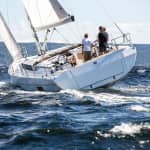
However, Bishop's understanding of size was extremely relative, as demonstrated by his choice of a Barnegat Sneak Box after an extensive search. The type had been developed in New Jersey for duck hunting in the shallow, brackish marshes along the Atlantic coast. A manageable twelve feet long and four feet wide, covered all round except for a cockpit protected by a sprayhood and all-round coaming, it was not only extremely stable and light, but also offered space for one person to sleep, supplies, a shotgun, blankets and cooking utensils. By the standards of the frugal adventurer, she was therefore almost perfectly suited for epic expeditions.
The price for the sneak box: 75 dollars - anchor, rudder and rig included. For this sum, Bishop had purchased a boat with a spoon-shaped hull from "Honest George" Bogart in Manahawkin, with a centreboard instead of a keel, which "moved over the water rather than through it" - almost like a skiff. The fast spritsail was particularly impressive in aft winds. At all other times, the boat was at least rowed - or the current did the day's work. The shallow draught of just one foot was important for this at night, when it was necessary to land on the shore.
Start in Pittsburgh, Pennsylvania
On 2 December 1875, the journey of the "Centennial Republic" began in Pittsburgh, Pennsylvania. The city itself was a symbol of a country in upheaval on the eve of its centenary. The scars of the Civil War and the labours of Reconstruction, the rebuilding of the defeated southern states of the former Confederacy to the specifications of the victorious North, were still fresh in the national memory.
But here, amidst the smoking chimneys and the hammering of the blast furnaces, between soot and dirt, the Gilded Age was already taking shape - the Gilded Age of the USA. The seemingly unlimited industrial power of coal, steel and oil gave rise to a titan, and Pittsburgh was one of its birthplaces.
Lonely farewell
Symbolic of sprinting progress, the boat and crew arrived at the starting point by railway. Although the afternoon had already begun and only a few hazy hours of daylight remained, Bishop decided to escape the crude industrial juggernaut as quickly as possible.
"Without even a friend to see me off," he launched his tiny vessel at the waterfront and navigated between huge paddle steamers and barges out onto the muddy Monongahela, one of the two headwaters of the Ohio, which join just below Pittsburgh.
Trapped in the pack ice
After just a few minutes, Bishop arrived at the confluence and was surprised to realise that the Allegheny River coming from the north was carrying so much floating ice that the sneak box was soon trapped in a dangerous labyrinth that was constantly changing and stretching from bank to bank. He saw no reason to panic - at least in his later book "Four Months in a Sneak Box": "A canoe would have been crushed by the ice. But the boat, with its elastic white cypress planking, found it easy to fend off this attack."
Bishop worked his way through the pack, avoided dangerous eddies and finally got back into clearer water. By the time dusk fell, he had covered 35 kilometres. He slid the bow onto a deserted shingle beach, pulled the boat ashore and secured it with pegs in case the current suddenly rose.
The first camp for the night
He turned the cockpit into a bunk with a thick cotton blanket underneath and used his travelling bag as a pillow. He ate bread with butter and Shaker's Peach Sauce (a fruit jelly), plus a "generous slice of Wilson's dried beef". He then wrapped himself in two blankets while still lying down and closed the cockpit - he called it his "flat" - with a cover over him as a roof. The crunching of the ice floes and the call of an owl accompanied him to sleep.
On the third day, the skiff passed the northernmost bridge on the Ohio at Steubenville, built by the Pittsburgh, Cincinnati, Chicago and St. Louis Railroad Company. The development of the continent by railway was still in full swing; the first connection between the Atlantic and Pacific coasts had only been completed six years earlier.
On the wintry Ohio River
On the shore, things became industrial again, the barren forests gave way to brick walls, the machine houses and factory buildings of Wheeling, West Virginia. Above them hung "a dense cloud of smoke, lit up again and again by the flames shooting up from the chimneys of the steelworks, glassworks and factories". The scenery reminded Bishop, who is well-read in the classics, of Dante's Inferno.
The "Centennial Republic" had travelled about 150 kilometres. The drifting ice disappeared. Instead, the Ohio now shimmered in all the colours of the rainbow: The region was rich in near-surface crude oil, which was already being extracted at great profit.
More traffic on the river
The pulse on the river now also increased and the traffic became heavier. Above all, it was the sternwheelers "with their huge paddle wheels at the stern, which were specially designed for shallow rivers" that whipped up the water and whose steam whistles announced them from afar, despite the often confusing twists and turns of the river.
"Against the current, they pushed two, four or six coal barges in pairs in front of them," wrote Bishop admiringly. "How they managed to steer such cumbersome convoys through the treacherous currents remained a mystery to me."
Axe and Colt always to hand
On both sides, the gently undulating land was now increasingly cultivated, even if the bare fields were in hibernation. Nevertheless, life on the river increased, but not to the delight of the lonely adventurer: "The Ohio and Mississippi are the highway to the West for a whole host of vagabonds," he wrote: "Tramps, tough guys and crooks of all kinds."
Then there were the shanty boatmen, mostly groups of men who lived on carpentered houseboats, but also taciturn loners. Even this part of the country still had a wild streak. When Bishop retired to his own wooden "flat" for the night's rest, he did so in hidden places, not without "hatchet and Colt ready to hand at my side".
Sauerkraut and roast pork
The snowfall increased and often blew across the river in such thick veils that Bishop eventually had to seek shelter within real four walls. In Cincinnati, Ohio, for example, in the house of a German emigrant. He was suspicious, although he was assured of payment: "Dat's vat dey all says." He had had bad experiences with bartending at "de Merican beeble". They agreed to pay in advance, and the frozen man not only got a warm bed, but also sauerkraut and roast pork. It was 17 December. He had travelled 750 kilometres to get here.
But the journey continued. In Louisville, Bishop overcame the rapids of the Ohio, the only obstacle to continuous navigation, but not on the short canal dug parallel into the rock, but on a horse-drawn wagon over land.
Part 2 of the Centennial Republic's journey will follow soon.

Christian Tiedt
Editor Travel
