


Congratulations, Schaalsee: 25 years of Unesco biosphere reserve! That needs to be celebrated. To be honest, I've been doing it for a few years now. Every summer, actually. Sailing with my dinghy, a C55 from Pelle Petterson. It is located in the former western part of Lake Schaalsee on the Schleswig-Holstein side.
For a long time, I thought that only residents with lakeside properties were allowed to set sail here with special authorisation, or rather, to set sail into the lake. The Happy Few. But that's not true. Sailing is generally permitted on Lake Schaalsee, but water sports are subject to strict conditions, compliance with which is also monitored. The number of boats is limited and only registered boats may be used; all others are issued with a day licence. This serves to protect the sensitive flora and fauna.
Directly on the inner-German border
The Schaalsee is a 24 square kilometre lake on the border between Schleswig-Holstein and Mecklenburg-Western Pomerania and part of the Unesco Schaalsee Biosphere Reserve. As a former border water in the border zone, it is known for its valuable, unspoilt nature, especially as a European bird sanctuary, which is why the use of the water is regulated. But in a different way, nowhere near as strictly as in the past, when boats of the GDR border troops still patrolled the water to prevent escape attempts.
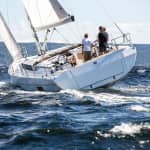
During the period of German division, the inner-German border ran right through the middle of the lake. The shore area on the eastern side was a restricted zone: only residents with special authorisation or border guards were allowed to stay there. For anyone not in uniform, this meant that access, bathing and everything else was forbidden, and tourist or private use was virtually impossible.
Also interesting:
- Germany: Countdown in Lusatia
- France: On the inland route to the Mediterranean
- Germany: Sailing on the Chiemsee
As lonely as in Canada
Fortunately, this episode is long gone. What remains is the largely unspoilt nature around the lake, which gave the area a special ecological value after reunification. Spoiler: The unspoilt shore often makes you feel like you're somewhere in Canada, or at least in Scandinavia. Especially when the white-tailed eagle circles overhead and looks to see if the black clouds of cormorants will leave anything for it. The eagle and the anglers in their rowing or electric boats on the lake have that in common.
My dinghy is moored on a small, cosy jetty with around 30 boats. Just entering the facility is a joy every time. The entrance gate could read: "When I see the lake, I no longer need the sea." The local recreation begins within the first few metres, with a view of the crystal-clear water, which is even said to be of drinking water quality. And it's lonely. Even on a Sunday in August, you might only spot three or four sails on the lake, even in glorious weather. Maximum! If there are five or six boats in the picture at the same time, then it is already "full".
Setting course for Cape Horn
I've only experienced that once in five or six years. I'm often travelling alone with friends or a dog. It feels pretty exclusive. Cast off, paddle out, along the reeds, quickly to the buoy in front and sail up. Head for Cape Horn, as it is called here, which is an exaggeration. A forested headland as a bearing, where it is sometimes a little windier. Sometimes the gusts chop over the treetops and into the sails from above, so you'd be well advised to keep the mainsheet in your hand.
A friend recently caught it. Zack! Capsized and got stuck with the mast in the bottom. But if you have to go swimming somewhere, it's here. And, as already mentioned, swallowing water is no problem here either.
Break at Gut Groß Zecher
Behind Cape Horn, the sea opens up and the breeze becomes steadier. And you rush along with half the wind. Head for Seedorf, for example, to the inn or on to the coachman's barn in Groß Zecher. Course cake or wild boar burgers. The bulge is called Küchensee. A tourist hotspot on the Schaalsee. It's a bit busier here because you can hire canoes.
Incidentally, the owner of the Groß Zecher estate owns the largest part of the lake. In addition to the bathing jetty for house guests, there is also a guest jetty. The estate advertises with the slogan: "A natural paradise, homemade specialities, homemade cakes, freshly made beds. Gut Groß Zecher is made for a good time. Just join us."
I usually make a U-turn and circle the Rethwiese, an island in the middle of the Schaalsee. Quite inaccessible. It should stay that way. The rule for all islands in the Schaalsee is: no trespassing. It's easy to imagine that there are still some undiscovered endemic species living here. Or a former GDR border guard who missed reunification. In any case, it would be easy to come up with a counterpart to Nessie, the Loch Ness monster, for the island if you wanted to boost tourism. But that's exactly what they don't want. The power of Lake Schaal lies in its tranquillity and the absence of hype.
What is allowed - and what is not
If it were only up to the conservationists, people and especially water sports enthusiasts would not even exist. But they don't: a special feature of the Schaalsee is that the former border waters are privately owned and divided between five parties, who allow boating and fishing. For a fee, of course. And under certain conditions.
You need a licence for electric motors, but this is limited and correspondingly sought-after. As a sailor, you can easily do without a licence. A paddle is enough for the last few metres. However, I also like to pull the boat into the box by swimming. You just have to make sure that you're back near the jetty before sunset, before the wind and thermals run out of steam. Anything else is not permitted anyway. Staying overnight on the water, for example.
Anchoring during the day is fine if you don't anchor too close to the reed fringe. Keep your distance. The prescribed distance is 50 metres. The same applies when tacking or jibing. Birds have right of way - and priority, so to speak. That's why catamarans, surfers and kiters are completely prohibited from travelling on the lake. I assume this is so that the fish and frogs don't have a heart attack and the ducks can escape in time.
Encounters with nature
To be honest, I can understand that. Strength lies in rest. And relaxation. The water spreads out in such an elegiac, even sublime way that anything travelling faster than seven or eight knots would seem like a foreign body. Any form of haste would be a breach of style for the whole atmosphere, which is why I have never taken part in the annual Whitsun regatta.
The best moments are when you sail along the edge of the reeds with a gentle breeze and whispering stern water and a grass snake crosses the wake. Or, as I did the other day, when it swam exhausted behind me and tried to grab hold of the tiller, which it managed to do. At first I thought it was wriggling on board, which was irritating despite its non-toxic nature.
When there is little wind, you can hear the twittering of birds from the treetops and the bells of Seedorf church in the distance. Sailing becomes a meditation. It couldn't get much more divine for me.
The long way to Zarrentin
There is a popular saying that is more valid than ever in times of climate crisis: "Why wander far away when the good is so close?" When it comes to the Schaalsee, however, the distance has long been a thing of the past. One of my first trips took me to the former east, to Zarrentin. In the very south of the lake. Pretty much the longest possible passage from the dinghy's mooring.
The sailing up to that point was fantastic, the arrival unfortunately less so. First of all, we were reprimanded by the fish sandwich man for simply mooring at his jetty, which spoilt our appetite due to the tone of voice. Then a park ranger came and pointed out to my friend and me - in a somewhat friendlier manner - that a different permit was required in the Zarrentin part of the lake.
That was twenty years after reunification, mind you. Two reprimands in the first few metres, as if we had crossed over illegally. A little frustrated, we cast off again straight away without any bread rolls or shore leave. The end of the story and the good news: the problem has now been resolved. It's possible that the fish stall owner's bad mood has remained. He will get a second chance. In any case, a single badge has recently been enough to sail the entire lake. At least in those places that are designated for this purpose and are not protected all year round or marked as a restricted water zone.
Navigating with the eye
Speaking of markings: There is no such thing as sea marks or nautical charts. Improvised at best. Shoals have to be recognised or known intuitively, so to speak. In some places, the end of a stick sticks out of the water. Hard to recognise even with a little wind and a light swell. Fortunately, the lake is very clear. In good weather, you can recognise the places where it becomes shallower by the colour of the water.
Or it's best to ask someone on site before launching your boat and day licence into the water. However, nothing can go wrong in the middle of the lake, the deepest point is 72 metres. And the satellite image from Google Maps helps for rough orientation. You should avoid the lighter coloured areas. So far, I've avoided running aground - which I'm happy to keep with my lifting keel.
A feeling of freedom
Let me summarise: Sailing on the Schaalsee is not a sport - it's an invitation to pause for a moment. An invitation to slow down, to be humble in the face of nature. Those who sail here become quieter. Observe more. Think less about speed or course. In the evening, you return to the jetty. The sun slowly sinks behind the trees, the wind dies down, the water surface calms down and becomes a mirror. A piece of German-German history. Today, a day on the Schaalsee feels like one thing above all else: Freedom.

Jan Jepsen
Freier Autor
