


Dear readers,
Imagine sailing alone across the Atlantic in a boat you built yourself. This boat measures just 5.80 metres and is made of plywood. Last week, when I went to the Transatlantic race of the Class Globe 5.80 I found it really difficult to understand.
Sure, space on a boat is limited - that's normal. But 5.80 metres? That's the length of a 4-person canoe, a luxury saloon or two and a half times the length of an Optimist. I think that's very little space to live, sleep and eat alone on for 30 days while travelling over 3,000 nautical miles - in conditions with metre-high waves and winds in excess of 25 knots, of course.
What is even more remarkable is that all the boats in the Globe 5.80 class are self-built. I wouldn't claim to have two left hands, but I wouldn't trust myself to build an entire boat from scratch. From the solid wood frame and plywood side planking to laminating, painting and moulding the lead keel bomb - everything is done by myself. What craftsmanship is required for this.
According to the father of the boat class, round-the-world sailor and adventurer Don McIntyre, it doesn't take that much. "Anyone can do it," he told me in conversation. A little experience and simple tools would be enough. Hard to believe, I think. But is that even safe? I would be worried that every cut, every incorrectly drilled hole would jeopardise the safety of the boat.
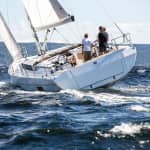
Here too, McIntyre took away my worries. To ensure that the construction would be forgiving of such construction errors, it was planned with a safety factor of four. This means that the wall thicknesses, frames and connections are four times as stable as would be required for an ocean-going cruiser. "It's like a survival capsule that travels 100, 120 nautical miles a day," says McIntyre - and he should know, as he took part in the first of three Globe 5.80 Transat races in 2021.
However, I was still not completely convinced. But when it came to the costs, I finally gave up my inner resistance. The seaworthy minis are said to cost between 35,000 and 50,000 euros ready to sail. The DIY concept and the lack of high-tech on board make the comparatively low costs for an offshore racer possible.
A safe, seaworthy boat that you can build yourself and that can be financed without sponsors or a large budget? It sounds too good to be true. But the Globe 5.80 Transat shows that this concept actually works. A total of twelve sailors are on their way to the Caribbean with their Minis.
The German Christian Sauer is also taking part. Shortly before his departure from Lanzarote, he gave me a Insight into the fascination of mini self-assembly. He spent three and a half years tinkering with his "Argo", and it was only finished a few days before the launch. The boat was barely in the water, he sailed 550 nautical miles from Lagos in Portugal to Lanzarote - a leg that not only served as a qualification for the Transat race, but was also the boat's baptism of fire, which it successfully mastered.
That impressed me and I realised how my initial doubts gradually turned into admiration. What Christian Sauer and the other sailors have achieved with their self-build and the ocean crossing requires courage and perseverance.
Yes, the boat remains small, but it is ultimately designed for single-handed sailing. So the small size brings certain advantages in terms of control and handling. And can you get to know your boat better than when you have held every screw and every piece of wood in your own hands? I don't think so.
I am now certain that instead of restrictions and safety concerns, the Globe 5.80 concept primarily harbours potential. After all, it opens up the field of offshore sailing to a new target group that wants to sail the world's oceans in racing mode without large budgets and sponsors.
It speaks to a type of person who is full of courage and confidence; who dares to do something and tests boundaries. That's how I would describe the fleet sailing across the Atlantic just north of Cape Verde. And isn't it precisely these qualities that should be emphasised more often outside of sailing?
How perspectives change when you deal with a topic more intensively.
Have a nice weekend and stay curious!
Fabian Boerger
YACHT editor
P.S.: We will continue to follow the Globe 5.80 fleet on its journey across the Atlantic in the coming weeks and report on yacht.de!
Click on it to see through:
The week in pictures


Recommended reading from the editorial team

Vendée Globe
The race in the live tracker

The live tracker of the Vendée Globe 2024/25: This tracking shows the race of the tenth edition of the round-the-world regatta - with Boris Herrmann!
New podcast episode
How do you prepare for sailing in heavy weather?

What does it feel like when the wind and waves take over? In the 63rd episode of YACHT - the sailing podcast, Kirsten Harmstorf-Schoenwitz is our guest.
Freenauticalchart.net
Categorisation of the BSH provides clarity about the underlying data

BSH department head Thomas Dehling in an interview with YACHT: The BSH's freely available open data nautical charts are not intended for navigation. Even navigation marks are not guaranteed to be up-to-date.
Globe40
Thriller finale in the top duel, Burke and Fink on the verge of a comeback

The long-running duel between "Crédit Mutuel" and "Nascafé Curium" is also coming to a head on Globe40 stage five. Team Germany has already reached Recife.
CNB 68
Line maintenance with more cabins

The CNB 68 replaces the CNB 66, with designer Philippe Briand stretching the design and designer Jean-Marc Piaton making the interior lighter and more contemporary.
Ghost ships
Two scares off the coast of California

A US warship, two unexplained encounters, no radar echo: The "USS Kennison" encountered ghost ships off the Californian coast twice during the Second World War - and the logbook entries leave no doubt about the crew's reports to this day.
Dehler burns in boat hall
Millions in damage prevented at the last second

A Dehler Optima 101 catches fire in a boat shed in Grünendeich on Monday afternoon. Passers-by and employees prevent millions in damage.
Poeler Kogge
Future of the "Wissemara" uncertain due to pest infestation

The Poel cog Wissemara is no longer allowed to set sail for the time being. Experts have discovered a massive infestation of pests. Restoration could cost up to five million euros.
Sold out
Silverrudder 2026 - too high rush, server goes on strike

The Silverrudder, the legendary single-handed race around Funen, has lost none of its fascination in 2026. All 450 starting places are taken. They were so popular that the server went down. The organiser vows to do better.
Emergency on land
Man burns neighbour's sailing boat at campfire

A 66-year-old man just wanted to burn some wood in his garden. He then left the fire unattended. The flames made their way across a dry meadow directly to the neighbouring property. An older sailing boat and a van were parked there. Both were burnt. The total damage amounts to around 9,000 euros.
"Spatz IV"
20-metre dinghy cruiser is not a racing boat and therefore exotic

More freeboard, more superstructure, more weight, more touring capability: the old wooden 20-metre dinghy cruiser "Spatz IV" is an exception in its class.
Newsletter: YACHT-Woche
Der Yacht Newsletter fasst die wichtigsten Themen der Woche zusammen, alle Top-Themen kompakt und direkt in deiner Mail-Box. Einfach anmelden:
