


100 years at the gateway to the world: Cuxhaven Sailing Association celebrates with a large flotilla
Ursula Meer
· 28.05.2026


The Cuxhaven Sailing Association is celebrating its 100th anniversary with a three-day festival from 29 to 31 May. The highlight is a spectacular flotilla parade on the Elbe at 1 p.m. on Saturday: 52 boats will be flagged across the Toppen and sail against the tide for two kilometres to the marina - a maritime spectacle that can be watched from the Alte Liebe. What began in 1926 with 15 enthusiastic sailors is now Germany's gateway to the world for anyone who has more in mind than Sunday sailing.
52 boats in formation in front of Alte Liebe
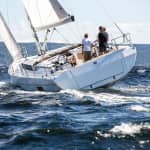
On Saturday lunchtime, there will be a sight that is rarely seen in Cuxhaven: 52 boats, all flagged over the tops, will form a two-kilometre flotilla in Amerika Harbour and then sail slowly against the tide back to the marina. The parade starts at 1 p.m. and can be perfectly observed from the Alte Liebe - a spectacle not only for club members, but for all Cuxhaven residents and guests who appreciate maritime tradition.
After the parade, when all 52 boats have moored again, the model boat regatta starts in the harbour basin at 3 pm. A tugboat gives the starting signal with a powerful foghorn, and then the small boats set course for the clubhouse - which is also easy to watch from the shore, where spectators can stand close together. The model boat group, which has been active in the club since the 1950s, shows that sailing can also be great fun on a small scale.
Home harbour of the legends
The list of those who set off on great voyages from Cuxhaven or felt solid ground under their feet again here after a long time at sea reads like a Who's Who of German sailing history. In 1927, Captain Carl Kircheiß arrived in Cuxhaven with his ten-metre-long cutter "Hamburg" after 30,000 nautical miles and two years at sea - the first circumnavigation of the world by a German after the First World War. He had passed Cape Horn, sailed through typhoons and moored in South Sea harbours that were not marked on any nautical charts. In 1931, Ludwig Schlimbach completed the first German single-handed Atlantic crossing with his "Störtebeker" - he also made Cuxhaven his home port.
Decades later, Wilfried Erdmann, the man with ten circumnavigations, made the SVC harbour his home port. On 9 May 1968, the club welcomed him after his first circumnavigation, during which he had sailed 32,000 nautical miles. The exceptional sailor had previously moored in Helgoland, but nobody there believed him that he had sailed single-handed around the world. He sailed from Helgoland to Cuxhaven, and once there, the floating jetties could barely bear the weight of the 90 curious travellers. Word of his story had spread faster than it took him to get off the red rock and into the Elbe. A reporter from "Stern" came on board and took him to the Hamburg headquarters, where editor-in-chief Henri Nannen himself bought the story exclusively from him. Erdmann became an honorary member of the Cuxhaven Sailing Association, and anyone walking through the harbour today will still meet sailors who remember the arrival of the "Kathena", the slight man with the weather-beaten face who talked about the world's oceans like others talk about a shopping spree.
1970 followed Rollo Gebhard, also a circumnavigator, also an honorary member. "Cuxhaven was always the first harbour that sailors approached from the sea," explains board spokesman Jörn Pietschke. This is no coincidence: its location at the mouth of the Elbe, where the river opens up to the North Sea, makes the harbour a natural hub for anyone travelling between the North Sea and the Baltic Sea, between inland and the open sea - or even between Germany and the rest of the world.
420 nautical miles to Scotland
From 1968 to 2019, the SVC co-organised one of the most challenging regattas in Europe: the Edinburgh Regatta as part of the North Sea Week every two years over 420 nautical miles from Helgoland to Granton near Edinburgh, directly across the North Sea. "Without proper oilskins made of breathable membrane, without GPS, only with consol beacons and astronomical navigation," recalls Dr Jens Kohfahl, whose father Meinhard founded the regatta in 1968 to mark the 100th anniversary of the Royal Forth Yacht Club.
Navigation was a real art back then: there were lighthouses and directional radio beacons on land, and the consol radio beacons of Stavanger and Bushmills on the open sea, which transmitted 60 characters per minute. You had to know which sector you were in, you needed the approximate location according to dead reckoning - ship's position according to course, drift and distance travelled - and with a bit of luck you could determine a second line of site astronomically, for example by the noon latitude. "And even worse than storms was the fog that you always had to reckon with," writes Kohfahl in the club's chronicle. "Crossing the North Sea was a real challenge that not everyone dared to take on."
As a result, participation was initially low. But over the years, the Edinburgh Regatta became an institution, with 50 to 60 boats taking part in the best years. A German-Scottish friendship developed, there were receptions with the Mayor in the City Chambers of Edinburgh, and everyone will never forget when Klaus Plate played the bagpipes and intoned the "Hamburger Veermaster" in 2007, followed by an enthusiastic horde of singing German sailors who marched with him through the venerable halls of the City Hall.
From youth to the top of the world
The SVC youth, which today works with Optimists, Lasers and the club's own J80 "Gerda M", has repeatedly produced sailors who have made it to the international top. Gordon Nickel started in the Opti on the Elbe, learnt to sail with currents, which helped him to upset the big Opti stars at the Störtebeker Cup off Helgoland. He sailed his way through 420s, Platu 25s and larger keelboats to the 32nd Americas Cup off Valencia, the Mount Everest of sailing. Today, he is project manager on a Danish XR-41 and won silver at the 2024 World Championship.
Jan Schoepe, who learnt to sail as a small child on his parents' boat, made a career in international match race sailing, battled for world ranking points in Markus Wieser's team off San Francisco, Rio de Janeiro and Malaysia and finally made the United Internet Team Germany at the 32nd Americas Cup. He later sailed major double-handed regattas on the North Sea with Alfred Zahn, 1000-mile races between IJmuiden and Bergen, and the "Round Great Britain and Ireland" regatta, the experiences of which, as the chronicle says, "would be worth a book of their own".
"You don't just learn to sail in Cuxhaven," says regatta sailor Dierk Müller, who has been sailing in regattas himself for decades. "With the necessary personal commitment, you can become a very good regatta sailor. Training takes place on optimist dinghies, after which ILCA dinghies and a J80 are available for regattas. But the decisive factor is the sailing area: if you can cope with the currents, tides and shipping traffic here, you are equipped for a lot."
Traditions with a wink
Not all SVC traditions are as serious as the Edinburgh Regatta. In June 2018, for example, Jens Nickel organised a new edition of the legendary brunch on the Yellow Sands - a sumptuous breakfast on the seabed - in response to popular demand. The Yellow Sands themselves were now forbidden terrain in the national park, but the sailors familiar with the area found an alternative that offered good anchorage for nine boats.
Elegant attire was required for this unusual event: the ladies in dresses, preferably long, the men in jackets, preferably dinner jackets. A tender took over the connection to the sandbank, where a long, albeit very low table was set up at low tide. White tablecloths and candlesticks were a must, and the culinary contributions were varied and unusual. The vastness of the Wadden Sea and the exclusive tasting stimulated all the senses until the tide came back in and everyone set off on the short journey home with beaming faces.
Butt-peddling also takes place in the mudflats - an ancient tradition in which you wade barefoot through the mudflats at low tide and feel for butt with your feet. What sounds like a relic from centuries past is a living reality for SVC members: if you have the Wadden Sea on your doorstep, you don't just use it for sailing.
Every two years, the club travels from harbour to harbour with a squadron trip, and then the big pig barbecue is celebrated - a tradition that combines conviviality and nautical camaraderie. The destinations change, sometimes to Helgoland, sometimes to Büsum or other harbours in the region, but the principle remains the same: sailing together, celebrating together, telling stories together that nobody will believe later.
And then there is the Bornemann Regatta, a fun regatta with nautical tasks that is not about the fastest time, but about skill and ability. Throwing lines, tying knots, man-overboard manoeuvres - all things that have to be done in an emergency, but which are spiced up with a good dose of humour in the Bornemann Regatta.
From 1993 to 2001, the sailors' ball in the HAPAG halls was a social highlight, where the sailing community dressed up and danced until the early hours of the morning. The tradition lives on in other forms: at regular curry dinners in the harbour, at spontaneous barbecue evenings in the new barbecue hut or simply in conversations on the jetties when the sun goes down and memories come flooding back.
"That's what makes an association," says Peter Kahl, the long-serving harbour master. "Not the infrastructure, not the moorings, but the people and what they experience together. Whether it's a brunch in a dinner jacket on the sandbank or a curry in a sailing jacket - it's always about the same thing: community."
More than a marina
The Sailing Association's harbour has 150 berths for yachts of various lengths - boats over 20 metres can be accommodated by prior arrangement with the harbour master. The harbour's exposed location directly on the Elbe has established it as a popular port of call for boats travelling between the North and Baltic Seas.
Many crews use Cuxhaven as a strategic stopover to refuel with bio-free diesel, wait out the weather or the right tide before continuing through the Kiel Canal or out into the North Sea. The infrastructure includes modern sanitary facilities with showers, a boat refuelling station with bio-free marine diesel (available around the clock via self-service), electricity and water connections as well as a children's playground and public catering close to the harbour.
However, unlike commercial marinas, the harbour of the Sailing Association is run by volunteers. The extensive preparatory work for the season - from positioning the floating jetties to commissioning the petrol station - is carried out by the members themselves.
Rough terrain, strong sailors
The deepening of the Elbe in recent years has made the area even more challenging: the current has become stronger, the swell higher and the mudflats have changed. "But no less attractive for anyone who knows their way around wind and waves", as the foreword to the commemorative publication puts it. Some places that used to be used for mudflat walks at low tide are now barely accessible.
Lutz von der Bank, who has been a member since 1951 and started in the model boat group at the age of eleven, remembers very different times: the old sailing harbour behind the Seebäderbrücke bridge, where the city's sewage ran untreated into the harbour basin and fish oil from fish processing settled on the sides of the boats. The time when not every boat had an engine and most engines didn't work anyway. To squadron trips to Neuhaus or Brunsbüttel, where 200 to 300 people came to sail off, picked up by the marching band of the shooting club.
After 100 years, the SVC is facing new challenges: Expansion of the winter camp, modernisation of the infrastructure, a new barbecue hut as a meeting place, digitalisation of the administration.
The course is clear: to remain a lively club, a community in which sailing, camaraderie and voluntary work take centre stage. And for all those who have more in mind than just barbecuing at the harbour basin, Cuxhaven will remain what it has always been: the place where many a great cruise begins or ends.

Ursula Meer
Redakteurin Panorama und Reise
