


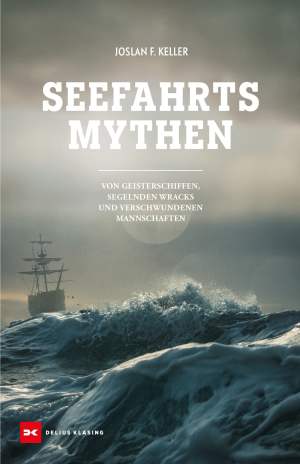
Ghost ships have fascinated people for centuries. They symbolise the unknown at sea, stories that defy any clear explanation. Some are based on real events, others are pure legends, passed on by generations of sailors. In his book "Maritime myths" collected numerous of these puzzling cases.
The legend of "Lady Lovibond"
12 February 1748 was a wonderful day, especially for two people who had decided to join forces for better or for worse. On this day, Simon Reed, the experienced captain of the beautiful three-masted schooner "Lady Lovibond" (sometimes called "Lady Luvibond"), married his beloved Annette. The entire crew was invited to the wedding and contributed heartily to the general merriment. John Rivers, one of the sailors, acted as best man and also did his best to ensure that the ceremony and the subsequent celebration were a complete success.
Seefahrts-Mythen
A jealousy drama
What the couple didn't realise was that John was devastated. He rejected this union because he secretly harboured a deep love for Annette. He was incredibly jealous and couldn't bear to see her marry anyone else, let alone his captain. He swore revenge and spent the whole night getting drunk.
The next day, 13 February, John Rivers made his way to the quay where Simon and Annette Reed, their guests and the crew were to board the Lady Lovibond to sail to Porto in Portugal. On the programme was a celebration and good cheer for everyone. At least for almost everyone.
At first, Captain Reed took the helm to leave the harbour and head out to sea. But then he left the ship to one of his men and went below to attend to his wife and their guests on the lower deck. John Rivers watched the scene in silence with a petrified expression and covered his ears so as not to hear the cheerful voices.
The drama takes its course
What happened after that is not entirely clear. Either Rivers had planned it or he had simply succumbed to madness. The rival sailor was consumed by his jealousy. While Simon Reed, his wife and their guests continued to celebrate, Rivers pulled a heavy, club-like nail from the railing and hit the helmsman on the head with full force. Unable to defend himself, the jealous sailor took the helm and steered the ship straight for the Goodwin sandbanks, a very dangerous spot on the Kent coast in south-east England.
As it began to rain heavily, the "Lady Lovibond" raced towards the ominous sandbanks that were left over from a former island and had become a veritable ship graveyard. As everyone was partying on the lower deck, nobody noticed anything. It was already too late when they discovered the ship was off course. The "Lady Lovibond" hit the Goodwin sandbanks with a terrible roar. The hull ripped open on the port side and the boat tipped onto its side. The main mast broke while the passengers tried to escape from the sinking ship as best they could. In vain, the schooner sank incredibly quickly and disappeared. They all lost their lives, drowned, were washed overboard or trapped in the wreck.
It is said that the flood washed up a number of objects in the days that followed and that even the body of John Rivers was found. However, not a single piece of wreckage from the "Lady Lovibond" remained.
Every 50 years again
This tragedy alone would probably be forgotten, but: 50 years later to the day, on 13 February 1798, James Westlake, captain of the "Edenbridge", a coastguard ship, reported that his ship had almost collided with a three-masted schooner, and added this curious detail: he had clearly heard the sounds of a celebration when the two ships came very close to each other.
A nearby fishing boat also observed the unknown vessel heading straight for the coast. When they turned off to come to its aid, the fishermen realised that the schooner had simply disappeared.
In 1848, the "Lady Lovibond" reappeared and convinced the local sailors that a shipwreck had occurred and the survivors had to be rescued. Although the fishing community of Deal, 13 kilometres north-east of Dover, sent out lifeboats, there was no trace of the unknown ship.
The same scenario was repeated on 13 February 1898, when the schooner reappeared at the site of its earlier shipwreck. In 1948, Captain Bull Prestwick claimed to have seen the cursed ship. He reported that it had seemed real and emitted a strange white glow - a feature that characterises several ghost ships.
At the same time, the Italian cargo ship "Silvia Onorata" ran aground on the Goodwin sandbanks, just like the "Lady Lovibond" 200 years earlier. No sightings were reported in 1998, so we will probably have to wait until 2048 to have a chance of catching a glimpse of the rarely appearing ghost ship.
Missing references
It would surely be more sensible to follow the opinion of authors George Behe and Michael Goss, whose research led them to believe that the whole story of the "Lady Lovibond" was purely fictional and perhaps the invention of a journalist who had been inspired by a real ship that sailed in the 1920s.
In fact, no reference to the sinking of a ship named "Lady Lovibond" can be found in the sources of the time, including in newspapers, in "Lloyd's List" (a weekly magazine for maritime information published since 1734) or in "Lloyd's Register", the famous British classification society for seagoing vessels. Furthermore, there is no description of the schooner anywhere. There is also no further information about the presumed starting point of the voyage to Portugal, even if one could assume a harbour in the east of England given the location of the shipwreck.
Playing field for legends
The Goodwin Sands are known for the many shipwrecks that have occurred there - and for ghost ships. In addition to the "Lady Lovibond", other mysterious ships cruise these waters, such as the "Northumberland" (which sank on 25 November 1703 and also reappeared 50 years later in 1753), the steamship "Violet" (which sank in 1857 and reappeared on 1 January 1947) and the Canadian passenger ship "Montrose" (which disappeared in 1914 and was sighted again in 1965).
This shoal area of sandbanks, which is extremely dangerous for sailors, is said to be the remains of a legendary island called Loméa, which disappeared during a storm in 1099 and which the Romans said was the island of hell.
In any case, according to authors Behe and Goss, there is no source that refers to the "Lady Lovibond" before an article in the "Daily Chronicle" from 1924. Should we conclude that this story of a newly married captain whose jealous sailor steers the ship onto a sandbank to destroy everything is just a pretty legend? Both authors are convinced that it is. They even make the temporal connection between 13 and 14 February to hypothesise that the stories about the schooner were invented on the occasion of Valentine's Day.
The book


Lars Bolle
Chief Editor Digital
