


Ghost ships: How the "HMS Resolute" drifted out of the pack ice and into the Oval Office
Lars Bolle
· 25.02.2026


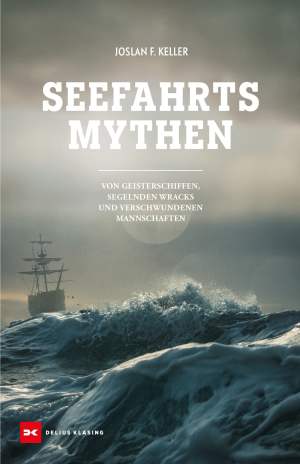
Ghost ships have fascinated people for centuries. They symbolise the unknown at sea, stories that defy any clear explanation. Some are based on real events, others are pure legends, passed on by generations of sailors. In his book "Maritime myths" collected numerous of these puzzling cases.
Encounter in the pack ice
On 13 September 1855, a ship drifted in the Davis Strait between Baffin Island and Greenland and threatened to run aground on the pack ice. Then, completely unexpectedly, the American whaler "George Henry" was overtaken by a warship that appeared out of nowhere. The sailors shouted themselves hoarse, but no one on the other side responded to their calls. Captain James Buddington then ordered four of his sailors to cross the pack ice to approach the mysterious ship. They returned without having seen anyone on board, but they had deciphered the name on the hull: It was the "HMS Resolute".
What "HMS" means - and why nobody answered
The abbreviation HMS precedes the names of the ships of the Royal Navy, the British navy. It means "His" or "Her Majesty's Ship" depending on whether the monarch is a king or queen. For Buddington and his American crew, these three letters already indicated the nationality of the ship, but nothing explained the absence of the crew.
Seefahrts-Mythen
In search of Franklin
In fact, the "HMS Resolute" is by no means an unknown ship. It was one of the four ships under the command of Edward Belcher, who set out in 1852 to search for John Franklin-Fitzjames' expedition, which was itself in search of the Northwest Passage to Asia. The "HMS Resolute" was launched in 1850 and was a 35 metre long three-master, which was bought by the British Admiralty after its completion by a private shipowner. She was reinforced, fitted with very hard wooden frames and equipped with an interior heating system to withstand the Arctic ice masses under the flag of the Royal Navy.
Rescue of the "HMS Investigator" - and the end of a mission
Unfortunately, despite the best efforts of the crew (including the Frenchman Émile de Bray), who set off on the search in the winter of 1852/1853 in difficult conditions with sledges, the three-master found no trace of the Franklin-Fitzjames expedition, which seemed to have vanished into thin air. Their only heroic deed was the rescue of another ship that was also searching for the lost explorers: the "HMS Investigator", of which there had also been no trace for three years. The "HMS Resolute" rescued Captain Robert McClure's crew, who were about to die of starvation or scurvy, but had to abandon ship. The ship had just discovered the last section of the Northwest Passage, which Franklin had set himself the goal of conquering.
Given up - and yet not lost
After this rescue, the following exceptionally harsh winter trapped HMS Resolute in a large ice floe. Captain Kellett was (rightly) convinced that the ship, which was drifting eastwards, would be freed the following summer, but after much toing and froing, Commander Edward Belcher, who was in charge of the Arctic Fleet, unexpectedly ordered HMS Resolute to be abandoned at this point in Viscount Melville Sound.
The salvage by the whaler "George Henry"
16 months later, James Buddington, captain of the whaler "George Henry", was completely surprised when he saw the three-master floating in perfect condition in the Davis Strait, more than 1,000 nautical miles (1,852 kilometres) from where it had been abandoned. Once the initial surprise had been overcome and it became apparent that the "HMS Resolute" had withstood the ice and still appeared to be seaworthy, James Buddington decided to salvage her. The captain of the "George Henry" took command of the "HMS Resolute", while his first officer assumed responsibility for the whaling ship. With no navigational instruments or charts and a crew of just 13 seamen, the journey to the USA was no mean feat. But the "George Henry", accompanied by her impressive floating three-master, reached New London in Connecticut on Christmas Eve 1855.
From media event to diplomatic gift
The story made headlines, and the discovery of the ghost ship freed from the ice impressed readers hungry for sensation. A press campaign was launched and the American authorities paid Captain Buddington and his crew considerable compensation totalling around 40,000 dollars. The restored "HMS Resolute" was then presented to Queen Victoria of England as a diplomatic gift on 7 December 1856.
The wood of the "HMS Resolute" in the Oval Office
The Royal Navy used the "HMS Resolute" for more than 20 years until it was scrapped in 1879. Then her fate took an unexpected turn. In fact, the British Queen gave instructions to build three desks from the ship's wood. The largest was offered to the USA and is still in the Oval Office of the White House. Since Rutherford B. Hayes in 1880, almost all US presidents have used the Resolute desk, with the exception of Lyndon B. Johnson, Richard Nixon and Gerald Ford.
The late search for traces of the "HMS Investigator"
The "HMS Investigator", the ship rescued by the men of the "HMS Resolute", was abandoned in Mercy Bay in 1853 without a crew. It was not until 2010 that Parks Canada, the government agency that manages Canada's national parks, among other things, commissioned a team of underwater archaeologists to search for the remains of the wreck. Although more than 160 years have passed since the Franklin Fitzjames expedition, such an expedition to the Arctic is still a dangerous challenge, as Andrew Cohen reports in his book "Perdu sous la banquise: L'histoire du "HMS Investigator" (2013)" (Lost under the pack ice: The story of the "HMS Investigator"). As part of this underwater adventure, Parks Canada succeeded in finding the lost ship, whose wreck lay in excellent condition at the bottom of Mercy Bay off Banks Island in Canada's Northwest Territories.
From historical find to ghost ship legend
The "HMS Resolute", which Jules Verne incidentally mentions in his famous novel "Five Weeks in a Balloon" (1863), is the perfect example of the authentic story of an abandoned ship that later became the legend of a ghost ship.
The book


Lars Bolle
Chief Editor Digital
