


Distress at sea: Rescue off Gran Canaria - "Everything went like in the textbook":
Ursula Meer
· 18.02.2026

It's a normal sailing day off the Canary Islands. Sunshine, 30 knots of wind from the north-east, a strong Atlantic swell - challenging, but nothing unusual for these waters. "We had a half-wind course, reefed strongly, but were still travelling at between seven and nine knots," recalls Kai Linnenbrügger of the trip from Tenerife to Gran Canaria. "The atmosphere was good, we all sat outside and the sailing was really fun."
Knee-deep in water within 30 seconds
But then: the blow! "We felt a vibration. At first I thought it was a wave thundering against the ship's side. But it was a very, very rough blow. You could also feel it in the rigging, which vibrated." A crew member is the first to notice water in the ship. Linnenbrügger goes down to check the situation.
"There was a bit of water sloshing over the floorboards on the side, so I switched on the bilge pumps first," he says, describing the situation, which initially seemed harmless. In addition to the bilge pumps, there is also a mobile submersible pump on board. He is just about to put it into action, but "within 30 seconds I was already knee-deep in water. That's when I realised: we can't do this with pumps."
Linnenbrügger has a charter company and a sailing school in Lemmer in the Netherlands. He has also been a sea rescuer there for 15 years with the Koninklijke Nederlandse Redding Maatschappij (KNRM). Thanks to his experience, he immediately knows what to do: "Looking for a leak anywhere makes no sense when the water is rising so quickly. You have to localise a leak, but you can't get everywhere so quickly," he explains, adding: "The boat can quickly become unstable, and then it becomes very dangerous inside." Linnenbrügger abandons the bilge measures and prepares to get out into the life raft.
The moment of truth
He wants to press the distress button on the radio, but at the same moment the device switches off. "The batteries were already flooded, even the higher battery of the replacement radio was already in the water." Linnenbrügger takes the EPIRB out of its holder and puts it in his oilskin bag. His grab bag, which always hangs ready to hand on a hook on the companionway, has already floated away into the boat's interior, out of reach.
High time for the life raft. When the crew pulls it aft, the boat is already deep in the water. "We had put up the sails and tried to keep the boat in the wind a bit, but it didn't work. The boat was no longer steerable, it was all very sluggish." The fact that the "Vlie" is less agile than usual is its good fortune in a sea that is still three metres high even when the island is covered. It moves in synchronisation with the island. "We were able to enter the island directly from the back of the boat, nobody had to go into the water."
Once everyone is on the island, the skipper activates the on-board EPIRB and another one in his lifejacket. The signal is first received by the Dutch coastguard - the "Vlie" sails under the Dutch flag and the EPIRB is registered there. "They then called me at home first," says Linnenbrügger.
His wife can confirm that her husband is travelling on the "Vlie" between Tenerife and Gran Canaria. She doesn't give a second thought to a possible false alarm; for her it's clear: "If the coastguard has received an emergency call from the ship, something really has happened. My husband doesn't do things like that for fun." The skipper describes the ensuing rescue operation, which involves lifeboats and a helicopter, as "really big stuff". Even a large freighter was diverted from the shipping lane to help with the search.
Green light - help is on the way
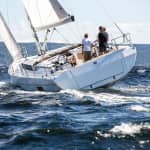
The crew in the life raft don't realise this at first. They have to watch as the "Vlie" sinks. "The boat sank over the bow. The bow went first, then the stern lifted up again. The dinghy was still at the back, I couldn't get it off," says the owner, describing the last glimpse of his "Vlie". Shortly after the Bavaria 45 was built in 2010 as a prototype of the Farr design series, it came into his possession. Now the dinghy is raised upright at the stern with one last wave before the boat finally disappears into the water.
Only then do they learn that rescue is on the way: his EPIRB is a PLB3 - a "really cool thing" that receives a confirmation that the emergency call has been received. "It lit up green, and then I knew: OK, all clear, here we go." Priceless, reassuring information in this situation. "I was able to sit back and relax on the island and say: 'All we have to do now is wait. And look at the panorama of Gran Canaria."
The island seems close enough to touch. The atmosphere in the life raft is calm. "I didn't really think about fear at that moment. We were reeling off memorised processes - processes that you should really practise. It felt like an exercise." Linnenbrügger describes the mood in the crew in a similar way: "They were all very calm and level-headed. Almost like in a training film. Nobody panicked, there was no shouting."
Rescue in less than an hour
Less than an hour later, the helicopter is overhead. "A frogman was lowered down to us on a winch and asked how everyone was feeling," says Linnenbrügger. One of them was feeling a little sick on the island - he was the first to be hoisted up. The other four are rescued one after the other, the skipper being the last to be rescued together with the frogman. The mood in the helicopter is already relaxed: "We took selfies with the helicopter crew during the flight." As soon as they disembark, it's clear: "Now we're going to take a taxi to the nearest pub and have a beer."
Dripping wet in the hotel lobby
He himself describes what happens next as a "disaster". Wet, without identity cards, wearing only life jackets and sailing gear - "I was still wearing a pair of pyjama bottoms under my oilskins" - they arrived on Gran Canaria. In the middle of the second largest carnival in the world. From the sailors' pub in the harbour, they first go to a watersports shop. With new T-shirts and shorts in their bags, they find themselves in the lobby of a hotel, the only one that still has rooms available despite the carnival. "We were standing there at reception really soaking wet - and had to hear that there was no room without an ID card. We weren't even allowed to shower or change."
The receptionist sends them to a police station so that they can file a loss report. It's not the right station; the stranded travellers move on to the next one. Back at the hotel, with the receipt for the lost ID cards in their hands, they are nevertheless asked to give their numbers. "You have to know them by heart!" the receptionist states sternly. They stand wet in the hotel lobby for three hours until they finally have all the numbers together thanks to photos and contacts with their families. In the meantime, the previously booked price for the rooms has risen considerably.
How did the accident happen?
Kai Linnenbrügger and his fellow sailors will probably never know what caused the leak. "We definitely hit something. There must have been a huge hole in the hull, otherwise the boat wouldn't sink at this speed." The ship is now lying at a depth of 1,500 to 1,800 metres on the sloping continental shelf. "We will never know. It will never be salvaged."
The search for possible causes of the serious accident remains a theoretical one, but "in December, a ship lost 50 sea containers in the area". Whether it was one of them? "It's all speculation." He dryly comments on the fact that some people in the comment columns under social media posts are talking about a keel falling off or an orca attack on the rudder: "If the keel falls off at half wind, the boat tips over. And the rudder was at the back, I could still see the rudder blades when the boat went under."
Lessons for other sailors
What advice would he give to other sailors? "From now on, I'll always keep my grab bag upstairs where it can't float away." Also important: "In countries where everything is very difficult without ID, you should have your ID in your pocket. Or photograph all ID cards beforehand and store the photos in the cloud. That would have helped us a lot."
In his opinion, the procedures for leaving the boat and the rescue from the air could not have gone better. "I couldn't have avoided the accident. But the five minutes leading up to the sinking and the rescue from the air were textbook."
What happens next?
Will he go out on the water again without thinking about the unexpected and inevitable situation? "I honestly don't know at the moment. But I do think I'll get back on the water and carry on."
Not only that, he is planning a new format for his sailing school after the drastic experience: realistic weekend safety courses on the water, with life rafts and practical exercises. Because he is "glad that it went the way it did, that we are all in good spirits and healthy. I'm very grateful for the training I've received from the KNRM over the past few years, thanks to which everything went very well when the "Vlie" sank."
Kai Linnenbrügger repeatedly emphasises that he would like to thank everyone involved: the Dutch coastguard, who not only coordinated the emergency but also kept in touch with his family in Germany, the Spanish sea rescue service and especially the helicopter crew.

Ursula Meer
Redakteurin Panorama und Reise
