


A catamaran has capsized west of Maupiti in French Polynesia. Three people were rescued after a large-scale rescue operation.
The emergency occurred on Wednesday, 11 March 2026 and was triggered by the signal of a distress beacon. The position of the accident was more than 260 nautical miles west of Maupiti and around 420 nautical miles from Tahiti. This meant that the boat and crew were far beyond the immediate range of helicopters. The Joint Rescue Coordination Centre Tahiti confirmed the distress call and subsequently deployed a Falcon 50 from the French armed forces in Polynesia.
Wreck and life raft discovered
The aircraft located a capsized catamaran with three people on board. Two people were on the upturned wreck. A third person was in a damaged life raft that was losing air and taking on water.
The crew of the Falcon dropped a survival pack. Among other things, it contained a self-inflating life raft, water, food, lamps and other safety equipment.
Salvage by freighter
As a rescue from the air was not possible, the nearest ship was requested to help. This was a merchant ship flying the flag of the Bahamas. According to the information available, it was around 13 hours away from the scene of the accident.
During the waiting time, the Falcon flew to the position again. A further overflight was used to re-localise the drifting life raft and to transmit current position data to the ship that had been summoned. The night-time mission was also intended to send signals to the shipwrecked people.
On Thursday, 12 March, the Falcon once again guided the merchant ship to the position of the life raft. Despite difficult sea conditions, the crew of the freighter managed to pick up the three shipwrecked people.
Injury and onward journey to New Zealand
One of those rescued was injured when the boat capsized. After a medical teleconsultation, however, the state of health of all three people was deemed satisfactory. A medical evacuation was therefore not necessary.
The merchant ship continued its journey to New Zealand. The rescued people were to be brought ashore there.
Warning of drifting wreck
After the rescue, a warning was issued to the shipping industry. The background to this was the capsized wreck, which is considered a potential obstacle to navigation.
The reports point out that a drifting wreck is difficult to locate precisely. Ships in the area were therefore called upon to pay particular attention.
Extensive search operation
The rescue operation lasted a total of 14 hours. According to the information available, three Falcon 50 flights were used. Two flight crews, each with six people, and three JRCC Tahiti employees on land were involved.
A local report puts the total flight distance of the mission at 7,500 kilometres.
Boat type and open questions
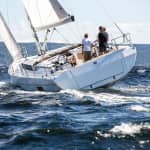
So far, only a few reliable details are available about the capsized catamaran. Several reports speak of a boat around 44 feet long. A confirmed model name has not yet been published. Based on the photos, YACHT believes it could be a Nautitech Open 44 or 48.
Speculation on the cause
There is also no reliable information on the cause of the capsize. The reasons have not been officially stated.
In discussions outside the official reports, there is talk of strong winds, sudden gusts in the tropics, possible overloading of the boat and the capsizing behaviour of larger cruising catamarans. There are also considerations as to whether special sea conditions or an interplay of wind and waves could have played a role.
There is no reliable evidence of this to date. There is also currently no publicly confirmed information as to whether technical problems, a structural failure or water ingress could have contributed to the loss of the boat.
How capsize-proof are cruising catamarans?
The capsize also raises the fundamental question of how capsize-proof modern cruising catamarans are. There are no generalised answers to this question. What is clear, however, is that a catamaran behaves differently to a keel yacht at the limit.
Monohulls usually give a clearer indication of overloading. They heel heavily, run off course or lie on their side in gusts. Cruising catamarans, on the other hand, remain comparatively stable for a long time.
High initial stability, little warning
It is precisely this high dimensional stability that is their great advantage. But it is also the point at which the risk begins. A cruising catamaran heels very little in normal operation. As a result, it gives the impression of having large safety reserves for a long time. However, if the limit is exceeded, the situation can change abruptly. There is often no long warning, as we know it from a keel yacht.
The righting moment is different
The reason lies in the stability curve. In catamarans, the righting moment is very high at the beginning. However, it reaches its maximum value early on.
As in our Special article this maximum is already reached at a position of around ten degrees. After that, the righting moment decreases significantly. On a keel yacht, it initially increases further with increasing heel and only becomes negative at very large angles.
Cruising catamarans are not fundamentally unsafe. However, their stability follows a different logic than that of a monohull.
Seamanship remains crucial
The high initial stability of a catamaran is no substitute for good preparation or careful weather management. Early reefing, a clean weight balance and a keen eye for gusts and swell remain key points.
Because the boat can appear unimpressed for a long time, the assessment of the situation is particularly important.

Lars Bolle
Chief Editor Digital
