


The comparison is obvious: JPK 10.50 against Pogo RC. Both boats are new, come from traditionally competing shipyards in Brittany, play in the same format and, with their crystal-clear focus, are aimed at the same clientele and the same handicap according to IRC (hence the name). The designs are also strikingly close to each other: on one side the JPK 10.50The first is the Pogo RC, designed by Jacques Valer, and the second is the Pogo RC, a collaboration between designers Sam Manuard and Bernard Nivelt.
More from the shipyard:
In fact, the concepts of the two racing yachts are so similar that one question seems unavoidable: Who has copied from whom? The answer is: no one. Rather, the two comparable designs demonstrate one thing above all: the current state of knowledge in modern offshore yacht design. The proximity of the boats is therefore neither coincidence nor plagiarism, but the result of consistent and contemporary development work within a new generation of IRC-optimised offshore racing yachts.
Measurement results of the test


The first major test of strength between the two rivals was therefore eagerly awaited: the Rolex Fastnet Race. There, the two protagonists had to show what they were made of on the big stage - and both delivered impressively. Victory in the overall standings (IRC Overall) for the JPK 10.50, third place for the Pogo RC. And that in a competition of no less than 380 boats. This is more than just a respectable success, but rather clear evidence of the enormous performance potential of both designs.
With the Pogo RC, the designers Sam Manuard and Bernard Nivelt are not leaving the familiar paths, but are consistently pushing development further. The most striking feature of the design is the voluminous, almost bulbous bow. The striking design language is familiar from the spectacular IMOCA class ocean racers and the latest developments in the attractive Class 40 racing yachts. The bold front is primarily intended to compensate for the buoyancy of the wide stern, ensure a more balanced swimming position and help with planing.
The design of the Pogo RC also shows a clear edge under water. The keel is now back in the classic T-shape with a lead bulb. There are also two rudder blades attached to the stern.
More control and safety thanks to attached rudder blades

Retractable rudder blades attached to the stern are nothing new in the world of ocean racing yachts. They have long since proved their worth in the IMOCA and Class 40 classes. However, the concept has only recently appeared on production yachts, namely the JPK 10.50 and the Pogo RC from Brittany. The solution is technically and constructively complex, requires the crew to carry out additional work and also drives up costs. Nevertheless, the advantages speak for themselves. The most important argument in favour is safety. The rudder blades mounted on the outside of the stern can fold upwards in the event of a collision. A predetermined breaking point is provided in the system for this purpose. This virtually eliminates the risk of serious structural damage following a collision. Unwelcome bycatch from plastic bags, seaweed or lines can also be removed more easily.
There is also the added benefit of sailing characteristics and performance. With only one rudder blade in the water, the boat reacts much more directly, lively and precisely. And: the folded-up rudder blade causes no additional resistance. On the Pogo RC, the rudder blades are raised, lowered and locked at the bottom using sheet pulls and tackles. The handling worked perfectly in the test. In practice, the windward blade is raised in light to medium wind speeds. In strong winds, both fins remain down for maximum control.
Free choice of rig and sailing wardrobe
On the Pogo RC, the rig is also positioned conspicuously far aft and has a large mast drop. The reason for this is that the unusual volume distribution of the hull means that the sail's centre of pressure has to be positioned far aft. Accordingly, the sail plan provides for a high and slim mainsail, but the J-dimension is longer, which allows for larger headsails. The French manufacturer AG+ supplies the carbon fibre mast with a pair of spreaders and Dyform shrouds as well as the boom, which is also made of carbon. However, if you prefer, you can also opt for a mast from another brand, and a rig with two spreaders is also possible. The customer has a free choice here, as well as in the composition of the sail wardrobe.
The Pogo RC on the water
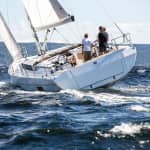
The conditions could not have been better for the YACHT test in Brittany. Sunshine, between 12 and 15 knots of wind and a wave that can be ridden wonderfully with a fast boat like the Pogo RC. With her full bow and flat underwater hull, the sporty Frenchwoman planes easily and quickly. In the crisp gusts and with the A2 gennaker, 12 knots of speed and more are soon on the log.
Steering the boat with a gennaker in these conditions is simply fantastic. It can be steered very controlled and lightly on the edge with the tiller, reacts immediately and extremely lively, sometimes even almost brute. If you lift the rudder blade on the windward side, the favourable impression is further enhanced. The boat can then be steered to leeward with a lot of feeling and pressure, similar to a dinghy. Even in the strongest gusts and with
even in the heaviest gusts and with a relatively high heel, the Pogo always remains controllable, even without much effort on the tiller.
On the cross against the wind, however, the fun factor is significantly reduced. The bulging bow doesn't really cope well with the incoming waves, and the boat often sets in unpleasantly hard, with the cockpit getting really wet from time to time. Despite the perceived braking effect in the waves, the Pogo RC surprises with its good performance potential. The boat reaches 6.9 knots
with a full mainsail and J2 genoa at an angle of around 40 degrees to the true wind.
Accessibility, handling and security
The layout in the cockpit is designed for sailing the racer with a crew of four or five people. However, with the open cockpit layout and tiller steering, handling is also easy for one or two-handed sailors. The designers at Pogo Structures have found very good and workable compromises in this respect, drawing on their wealth of experience in building high-performance ocean racing yachts.
In terms of equipment, the shipyard knows what it's all about: good accessibility, effortless handling and safety for a challenging race off the coast. All functions on the Pogo RC are uncompromisingly geared towards these requirements. The high-quality hardware and top-quality rigging with Dyneema cores also stand for this.
The Pogo RC's full performance potential can be utilised in a targeted manner thanks to its many perfectly implemented trim settings. The hoisting points of the short overlapping genoa are easy to adjust in three dimensions (downhaul, outhaul, inhaul) and, thanks to additional fine adjustments, can be optimally set at any time, even under pressure. However, you need to know where to pull.
No trace of cosiness below deck
Sheer functionality dominates below deck on the Pogo RC. At least two people could sleep reasonably comfortably in the foredeck. Additional tubular berths with leeboards are available aft. Two galley modules on the companionway with cooker and sink as well as a toilet, which is open and built into the foredeck without a partition, offer minimal touring suitability. However, these amenities correspond less to cruising requirements than to the specifications of the measurement systems.
As a standard boat, the Pogo RC costs around 264,300 euros gross from the shipyard. This is quite a lot of money for a sailing yacht with a hull length of ten metres, but is explained by the exquisite and cost-intensive equipment, among other things. The JPK 10.50 is a direct competitor with comparable equipment and costs 267,600 euros.
- Base price ex shipyard: 264.275 €
- Price ready to sail: 292.130 €
- Guarantee/against osmosis: 5/5 years
As of 2026, how the prices shown are defined, read here!
As is usual with performance boats, this does not include the sail wardrobe. For a complete set suitable for regattas (main, two genoas, two gennakers, code zero), buyers have to add around 50,000 euros, perhaps even more. The electronics with the autopilot are also not included in the basic package. Customers can spend an unimaginable amount of money on this, with the most exclusive package costing more than 40,000 euros.
Pogo has built a boat that will attract attention due to its many exciting innovations. And the first remarkable successes on the regatta course now promise even more attention - from potential buyers as well as from potentially envious competitors.
YACHT review of the Pogo RC
The new racer from Pogo Structures can and will shake up the IRC scene. The design has already proven its potential.
Design and concept
Uncompromising alignment
Innovative design
High acquisition costs
Sailing performance and trim
Great performance potential
Retractable rudder blades
Hard insertion in the shaft
Living and finishing quality
Straightforward functionality
Consistent lightweight construction
Sparse and uncomfortable inside
Equipment and technology
Water ballast optional
High-quality equipment
No electric motor as an option
The Pogo RC in detail

Technical data of the Pogo RC
- Designer: Manuard/Nivelt
- CE design category: A
- Torso length: 10,26 m
- Total length: 11,72 m
- Waterline length: 8,59 m
- Width: 3,49 m
- Depth: 2,25 m
- Mast height above WL: 16,17 m
- Theor. torso speed: 7.1 kn
- Weight: 3,44 t
- Ballast/proportion: 688 kg/20 %
- Mainsail: 40,0 m²
- Furling genoa (106 %): 32,0 m²
- Gennaker: 126,0 m²
- machine (Yanmar): 14 kW/20 hp
- Fuel tank: 40 l
- Fresh water tanks: 2 x 20 litres
Hull and deck construction
GRP sandwich constructions with foam core and vinyl ester resin. All parts are produced at Pogo Structures using the vacuum infusion process. Keel fin made of cast iron, keel bulb made of lead.
Rig and sail
The standard specifications call for a carbon fibre mast from the manufacturer AG+. However, the customer has a free choice. As is usual with racers, the sails are not included in the basic price. A set of laminate sails from manufacturer Incidence (main and genoa) costs around 18,000 euros.
Water ballast
The Pogo can be optionally equipped with water ballast tanks on the side and aft. The surcharge for all three tanks (200 litres each) with the systems for filling and emptying is around 9,400 euros.
Shipyard and distribution
SAS Pogo Structures; 29120 Combrit (France); www.pogostructures.com
Competition focusses on maximum performance potential
Beneteau Figaro 3


Radical standardised racer from Beneteau with laterally extendable foils. The Figaro 3 has also established itself internationally as a strong standardised class for the single and double-handed scene.
Italia Yachts IY 9.98


Successful regatta boat, designed by ORC artist Matteo Polli. The IY 9.98 Fuoriserie has already won two world championship titles. The interior below deck is modern and suitable for touring. Read the test here.
Jeanneau Sun Fast 3300


Innovative and attractive series racer from Jeanneau, optimised for long-distance use with a small crew. The special hull design originates from the Andrieu/Verdier co-operation. You can read the test here.
Jeanneau Sun Fast 30 OD


Innovatively planned One Design concept by Jeanneau and Multiplast. Uncompromising focus on ocean racing in the one class. Functional and cosy inside. Click here for the test.
JPK 10.50


She is the IRC overall winner of the ocean classic Rolex Fastnet Race 2025 and currently the most direct competitor to the Pogo RC (3rd place). The design was created by Jacques Valer. You can read the test here.
J/99


Sophisticated and therefore successful sports package for active regatta sailors from J/Boats. Highly customisable boat depending on use and measurement system. Suitable for touring below deck. You can read the test here.
ADVERTISEMENT

Pogo RC insurance from 1,900.06 euros per year* - liability and comprehensive cover. Many options available: Protect your crew with passenger accident insurance. Simply calculate and take out online: yachting24.de
** Yachting24 offer valid for a sum insured of EUR 282,000 (with current value cover), excess of EUR 1,400, liability cover of EUR 8 million

Michael Good
Editor Test & Technology
