Dear readers,
Do you like to keep things as simple as possible when sailing?
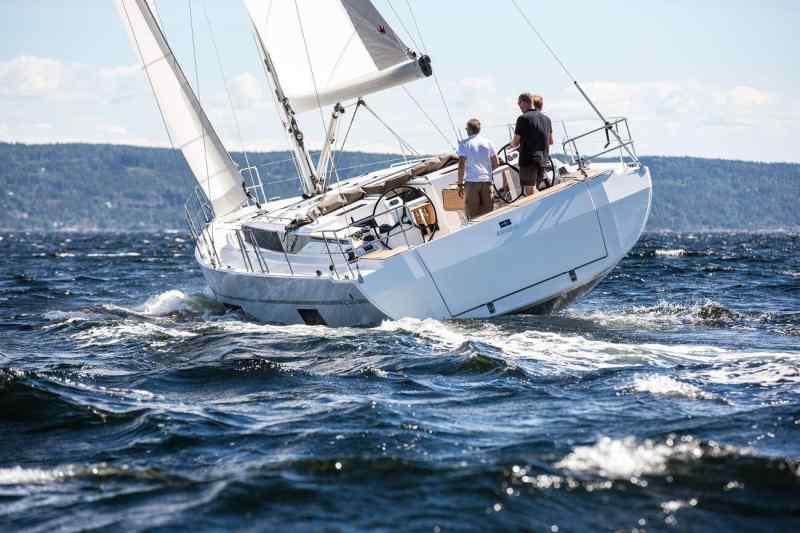
The market, the customers, the sailors of today want more comfort, not only for living on board, but also when travelling. That's the general consensus and expert opinion. The self-tacking jib should make a contribution to this. Long forgotten and only used on a few unreservedly Northern European yachts, it has experienced a brilliant renaissance in recent decades. Hanseyachts got the ball rolling, French shipyards followed suit and soon self-tacking jibs were even being used on catamarans, even though you sometimes want to keep the headsail back for a successful tack on these vessels. But is the mimic, which is offered on almost every cruising boat today, really useful?
One thing is clear: tacking with a self-tacking jib requires no work on sheets, winches or cranks. This makes the boat suitable for single and small crews. But the disadvantages outweigh the advantages: Of necessity, the cloth is smaller than the maximum foresail triangle, so there is a lack of surface area and therefore sail horsepower. With the track and sheet deflections, whether on deck or through the mast, more fittings are required, which means more fuss, more weight and more costs. As soon as a schrick in the sheets is the course of choice, the self-tacking jib opens at the top and a good part of the already smaller sail area becomes ineffective. This can only be remedied by using a barber haul, which requires another fitting with an additional sheet and deflection. On deep courses, the sheet car bangs from one side to the other. And even in the harbour, the self-tacking jib seems to overwhelm some of the crew. While it may still be possible to remove the main halyard and thus prevent noise, the jib sheet, which is guided up the mast and then deflected downwards again, often remains a seemingly unfathomable and irremovable source of annoying, usually high-frequency and annoying flapping noises.
There are therefore many arguments against the self-tacking jib; the desired comfort comes at a high price. And self-tacking jibs are not unconditionally favoured by cruising sailors either. Charter sailors, of all people, reject the automatically tacking headsails and would specifically look for and book boats with a conventional arrangement, as large providers report. This is because this customer group does not want to sit idly by while only the person at the helm has anything to do and sails actively.
So what is the best solution? A headsail that overlaps only slightly and completely fills the triangle of mast, foresail and forestay creates short sheet paths and can also be turned quickly and trimmed comfortably by a small crew or single-handed. With rails on the coachroof or positioned close to it for narrow sheeting angles and then equipped with an inholer, it can be trimmed effectively. With padeyes on the deck edge and an outer sheet, the sail remains effective even on rougher courses.
The following applies in particular to the self-tacking jib and the small genoa: A Code Zero or a Gennaker ideally completes the wardrobe, which then covers all wind angles well, promotes sailing fun and also keeps the crew busy. Overall, this means more clutter, but it serves the sailing finesse. More comfort is just as nice as it is good, but preferably not at the expense of performance. And if sailing were easy, it would be called football.
Fridtjof Gunkel
Deputy Editor-in-Chief of YACHT
Click on it to see through:
The week in pictures


Recommended reading from the editorial team

Vendée Globe
The race in the live tracker

The live tracker of the Vendée Globe 2024/25: This tracking shows the race of the tenth edition of the round-the-world regatta - with Boris Herrmann!
Malizia 4
First the damage to the foil, now the mainsail has torn

First the damage to the foil, then broken hull reinforcements, and now a tear in the mainsail. Two new videos show how Team Malizia is repairing and further developing the IMOCA ahead of the Route du Rhum.
Silting up of the Elbe
Small ports are fighting for every metre of water depth

The Lower Elbe is silting up, time windows are shrinking and ports are becoming difficult to reach. With flat-bottomed boats and homemade dredgers, sailors are fighting to preserve their fishing grounds.
Propulsion
Max Bianchi variable-pitch propeller, which adjusts its pitch whilst the aircraft is in flight

A variable-pitch propeller that automatically adjusts its pitch whilst in flight: this is what Max Prop’s Max Bianchi model is designed to achieve in powered flight and motor-sailing.
Interview
What is it like to work on board the ‘Thor Heyerdahl’?

The ‘Thor Heyerdahl’ has been sailing the world’s oceans for more than 40 years. YACHT editor Fabian Boerger explains why this historic vessel remains relevant.
Hurricanes 2026
Dramatic rescue off the coast of California – El Niño shapes the storm season

A lifeguard rescues a sailor from a partially flooded yacht off the coast of California. Why the 2026 hurricane season is turning out so differently between the Atlantic and the Pacific.
Blue-water yachts
These five are heading to the ends of the earth

Five blue-water yachts, five designs: the Boréal 56, Kraken 58, Pure 49, Stem 50 and Breehorn 55 demonstrate their strengths and weaknesses on a long-distance voyage.
Record low water level in Lake Zurich
Sailing yacht flown by helicopter to its winter storage facility

Water levels in Lake Zurich are below the previous record low. Because his sailing yacht was stuck in the shallow water and in danger of capsizing, a 65-year-old owner had his boat airlifted out by helicopter. The operation cost around 2,000 francs and highlights just how much the exceptionally low water level is now affecting navigation.
Series of thefts continues
Thieves make off with two 300 PS outboard motors from Wieltsee

Thieves have struck again at Wieltsee: they have stolen two boats and removed heavy outboard motors. This is already the fourth such incident in three months.
Second-hand boat of the week
Arietta 31 – the dawn of an era

A narrow waist, mahogany hull and elegant overhangs: the Arietta 31, designed by Olle Enderlein, prioritises balanced lines and seaworthiness over maximum living space. As a forerunner of later Scandinavian cruising yachts, it is now an interesting classic for sailors seeking a traditional, compact cruising yacht.
Breehorn 55 review
Is it the ideal home at sea?

A pilothouse, teak fittings and an unusually accessible service tunnel: this is how the Breehorn 55 works below deck, and these compromises remain.
Newsletter: YACHT-Woche
Der Yacht Newsletter fasst die wichtigsten Themen der Woche zusammen, alle Top-Themen kompakt und direkt in deiner Mail-Box. Einfach anmelden: