


RORC Transatlantic Race 2026: Test passed - "Raven" as the first mono in the Caribbean nest
Sören Gehlhaus
· 19.01.2026


Record broken, proof provided: "Raven" emerges from the RORC Transatlantic Race 2026 as the fastest monohull superyacht in the world. The fact that the 34-metre-long hybrid foiler is not a racing machine like "Lucky" or "Comanche" became clear during the stern-to docking in Antigua. Teak staves appeared in the cockpit, darkly tanned from the spray showers of the final space sheeting. Below deck, the crew of 17 must have enjoyed a high level of comfort during the almost seven days at sea. The Interior Baltic Yachts in Finland built the boat to its own rigid lightweight construction and superyacht standards. In some ways, "Raven's" performance spectrum is similar to that of the bird that gives it its name, which glides along economically but is also capable of fast and furious manoeuvres.
"Raven": with 30 knots to the finish line
On 18 January, "Raven" crossed the finish line off English Harbour at 30 knots and took six days and 22 hours to cover the 3,000 nautical miles from Lanzarote to Antigua. In 2025, the 88-foot-long "Lucky" received line honours after seven days and 20 hours, but was still bound for Grenada. It was the first time that the RORC Transatlantic Race officially ended in Antigua. However, the pandemic forced the organisers to move the 2021 race from Grenada to Antigua. The VO70 "Green Dragon" won with a total time of nine days and 17 hours.
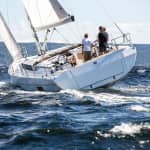
Unlike fully lifting foilers, "Raven" relies primarily on the enormous righting moment of the T-foils and maintains contact with the water for the most part. An elementary prerequisite for skipper Damien Durchon: "This boat is incredibly stable. The better it performs, the safer it becomes. We have an enormous righting moment due to the foils, supported by ten tonnes of water ballast and high hull strength. If a foil breaks off, the boat simply behaves like a conventional yacht. In many ways, I would say that 'Raven' is safer than most offshore boats."
More potential in "Raven"
The race ended so quickly, how it had begun. Navigator Will Oxley called the last shot towards Antigua under difficult conditions. "It was a very dark night, no moon, lots of turning winds and variable pressure," he recalls. "We wanted to have a good layline for the finish. With a bit of practice and a bit of luck, we managed it and crossed the finish line in over 30 knots. That was a very special end to the race."
Will Oxley, who navigated "Comanche" to the monohull record in 2022, comparing the two boats shows how radically the "Raven" is designed. "It's interesting to compare 'Raven' and 'Comanche'," explained Oxley. "'Comanche' is still the global benchmark in terms of VMG downwind, but 'Raven' has clear performance advantages at certain angles. In this race, which is largely a classic downwind Atlantic crossing, we are faster at our angles. Where 'Comanche' still has the edge is in pure VMG, and we are continuing to work on that. But 'Raven' is an incredible platform and what we've achieved here sets a significant benchmark."
"Demanding, but controllable"
The RORC Transatlantic Race in direct comparison to the trimarans. When the leaders made their pioneering manoeuvres west of the African coast, "Raven" regularly reached 25 knots and was therefore only 2-3 knots slower than the MOD70 tris. As the race progressed, aft winds forced the semi-foiler to gybe constantly in order to keep the speed high. "At 25 knots it already feels fast," explained Damien Durchon. "At 30 knots and above, you're moving faster than the waves themselves. You're working your way through the sea instead of reacting to it. It's challenging, but the boat remains remarkably controllable."
The "Raven" crew, which relied exclusively on furling foresails, logged a peak value of 35 knots on the Atlantic, reports project manager Klabbe Nylöf. He sees the future in "Raven": "This is a step forwards. You get foiling performance without flying completely, which is crucial for ocean racing. It's a very good combination of a fast monohull and foiling technology. I think you will see more boats like this. It's efficient, reliable and you can sail it like a normal boat while taking it to a whole new level of performance."
According to the calculated time, the still sailing "Sisi" and "Be Cool" will not be able to challenge Nylöf and his team for victory in IRC Zero. The Mach 50 "Palanad 4" is currently hurtling towards victory in the IRC overall standings and Group One. The Scow Bow format with Canting Keel should arrive later on Monday.
MOD70 "Argo" breaks multihull record
Two days before the arrival of "Raven", Jason Carroll's MOD70 "Argo" had already won the Multihull Line Honours. The team crossed the finish line off English Harbour on 16 January and set a new multihull record for the Lanzarote-Antigua route with a time of 4 days, 23 hours, 51 minutes and 15 seconds. Close on her heels was Erik Maris' MOD70 "Zoulou", which crossed the finish line just two hours and 32 minutes later - the result of one of the closest and most intense multihull duels in the history of the RORC Transatlantic Race.
For "Argo" skipper Chad Corning, the race delivered exactly what the team had hoped and feared. "We knew it was going to be a close match race with our friends on 'Zoulou' and it was exactly that," said Corning. "We managed to get a small lead early on and built it up very slowly. They held on very tenaciously the whole time and pushed incredibly hard. That made for a hectic pace from start to finish."
As soon as the boats entered the trade winds, the race shifted into a completely different gear. The daytime speeds were extreme, the night sailing something very special. "From day two onwards, we were running 30 to 32 knots in high seas," said Corning. "The nights were long; 13 hours, very dark, very little moon. It felt like travelling down a black runway blindfolded."
Sam Goodchild: "Like a go-kart!"
When the rowers were relieved every 45 minutes, they were soaked, exhausted and with burning eyes from the constant splashing water. "You're fixated on the true wind angle, feeling the force, the heeling, the waves trying to throw the boat sideways. You try to keep the boat surfing and not allow the wave to take control," continued Corning.
For Sam Goodchild Argo" offered a completely different experience to the larger Ultim trimarans he had recently sailed with. "The MOD70 is like a go-kart! With six people you can send it fast. Manoeuvres take 20 seconds, not six minutes like on an Ultim. It's simple, fast and incredibly fun." The main difference in terms of speed: "An Ultim flies flat at 45 knots, but it's a big boat that you can't push as close to the limit as a MOD70. Just flying the centre hull on 'Argo' reduces drag, but also brings you closer to the limit. It's all about trusting the people around you."
