A small, formerly important segment of yacht building is coming back to life. This refers to boats that are not intended for long voyages or permanent holidays on the water. They are primarily intended to offer light, fast sailing fun, with more or less comfort for a weekend or even a week at a time, which can be trailered to make wintering in and out easier and which can also easily reach foreign waters via tarmac.
A precise definition of this segment is difficult, somewhere between pure regatta sailing and full-time cruising. Such boats are often referred to as daysailers, weekenders, sports boats or simply fun boats.
They represent a heterogeneous segment that caters for a wide range of tastes. YACHT invited these fun boxes to the Schlei for a comparison. With minor differences: Instead of the Seascape 27 (now First 27), the newer Seascape 24 (First 24) was included, one candidate cancelled due to a lack of demonstration boat, and the JK 28 was added instead. The seven boats represent the entire spectrum of modern, sporty small cruisers, both in terms of length and sailing potential and in terms of pricing.
Great variety
The word "comparative test" is deliberately not used here, as it would be an apples and oranges competition due to the major differences. Rather, the aim here is to offer a concept comparison, a decision-making aid if you don't want a fully equipped, small cruising boat. There are plenty of them, especially from Poland. But these mini yachts usually play in a different league.
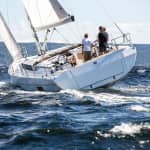
If you want to have fun sailing, be close to the water and not drive a motorhome, there is no way around compromising on comfort. The crew can sleep on all seven candidates, but that's about it. Cooking, living, living: All of this is usually possible, but only in a rudimentary camping style. This is because sailing fun is generated by a simple formula: as little weight as possible with the largest possible sail area. Sail carrying capacities of well over five, sometimes well over six, prove this in figures, namely the ratio of sail area to displacement.
The group of comparison boats can be divided into three categories, although these also overlap. Firstly, there are the semi-dinghy cruisers JK 28 and Lago 26, which share a variable draught thanks to their ballast centreboard. With the JK 28, the symbiosis between classic dinghy cruiser sailing and increased safety through ballast has been convincingly achieved.
The Lago 26, on the other hand, ranks at the sporty upper limit and is clearly more of a fun or sports boat than a travelling boat. Equipped with a trapeze, this large dinghy was able to impress with a lot of speed in the light wind conditions on the Schlei, but was easier to control and, thanks to its great dimensional stability, stiffer than the delicate appearance in the harbour would suggest. In terms of comfort, however, the dinghy cruiser is extremely spartan with only one fixed forward berth. The JK 28, only half a metre longer, has more to offer with two additional "saloon" berths.
Some similarities
Seascape 24, Saphire 27 and LA 28 can be categorised in the second group, as they tend to be sports boats. Although these boats also have variable draught, they are not as easy to handle as the semi-dinghy cruisers. While the swivelling keel on the Seascape can still be raised relatively easily, this is only useful for trailering on the Saphire and LA. However, the LA 28 is now available in a lifting keel version.
All three boats have four berths and minimal comfort below deck. This has been increased slightly on the Saphire Cruise. They are all designed for maximum sailing fun, especially on the beam reach - gennaker sizes between 65 (LA 28) and 70 square metres (Saphire 27) are a clear statement. As a result, these three mostly outperformed the others; only the Lago 26 was on a par with them, as was the JK 28, albeit with slight compromises, but the three sports boats offer the safety of real keels. The big overlap here is the speed potential, all five bring real horsepower to the water, the separation takes place in the variability of the draught.
However, the LA 28 deserves a special mention, as it not only impressed on all courses with its balance and enormous speed - although it also had the longest waterline length of all seven boats - but is also something special in terms of its design. Not only because of the elegant mahogany look, the rounded side decks are particularly eye-catching. They provide plenty of height below deck and conceal the massive freeboard. A good comparison is the Saphire, which also offers plenty of space below deck, but has a visibly high freeboard.
Small space miracles
A similar design trick was used on the Bente 24, but instead of curves there are corners. It, too, is more or less a forecastle, with a bevelled transition between hull and deck. The generous width of 2.75 metres gives the Bente the greatest amount of space. It is therefore also best suited for longer cruises, albeit with a reduction in speed potential. At least in light winds, it had no chance against the five boats described above. To be fair, however, it must be mentioned that she was packed with around 300 kilograms of equipment and food.
The SixFor4 is very similar to the Bente, but with a hull length of just under six metres, it is significantly smaller. A very beefy-looking, relatively wide hull and high superstructure create a lot of space below deck, and the small Polish boat also had a fully-fledged interior for its length. This made it all the more astonishing how well she could keep up in terms of sailing.
Prices of the fun boxes at a glance
The heterogeneous nature of the "fun box" segment is also reflected in the prices. The Polin is ahead, not only because of its small size, but also in terms of price per metre of boat length. The LA 28 ranks right at the top of the scale - no wonder, considering the material and the hours spent building the boat. But even when comparing seemingly similar boats, caution and meticulousness are required. For example, some carbon fibre masts and high-quality sails are included in the basic price, while others use aluminium and cruising cloths.
- Bente 24: 63,000 euros incl. 19 % VAT.
- JK 28: 61,875 Euro incl. 19 % VAT.
- LA 28: 214,200 euros incl. 19 % VAT.
- Lago 26: 81,208 Euro incl. 19 % VAT.
- First 24: 70,091 Euro incl. 19 % VAT.
- Saphire 27: No longer built.small cruiser
- Sixfor4: 28,514 euros incl. 19 % VAT.
As of 2025, as the prices shown are defined, you will find here!
The differences in equipment are also enormous. In order to be reasonably fair, the e-refrigerator compartment was not included in the quoted ready-to-sail price, as some do not even offer it. The holding tank has also not been taken into account. Instead, the gennaker package has been added to all of them, and only a standard outboard motor has been assumed instead of the electric motor package, as is possible with some.
So who is the winner? The boat with a price-performance ratio like the SixFor4, a spaciousness like the Bente 24, an appearance like the LA 28, a variable draught like the Lago 26 and JK 28, and a smooth ride like the Seascape 24 and Saphire 27. But there is no such jewel. Every supplier is still trying to create their own niche in the market. This doesn't make it any easier for buyers, but it does offer them the chance to find the ideal boat for their own requirements.
The competitors in detail
Bente 24


Technical data of the Bente 24

- Torso length: 7,55 m
- Waterline length: 7,15 m
- Width: 2,75 m
- Theoretical torso speed: 6.5 kn
- Weight: 1450 kg
- Ballast/proportion: 400 kg/28 %
- Draught (sports version): 1,80 m
- Mast height above WL: 11,15 m
- Mainsail/Genoa: 19,0/11,0 m2
- Gennaker: 42,0 m²
- Sail carrying capacity: 4,84
- Base price ex shipyard: 63,000 € incl. 19 % VAT.
JK 28


Technical data of the JK 28

- Torso length: 8,50 m
- Waterline length: 7,75 m
- Width: 2,55 m
- Theoretical torso speed: 6.76 kn
- Weight: 1030 kg
- Ballast/proportion: 225 kg/22 %
- Depth: 1,75-0,20 m
- Mast height above WL: 12,00 m
- Mainsail/Genoa: 18,8/12,6 m²
- Gennaker: 58,0 m²
- Sail carrying capacity: 5,55
- Base price ex shipyard: 61,875 € incl. 19 % VAT.
LA 28


Technical data of the LA 28

- Torso length: 8,50 m
- Waterline length: 7,90 m
- Width: 2,50 m
- Theoretical torso speed: 6.83 kn
- Weight: 1300 kg
- Ballast/proportion: 600 kg/46 %
- Depth: 1,75 m
- Mast height above WL: 12,20 m
- Mainsail/Genoa: 22,0/15,0 m²
- Gennaker: 65,0 m²
- Sail carrying capacity: 5,57
- Base price ex shipyard: 214,200 € incl. 19 % VAT.
Lago 26


Technical data of the Lago 26

- Torso length: 7,95 m
- Waterline length: 7,64 m
- Width: 2,50 m
- Theoretical torso speed: 6.72 kn
- Weight: 720 kg
- Ballast/proportion: 125 kg/17 %
- Depth: 1,40-0,21 m
- Mast height above WL: 10,10 m
- Mainsail/Genoa: 18,5/12,8 m²
- Gennaker: 48,0 m²
- Sail carrying capacity: 6,24
- Base price ex shipyard: 81,208 Euro incl. 19 % VAT.
Saphire 27 Sport (only available second-hand)


Technical data of the Saphire 27 Sport

- Torso length: 8,00 m
- Waterline length: 7,50 m
- Width: 2,50 m
- Theoretical torso speed: 6.65 kn
- Weight: 1300 kg
- Ballast/proportion: 500 kg/38 %
- Depth: 1,70 m
- Mast height above WL: 12,00 m
- Mainsail/Genoa: 29,0/15,0 m²
- Gennaker: 70,0 m²
- Sail carrying capacity: 6,08
First 24


Technical data of the First 24

- Torso length: 7,30 m
- Waterline length: 7,25 m
- Theoretical torso speed: 6.54 kn
- Width: 2,50 m
- Weight: 950 kg
- Ballast/proportion: 320 kg/34 %
- Depth: 1,90-0,30 m
- Mast height above WL: 11,25 m
- Mainsail/Genoa: 25,0/17,0 m²
- Gennaker: 67,0 m²
- Sail carrying capacity: 6,59
- Base price ex shipyard: 70,091 Euro incl. 19 % VAT.
- Read the individual test of the First 24 here
Sixfor4


Technical data of the Sixfor4

- Torso length: 5,98 m
- Waterline length: 5,70 m
- Width: 2,49 m
- Theoretical torso speed: 5.8 kn
- Weight: 750 kg
- Ballast/proportion: 200 kg/27 %
- Depth: 1,40 m
- Mast height above WL: 9,1 m
- Mainsail/Genoa: 13,0/8,5 m²
- Gennaker: 30,0 m²
- Sail carrying capacity: 5,10
- Base price ex shipyard: 28,514 euros incl. 19 % VAT.
The article was first published in 2016 and has been revised for this online version.

Lars Bolle
Chief Editor Digital