


The full test report will appear in a future issue of YACHT. Until then, you can see the first photos of the test in central Switzerland in ideal conditions in the gallery above. The J/7 was specifically designed by J/Boats and designer Alan Johnstone to be used for fast sailing fun in between. Accordingly, the concept should be as simple as possible. The standard ex-boatyard equipment includes a simple aluminium rig, two Dacron sails (mainsail and short genoa) and a minimum of sheets and trim lines.
"Pimped up" test version
However, our test boat, built under licence by J Composites in France, was "pimped up" by the Swiss dealer Dyna Yachting with a set of laminate sails and a gennaker equipment including a permanently attached bowsprit. In this form, this is a very harmonious upgrade, which extends the super-simple sailing pleasure of the basic model to include sportier and regatta-compatible applications if desired.
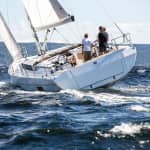
Daysailing also includes a large cockpit with plenty of space to enjoy and relax. On the J/7, the thwarts are 2.60 metres long. Up to four people can sit comfortably on them upwind when travelling. The benches can also be used as sunbathing areas. As a special design feature, a small bathing platform is separated from the cockpit aft.
Works well, even with mainsail only
The aluminium mast is on deck and can be easily rigged and de-rigged by hand using a hinge. The rig is also positioned very far forward in the boat. There is a good reason for this: the J/7 also shows good and balanced characteristics in the wind with a mainsail only. This was confirmed during the test in gusty conditions on Lake Zug. This pleases single-handed sailors, for whom the already extremely easy handling is made even easier - especially in strong winds.
With a width of 2.47 metres and a weight of just over one tonne, the J/7 can be easily transported on a trailer and with a mid-range car as a towing vehicle. A hot eye is available for quick launching and retrieval by crane and sling. Thanks to a draught of just 1.16 metres, the boat can also be launched just as easily via a suitable ramp. The rudder blade is only attached to the stern and can be removed in one easy step. However, a lifting or swivelling keel has never been an issue for J/Boats and is not an issue for the new small boat either.
Solidly built for an attractive price
The hull, deck and structural bulkheads of the J/7 consist of a sandwich construction with biaxial E-glass, a Corecell foam core and high-density core inserts for areas subject to higher loads, such as the fittings on deck. All components are built at J Composites using the weight-saving vacuum infusion process. The lead keel with L-shaped ballast body weighs a total of 476 kilograms with a total weight of just 1,044 kilograms. The proportion of ballast is therefore over 45 per cent, which ensures a high righting moment and therefore stable sailing characteristics.
Below deck, the small slip cabin offers space for a maximum of two people to sit and also just for protection against the weather. The concept does not provide for any more space. If you want, you can set up a sleeping area in the foredeck with sleeping mats or additional cushions. The area is large enough for this - even for two people. However, it is not really cosy below deck.
The exciting J/7 is offered with the basic basic equipment including the simple Dacron sails for an introductory price of 44,190 euros. Including 19 per cent VAT, the gross base price is 52,580 euros.
Technical data J/7
- Designer: Alan Johnstone
- Hull length: 7.04 m
- Waterline length: 6.35 m
- Width: 2.47 m
- Draught: 1.16 m
- Weight: 1,044 kg
- Ballast/proportion: 476 kg / 45.6 %
- Sail area upwind (genoa + main): 23,8 m2
- Motorisation: Outboard motor (petrol or electric)
Further links on the topic

Michael Good
Editor Test & Technology
