


- Deck jump makes the hull smile
- 4,500 hours of dedication for 16 feet
- Planks of the Haven Class bent by yourself
- Friend of the father left reference books
- Haven Class was designed by Joel White
- Retro design is suitable for trailers and slippers
- Long voyage planned with Haven Class
- Technical data of the Haven Class
It is one of those quiet, actually unspectacular, but nevertheless enchanting days on Lake Ammer. In early summer, the northern peaks of the foothills of the Alps are still covered in fresh snow. The soon to set in
Holiday hustle and bustle seems infinitely far away. Now there are hardly any walkers or cyclists strolling along the western shore near Utting, with only a few boats drawing keel lines through the water. The sky is slightly overcast, with the first patches of blue in between, the light soft, the lake lightly scaled by a gentle southerly wind.
Also interesting:
The picture-book idyll seems so enchanting, so surreally elegiac, that you almost start to doubt whether it is just a projection, a dream. Especially when Jonas Baedeker and his girlfriend Alice jibe through the field of buoys with their Haven Class.
Her small, graceful daysailer with an open cockpit, clear-painted steep gaff rig and red sails ennobles the moment and transports the scenery a good hundred years into the past. Yet only two weeks earlier, the boat had had water under its long keel for the very first time. A TV crew from Bayerischer Rundfunk also attended the christening at the slipway between the reed belt and the boat hire centre. Jonas, an architect in real life, has achieved national fame with "Uschi".
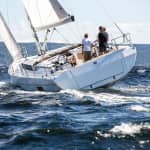
Deck jump makes the hull smile
In the corona lockdown, the 34-year-old from Dachau began building it himself as a garage project more than three years ago, based on plans from the USA. First the local press reported on it, then the "Süddeutsche Zeitung" also sent a team to make his work the subject of a multimedia documentary. Television was even there twice. An overwhelming response for a Slup measuring just 16 feet with classic lines.
The charm that makes the few passers-by on the lakeside path pause on this early summer's day is probably due to the likeable modesty that the boat and crew convey. Although the Haven Class is more suited to the US East Coast, where it was built, than to an Upper Bavarian lake, it radiates a casual authenticity, an unaffected presence that even non-sailors immediately recognise. "She's so pretty," says an elderly lady walking her dog reverently. And that's fair to say.
The deck moulding makes the hull smile, so to speak. The heart-shaped transom with the hand-brushed boat name contrasts beautifully with the white panelling. The entire running rigging is made of beaten rope, the blocks of beech wood, as if it were still the year 1914.
Jonas only oiled the ash coaming and the finely planed floorboards made of Siberian larch with Owatrol, not clear varnish, which makes them pleasant to the touch, to the feet and to the soul. For the frames, stem, transom and keel wood, he used wood from a chestnut tree that he had felled and sawn up years ago in northern Italy. It stood on a piece of land owned by his parents. He sawed and filed the cleat on the foredeck from a South American hardwood that a friend had brought him.
4,500 hours of dedication for 16 feet
The entire boat, measuring just 4.60 metres, has become a real gem - and at the same time a collection of memories and anecdotes. There is even a story about the trailer. It was built in 1977 and was used for a long time as a mobile base for a Varianta 65.
Jonas bought it via an online advert from an old gentleman who lives in the north of Berlin. When he heard what he was working on in the garage, he drove the trailer to Dachau himself - and a few days later sent him a parcel of wooden blocks. He would certainly be able to use them.
The boat with its classic lines and modest dimensions seems to fit like a universal key into the hearts of sailors and non-sailors alike. Jonas could easily have had the construction sponsored by fans and followers via a YouTube or Tiktok channel. But he didn't want that. On the contrary: for him, the Haven Class was a task "to get away from the computer".
On some days, he would only go into the garage, which he had converted into a shipyard, to work "in the wood" for an hour or an hour and a half or to think through a complex task - as a distraction in between, he says. "But I always tried to keep Fridays free and then spent at least six hours or more building the boat."
In the end, he has roughly calculated that the project has taken him 4,500 hours off his mind, almost ten hours per centimetre of torso length or three hours every single day over the past three and a half years. That is more than he had calculated, he admits.
Planks of the Haven Class bent by yourself
But it doesn't seem as if the time has become too long for him, the boat too much. And he didn't go into the work naively. "Uschi" is Jonas Baedeker's second self-built boat. During his civilian service, he had already tried his hand at a clinker-built rowing boat. It is now standing unplanned on the lawn and could do with some attention soon. It was his journeyman's piece, if you like. Anyone who talks to him for any length of time realises that the Haven Class may not yet have been his masterpiece, although it would undoubtedly be accepted as such by any chamber of crafts.
You have to look very closely and want to find even the smallest imperfections in order to criticise anything at all. The lines are so cleanly drawn, the joints so carefully joined.
At most, there are gaps at the stem and at the front of the coaming. Pedants might criticise a few visible screw heads in the cockpit. But that doesn't take anything away from the boat's charm, its class and its recognisably high level of craftsmanship. Especially as it was not a CNC-milled kit that "only" had to be assembled, which is not meant to sound disrespectful. But the steep gaff construction really is entirely handcrafted, even the mall frame.
Jonas bent the planks himself under steam, shaped and lengthened every frame, glued and planed all the Douglas fir spars himself. Apart from the sails, the standing rigging and a few fittings: all DIY.
He didn't need much for it. He had an old band saw, a cordless screwdriver, chisels, a plane, a calfing iron from the flea market and antiquarian hand drills that he had bought on eBay from a retired boat builder. Plus eight construction plans that served as a railing for the building process. Nothing else. He had ordered the drawings from WoodenBoat in the USA, a specialised publishing house with an affiliated boatbuilding school in Maine. There they are listed under the work number 75, the construction runs under the name "16 foot Haven 12 1/2 class", which we will come to later.
Friend of the father left reference books
The plans are labelled by hand and clearly dimensioned, albeit in inches and feet instead of the metric system. However, the price of around 170 euros does not include the order of the work or anything like instructions for building.
"I had already read up on most of what I needed to know before building the rowing boat," says Jonas. A friend of his father, who worked as a carpenter but had learnt boatbuilding, left him his collected reference books - including classics such as "Practical Shipbuilding" by Anton Brix, first published in 1900, and "How to Build a Wooden Boat" by David McIntosh and Samuel Manning. The architect and self-taught boat builder still raves about the line drawings today, having studied them many dozens of times.
If he was still stuck, he would watch online videos by like-minded Americans to learn a few tricks or sit in the garage on the captain's chair he had inherited from his grandfather to work out a solution himself. "That was one of my favourite things: thinking through a problem from all angles, without time pressure. I don't usually have that peace and quiet at work."
So, when the hull was planked and painted in two colours - white above the waterline and Swedish red below - he devised a kind of roll bar to turn it on its keel in front of the garage and cover it later, back in the garage.
He took his time with some details until after the christening. In July, he covered the gaff shoe with naturally tanned cowhide so that it would not rub against the mast. The mast itself was also given a sleeve where it is held in place by a bronze bracket before the forestay and shrouds are attached. It's like everywhere else: boats are simply never finished. There is always a detail that needs attention or reworking.
Haven Class was designed by Joel White
You can hardly tell that Jonas Baedeker had a limited budget for his own construction. If anything, you can see it in the rig fittings, where stainless steel splints, bronze clamps and tufnol clamps form a mix that is not entirely pure. But this in no way detracts from the fidelity to the original and the quality of his work. Rather, it is an expression of an uninhibited pride in his work.
The Haven Class was designed by a designer who is only known to a few in this country: Joel White. He created it in 1985, at a time when GRP series production had already largely replaced wooden boat building and self-build projects were no longer in great demand. However, White, who himself owned a 30-foot double-ender built at Walsted on the Danish island of Thurø, struck a chord with his sailing dinghy that still delights owners today.
All of his designs, including the late designs that he drew at the end of the nineties, show classic lines: slim hulls with long overhangs and flat superstructures. Most of them are long keels. You could call him a yacht-building romantic, inspired by the old guard of US designers.
He was most influenced by Nathanael "Nat" Herreshoff, the "Wizard of Bristol", as he was known because of his legendarily successful cracks. Some of White's designs are based on or inspired by Herreshoff, such as the Centre Harbor 31, a sloop based on the 30-foot ketch "Quiet Tune". Or the Haven, which was modelled on Herreshoff's famous 12 1/2.
The old master's keel dinghy was built hundreds of times; generations of Americans learnt to sail on her. And anyone visiting Mystic Seaport, this magical centre of historic sailing in Connecticut, can still cruise around the harbour on half a dozen of these iconic boats.
Retro design is suitable for trailers and slippers
The model name is derived from the waterline length, which is twelve and a half feet, the equivalent of 3.84 metres - exactly like Joel White's Haven. This looks very similar to Nat Herreshoff's model. From some angles, no differences can be recognised at all.
However, it has a slightly wider hull and - far more importantly - a centreboard glued from two wooden profiles, which carries 30 kilograms of lead in a cut-out and supplements the 280 kilos of ballast in the long keel. The variable draught makes the retro design suitable for trailers and slips. This is probably why the Haven 12 1/2 is the more accessible, more practical boat among the otherwise identical twins.
This feature was also decisive for Jonas in the end. During the on-site meeting with YACHT on the Uttinger Ufer, he and his girlfriend Alice demonstrate how easy it is to get their "Uschi" ready to sail and in the water. Even though it is only the third day of sailing, so not every grip is in place, it takes less than half an hour. The mast can even be hoisted by hand on the slightly swaying ex-Varianta trailer. Thanks to the steep gaff, it is only slightly longer than the hull - it measures just five metres.
A short time later, the Haven is afloat and the sails go up. And although the wind is blowing at barely more than 2 Beaufort, she immediately leans slightly to leeward on the wind and churns away with a temperament that is respectable for her age and the solid wood construction - so fast that you can't follow her for long in the rowing boat.
Long voyage planned with Haven Class
As the pressure increases slightly, she even produces a recognisable displacement wave amidships; at the bow, the water of the Ammersee splashes up happily at waterline level. You wouldn't have thought a hundred and ten-year-old would have so much vigour!
And no, we didn't measure top speed or the average over 500 metres, we didn't take any turning angles. It seemed inappropriate to us. Because this tiny, brave little boat was not designed for racing, not primarily anyway. Admittedly, one or two dozen of them still gather at class reunions today, which is never without a regatta - very much in the spirit of its forefather Nat Herreshoff.
However, Jonas and Alice have other things on their minds. The two are windsurfers, and when they want to travel fast, they get their boards out of the bus, which is now increasingly followed by "Uschi" in the slipstream and on the trailer coupling. They are planning a proper long trip: with cockpit tarpaulin, sleeping mat, sleeping bag, cooker and provisions in the fore and aft peaks.
Where to go has not yet been fully decided: down the Danube into the Black Sea was once the idea before the Ukraine war broke out. Now it is more likely to be the archipelago off Stockholm or the Dalmatian islands.
Jonas sometimes thinks even further ahead. Not with the Haven. He already has something else in mind, something bigger. How big? "I wouldn't build it in the garage any more," he says.
Technical data of the Haven Class

- Designer: Joel White
- Torso length: 4,60 m
- Waterline length: 3,84 m
- Width: 1,86 m
- Draught min./max: 0,50/1,04 m
- Weight: approx. 750 kg
- Ballast/proportion: 310 kg/48 %
- sail area: 14,4 m2
- Sail carrying capacity: 4,2

Jochen Rieker
Herausgeber YACHT
