


The IOR yacht "Düsselboot", built in 1981, won the Admiral's Cup as the "Outsider" in 1983. She is now considered a movable cultural monument and is to be refloated.
Probably the most famous piece of high-tech scrap in German sailing history is to be refloated The IOR racing yacht built in 1981 by Michael Schmidt as the "Düsselboot", which sensationally co-won the Admiral's Cup for Germany in 1983 as the "Outsider" in the hands of Tilmar Hansen from Kiel.
Also interesting:
Although it was the second success after 1973 in this then highly prestigious (and now revived) team event, for German sailing, victory 2 was the dawn of a new era and "Düsselboot" its breakthrough symbol: the first major international success of the later world-famous designer duo Judel/Vrolijk, radically conceived and fuelled by the unconventional free spirit of skipper and later Hanseyachts founder Michael Schmidt. And she was one thing above all: small. And she was also: light.
Homecoming of the "Düsselboot"
After several decades and in the hands of people with very different ideas about boat care and maintenance, she already looks a bit worn out and scruffy. There is no longer any sign of the original paintwork. Instead, it looks as if someone has spread old white wall paint on her with a tassel and traced a water line over her thumb.
The description of the ex-"Düsselboots" condition is of course a gross understatement - out of respect for the owner. Yes, this boat, which was difficult to sell at the time, has an owner! From Germany! He discovered the sad yacht in Baltimore (USA), where it was dismantled and shipped. This was also out of respect for the importance of this yacht for Germany.
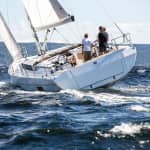
The new owner is a rather reserved architect from the Rhine-Main region, a patron who wants to use the boat to impart training and values ("to inspire other sailors"). A support organisation was founded for this purpose. Format and funding: unclear. As it is not far from the current owner's home to Düsseldorf, Petros Michelidakis, Director of the world's largest water sports fair, quickly declared the yacht's return home a matter close to his heart. In 2020, the "Düsselboot" was somehow lost at the eponymous "boot Düsseldorf", a somewhat touching sight for history-conscious trade fair visitors.
The "Düsselboot" at boot Düsseldorf
After all, the trade fair is virtually the home harbour of the "Düsselboot". A sponsorship project of unprecedented proportions started here in 1981. The high-tech yacht was once celebrated as a star here. Maker Schmidt on the deal at the time: "There had never been anything like it on this scale before, it pushed the trade fair out of the carnival corner." And here she was again, ready to sail on the fjord with offspring after a complete refit in Kiel - if the ambitious plan ever materialises.
A lot has changed since the 80s: This year, there is a two million euro inflatable boat in the motorboat hall, and the average size for the yachts there is growing and growing. So why has something that looks like a lump of old papier-mâché become one of the most important exhibits at the world's largest boat show?
Because Michelidakis considers sailing to be the "soul of water sports" - and is of course absolutely right. Because although the volume share of the overall market is probably rather manageable, especially for inexpensive sailing boats, without sailing there would probably be no trade fair at all. But back then it wasn't so easy with the commercial side and sailing. Financial aspects were considered rather indelicate and were kept quiet as far as possible, although large sailing campaigns had long been professionally organised and expensive. But overt sponsorship was simply forbidden. So the creative approach was to bring the new yachts so close to the business that the commercial connection was obvious, but just sufficiently concealed and therefore compliant with the rules.
"Düsselboot" is considered a "Mini Admiral's Cupper"
The mega-deal of the then boot captain Abdul-Rahman Adib, also known as "Mister boot", together with the trade fair company Nowea and Schmidt put an end to the concealed obviousness for the time being. However, "Düsselboot" also took part in the German competitions, but without the "ü" dot in England. The sailing gentlemen in the Solent were only allowed to call her "Dusselboot" - as if she were merely the boat of a foolish person.
"Düsselboot" was a novelty as the smallest cupper, a so-called "Mac". This has nothing to do with small computers or fast food, but is simply called "Mini Admiral's Cupper" and describes a trend favoured by the International Offshore Rule for designers to draw boats that were at the lowest limit of the rating band declared for the Admiral's Cup. They were measured so small that they were in principle only a stone's throw away from the then still Cup-foreign, but highly developed one-tonne boats with filigree trim and handling-sensitive 7/8 rigs and could use their sail areas, which were generous in comparison to the boat size, more effectively.
Yachts such as the "Düsselboot" by Judel/Vrolijk or the "Sabina V" by Kos de Ridder, which was still made of aluminium at Huisman, both of which were built in the 1981 Cup cycle, were pioneers of this trend. And they gave the larger competition a real run for their money thanks to their manoeuvrability and relative speed. "Mac" therefore stands for the invention of the sailing calf-biter.
Harbinger of a second wave of German success
In this case, invention means genuinely new territory. Wild experimentation with exotic materials was fashionable in the early eighties. Contemporary literature cites the "Düsselboot" as the "fastest building site off Kiel, surrounded by Schmidt's ingenious chaos".
"It started with the fact that we didn't even have any drawings when we started on the boat," says boat builder and fellow sailor Willi Reiners, who was responsible for production at Schmidt's own small yacht shipyard Yachtwerft und Reparaturen GmbH in Wedel near Hamburg at the time. "There was always an IYRU meeting in London in November, where the latest IOR rules were decided. But the boat had to go to the trade fair. That's when we built a deck."
The small yacht was therefore the harbinger of a second wave of German success after the early seventies, which led to two successive victories (1983 and 1985) - to what Schmidt rightly calls "German superiority in the offshore sector". "The lines were modelled on our already very fast half and three-quarter tonners," recalls Vrolijk. "And she was the first large composite Admiral's Cup yacht." "She was certainly oversized," says Reiners. "There were no concrete calculations. Experience yes, calculations no. So it was trial and error. And because we bonded the balsa core with Kevlar, the competition later called us 'bulletproof'. There was no epoxy yet, it was all isophthalic acid resin."
The competing crews were amazed: "We'd love to have an owner like that, who does without everything." Reiners: "The big yachts at the time at least had an owner's cabin - our luxury was an Origo cooker." Schmidt didn't mind; the boat had "nothing else to do but win". The fact that the small yacht was so radically sparse shocked the scene, but was also due to the project's tight budget.
Success and technical problems like genius and madness
This made it necessary to save on complexity and weight wherever possible. For example, there was only a plastic pipe that led into the cockpit as an exhaust pipe so that there was no need for a long hose. Roland Michael, the boatswain at the time, remembers: "It was actually practical for canal trips in the spring. You always had warm feet in the cockpit because the cooling water ran over the floor." Or the aluminium railing supports, which, however, broke off in the direction of the cockpit when the genoa was tied to them. A sawn-off aluminium ladder from the DIY store had to be used as a companionway. There was no wind measuring system at all.
"Düsselboot" was ready in good time and quickly showed what the project would be all about throughout the year: successes and technical problems were as close together as genius and madness at times. The mast buckled during training, the hydraulics failed again and again, the boat had a twist to port. But it won the inner-German elimination ahead of the older aluminium constructions "Pinta" and "Container"; both Peterson constructions, by the way, which Judel/Vrolijk radically modified. The highlight before the Cup itself: "Düsselboot" outclassed the entire competition of 1047 yachts in the traditional Round the Island (of Wight) race.
Success as an "outsider"
Then the low point in the Cup itself: mast breakage in the double scored channel race. In 36 hours, the crew shafted, screwed and riveted the thin profile back together. The conservative sailing establishment feels vindicated in its rejection of the "Düsselboot" project ("if you don't have enough budget, you should change class"). Only grand seigneur Hans-Otto Schümann is so enthusiastic about the breath of fresh air, the new technology and the team ("What they've put together is great") that he not only donates the wine for a crew evening, but also celebrates a farewell and starts cupper sailing again. The palm tree stays up and "Düsselboot" finishes fifth in the final Fastnet Race. Third place for the German team.
It's no wonder that the scene took notice of the "Düsselboot" principle. She quickly passed into the hands of her most successful owner Tilmar Hansen in 1983, who won the Cup with two "Outsiders" in succession. "IOR actually produced slow boats, but they were a good school. Today, it's probably difficult to inspire young people with yachts that run at nine knots." He says and turns to a TP52, which easily goes three times as fast.
He welcomes the repatriation, but has nothing to do with it. After the 1983 Cup, he was able to sell the boat to Berndt Hildebrandt in the USA, where she honoured her reputation as a calf-biter for a few more years. Then Hildebrandt slowly lost interest and the trail petered out.
Admiral's Cup 1983 is sensationally won
The 1983 Cup year was a very special one: the development of composite materials and their processing methods had progressed according to plan, especially when the first cuppers with honeycomb cores were baked into the wonder boats "Pinta" and "Container" designed by Judel/Vrolijk. Then the unthinkable happened: the "Outsider" kicked the new, more modern "Container" out of the team. "Pinta" did make it into the team. But before that, owner Illbruck insulted the German jury by saying that he only wanted to compete with his high-tech sister, "that's the only way we can win".
Things turned out differently in the Admiral's Cup itself. The Channel Race was a flat disaster. The little "Sabina" came second, "Outsider" fourth. The calf-biter's hour had come.
The boats measured at 30 feet at the lower rating limit for the Cup were unbeatable - they were fast relative to their racing value. The "little ones" became a real weapon in the battle against the very localised English sailing. Why the composition of a three-boat team for a country was so sensitive is rooted in the Solent and English Channel area - in lulls and currents, navigational pitfalls and "tidal gates", valve or concertina effects caused by strong tides, which often end at anchor until the tide turns again. And all this time the compensation clock is ticking. Bizarre.
Stefan Lehnert was a tactician in 1983, when "Düsselboot" sensationally won the Cup as an "outsider". He remembers: "The shape of the main bulkhead with less resistance and the design of the boat were probably decisive for the success. It was lighter than the aluminium boxes. The 7/8 rig was also a success factor, and the ship was sailed very well by a young gang." Lehnert continues: "After the 'Outsider' was taken over by Tilmar Hansen, there were already a few more ships based on the 'Düsselboot' concept worldwide. But the German ships were phenomenally better prepared and sailed in comparison."
New life for the "Düsselboot"
Boats like the "Düsselboot" were calculated for wear and tear. At the height of the Admiral's Cup fever in Germany, the rate of innovation was so high that there was a constant stream of new builds. On the other hand, a creative culture of hazardous waste disposal developed. Two hulls were simply sawn up ("Diva" and "Rubin"), the hull pieces were given away to the crews as souvenirs and another "Diva" was donated to the German Maritime Museum. It still stands there to this day.
There is another way. "Sabina V" sails in formidable condition on the Wannsee, "Düsselboot"/"Outsider" is back and is to sail with youngsters after a refit in Kiel. This is the vision of architect Frank Winter from Mülheim near Düsseldorf, who is trying with admirable tenacity to finance an elaborate restoration of the boat. To this end, the German Foundation for Monument Protection has also stepped in. It has given the scrap cupper the status of "movable cultural monument" and is funding its reconstruction. The foundation: Now there are dedicated people who want to refloat the sailing legend. The interior of the yacht is badly damaged and the keel, hull, deck, rigging, mast, engine and sails are also in a desolate state. With your donation, you can help to get the "Düsselboot" ready to sail again. In future, young sailors will be able to use her to train for regattas.
Long way to a ready-to-sail state
Wedel-Cowes-USA-Düsseldorf-Wedel. After a long journey, the "Düsselboot" is now being restored where it was built, just outside the Hanseatic city. Thorsten Jensen's shipyard there has been entrusted with the refit. "First of all, we want to get the Düsselboot out from under a layer of 21 millimetres of filler," says new owner Frank Winter. Other construction sites include the interior, where the conventional wall paint is falling off the surfaces. And the deck, where the foam core and the outer layers of the sandwich have become soft. Back at it again: the former builder of the boat, Willi Reiners. The former foreshipman of the "Düsselboot" is a retired surveyor and now supervises the construction at the shipyard and advises Frank Winter.
It is intended to serve young people for sailing training
Funding, however, is proving difficult. The German Foundation for Monument Protection has so far been able to provide 70,000 euros. Around 5,000 euros have been donated. Welcome money, but not nearly enough to get the boat sailing again. When the time comes, it will be used to show young people the way from dinghy sailing to ocean sailing in larger teams. Winter wants to give women in particular the opportunity to grow into professional sailing.
Technical data "Düsselboot"

- Designer: Judel/Vrolijk
- Shipyard: Yachtwerft und Reparaturen GmbH, Wedel
- IOR rating: 30.0 ft
- Torso length: 11,90 m
- Width: 3,83 m
- Weight: 5,8 t
- Construction method: Foam core, R-glass and iso-resin/hand lay-up method
The article was first published in 2020 and has been revised for this online version.
