


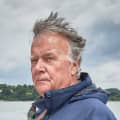
The elderly gentleman at the next table approaches Norbert Sedlacek, tentatively at first, then with increasing determination. The Austrian is just tucking into his midday salad rather listlessly, which he is eating outside the bistro of a large supermarket in the industrial estate. The passer-by rummages in a worn shoulder bag, pulls out a postcard and asks for an autograph. An autograph! From a sailor! One who hasn’t broken any records, won any Olympic medals or achieved any major victories. An adventurer – admittedly rather endearing, a wiry and alert man in his sixties – but one who simply hasn’t made a big splash yet.
Or is it? Sedlacek, on the other hand – the Austrian with the most nautical miles logged in racing mode in his personal logbook – now lives in France on the Atlantic coast, which goes some way towards explaining the rush to get his autograph. In Les Sables d’Olonne, no less – sacred ground, so to speak – the little harbour town that is regarded by enthusiasts of high-level offshoresailing, is regarded as both a Mecca and a legend, situated in the Vendée department, which lends its name to the non-stop single-handed round-the-world race that starts there. Norbert Sedlacek has already managed to take part twice in the ‘race of all races’ – the first German-speaking sailor to do so.

In 2004, having qualified thanks to a strong performance in the Atlantic race, he set off but was forced to abandon the race off Cape Town after 6,800 nautical miles. The keel mount had broken – fortunately before he reached the isolation and brutality of the southern oceans. But he carried on. In 2008 he was back in the race, once again underfunded and with no chance of success in a boat that, although completely refurbished, was outdated. He had already built the boat himself back in 2003 at Garcia’s in Normandy; the aluminium hull with a GRP deck is too heavy, but bulletproof, and the Austrian has no alternative.
Sedlacek to the *Der Spiegel* reporter: “The goal is the goal.” He achieves it. Eleventh place in a record field of 30 competitors. The fact that Michel Desjoyeaux took just 84 days to secure his second victory on *Foncia*, whilst Sedlacek took 126, is a mere detail. To date, Sedlacek is perhaps the happiest of all those who finished last.
The tough way to travel under sail
He had long since set his sights on his chosen pursuit: sailing the rough and tumble of the open seas. The son of a civil servant, he left his secure job as a tram driver in Vienna in 1996, at the age of 34, in favour of a more exciting life on the water. His first attempts at sailing, in a small cruiser just 18 feet long on the Adriatic, were followed by another boat he built himself. For three years, the 26-foot-long little boat took him from Grado on the Italian Adriatic back to Grado – single-handed and over long stretches.
In 2000/01, he became the first Austrian to circumnavigate Antarctica non-stop in 93 days, covering 14,300 nautical miles. He ventured as far south as 62 degrees south, a latitude that no racing yacht reaches today due to the safety limits imposed in international races. His vessel: a 54-foot aluminium yacht of the Passoa 54 class; he helped build the boat at Garcia’s in Normandy – yet again. He writes books, gives talks and becomes managing director of Marina Wien. But that, once again, is not what he’s good at or what appeals to him.
The Vendée becomes the centre of his life. Two marriages, two round-the-world races and years on: he is still seeking the ultimate challenge; he has matured and is well prepared. But Sedlacek lacks the money, the youth and the right boat to take part in the Vendée again. He would need at least five million euros; he is no longer a spring chicken; and his Vendée boat was already, back in 2008, “more of a death trap than a racing yacht” (“Yacht-revue”).
Volcanic rock fibre for boat building
Sedlacek discovers a new, additional topic – one that, at the time, wasn’t really a topic at all: sustainability in boatbuilding. He is particularly taken with volcanic rock fibre. The material is extruded into fibres from solidified and remelted magma, which can then be processed into sheets. The material is not new, but is considered fragile and difficult to work with. Together with his sponsor Kapsch, Sedlacek finds ways to lay the fibres—which are almost as strong as carbon fibre in the longitudinal direction—without weakening them. He builds a test vessel himself (how could it be otherwise?), the ‘Fipofix’. The design, by his then-wife Marion Koch, is a scaled-down Open 60 – an Open 16, so to speak: smaller than a Mini, more like a Laser with a cabin. The bright yellow, cute little craft was supposed to sail from Les Sables to the USA and back, just to demonstrate the performance capabilities of the design. Of course, things turned out differently.
The fibre manufacturer and partner company goes bankrupt, yet he sets off anyway; the boat has problems with its power supply and is towed into Gijón, during which the rudder fittings break. Business deadlines are looming, time is running out, so Sedlacek sends his son Harald – who has already provided technical support on several projects – to complete the Atlantic crossing. He manages it, but the outward journey in particular is gruelling, averaging less than three knots. On the return leg, they manage almost five knots. Harald is exhausted, having spent a total of over 130 days on the tiny boat. But the boat comes through it all with flying colours.
The Open 60AAL, an Imoca derivative, is taking shape
His father is thinking ahead: now it’s time for a major project, and he’s drawn back to the sea anyway (“I need to do something; I’m not very good at sitting on the sofa”). Through his company, Innovation Yachts – which he was running at the time together with Marion Koch – he secured support from the local council in Olonne and, more importantly, a silent investor. On top of that, he had numerous partners such as Dimension-Polyant, Incidences Sails, Harken and FSE Robline, who supplied materials and technical support.
At the entrance to the town, in the harbour area, they have provided him with a 400-square-metre hangar, plus an office and spaces for motorhomes. Some of the freelance team members are happily based there – a likeable international mix of migrant workers and professional riggers, crew members for regatta yachts. Sedlacek is delighted: “That way we save ourselves the trouble of keeping watch.” This is where the boat was built; it’s now afloat. Interestingly, it’s the first Open 60 to have been built in Les Sables. Actually, that’s not quite right either, because it isn’t really an Open 60 – with three centreboards, it has too many moving underwater parts. The third centreboard is positioned centrally in front of the keel and is designed to protect it from ice and flotsam. Furthermore, the keel fin is welded rather than milled, and the boat has not yet passed a heel test.
Further differences lie in the aforementioned volcanic fibre and a special epoxy resin, which is harmless to health, biodegradable and recyclable. The sandwich core is made of certified balsa wood; foam was typically used on regatta yachts at that time.
Sedlacek prioritises safety
The ‘Innovation Yachts’, named after the shipyard and measuring 18.30 metres in length and 5.80 metres in width, can be shredded and then given a new lease of life as a panelling panel in a passenger vessel, a piece of furniture or a shower screen. The mast and boom are made of carbon fibre, whilst the standing rigging is made of Rod. The 29-metre rig is mounted on deck and is tensioned hydraulically. “We put less strain on our boat. A modern IMOCA, such as the ‘Virbac’, carries a 30-tonne load at the mast base – we only have about half that,” said the skipper during YACHT’s visit on board. But his boat is also heavier: it tips the scales at 9.5 tonnes, whilst an Open 60 designed uncompromisingly for speed weighs a full two tonnes less. This is due not only to the calculated fibre properties, but also to the safe construction method.
To make the boat resistant to floating debris, water ingress and capsizing, it is fitted with seven watertight bulkheads and a double bottom divided into several sections; the laminates are of a heavier gauge. Sedlacek prioritises safety. For example, all halyards are duplicated. He has two self-contained autopilots on board and four independent GPS receivers.
A notable feature is the engines. Two electric drives from Oceanvolt have been fitted. Weighing just under 50 kilograms each, the units can be raised up through shafts by pulling on a rope, thereby reducing water resistance and the risk of collision; when decoupled, they function as hydrogenerators, generating electricity through energy recovery – at a speed of seven knots, this is said to amount to 2.3 kilowatts. As there is a risk of overload at high speeds, one of the two propellers is an adjustable model that automatically adapts its pitch to the speed. The pods power a large bank of lithium-ferrite batteries. Cooking is done by induction, so there is neither diesel nor gas on board – no fossil fuels at all. Sedlacek wants to do without packet food (“too bland”). He opts for a more conventional – and even enjoyable – source of calories: from chocolate bars to crisps and “chewy sweets”, there’s also something healthy for the soul. According to the inventory list, there are a total of 603,344 kilocalories on board, not including contraband or last-minute farewell gifts. That works out at around 3,000 kilocalories a day, as Sedlacek is planning for a 200-day trip.
Record is set to secure a breakthrough in volcanic fibre
A figure that is difficult to calculate; the only certainty about the route is its unpredictability. The voyage begins on 29 July, heading for Greenland and Baffin Bay, and from there through the Northwest Passage. Whether this will be navigable, whether the more direct route will be clear, or whether detours will be necessary, will only become apparent once we are there. The distances along the seven different routes vary by 3,100 nautical miles. Moreover, it is by no means clear whether the passage can be completed in one go this summer. Incidentally, a record was set there in 2017, when 23 yachts completed the route; in each of the two previous years, the figure had been twelve.
This is followed by a long stretch across the Pacific along both American west coasts, first with the north-easterly trade winds, then more or less against their south-easterly counterparts, culminating in the first rounding of Cape Horn. Circumnavigating Antarctica, mainly with westerly winds, is familiar territory for the Austrian. Then Cape Horn is to be rounded for the second time. The return journey follows the classic south-north Atlantic route and, via the Azores High, back to the home port. The big figure of eight.
Sedlacek has now changed his route; he felt that the passage through northern Canada was too unsafe from a regulatory point of view. He will now sail round Spitsbergen and then head south into the Atlantic, rounding the Cape of Good Hope first.

Why this route – effectively a double circumnavigation of the globe? “Quite simply: because no one has done it yet,” says Sedlacek. In fact, the American Rendell Reeves, who set off from San Francisco in autumn 2017, had to abandon his similar project and is now on his way to completing a conventional round-the-world sail. He is doing so on the ‘Asma’, built in 1998 by Dübbel & Jesse (Norderney), on which Clark Stede from Augsburg circumnavigated both Americas (albeit as deck cargo for part of the Northwest Passage).
Sedlacek is not just aiming for a first; he hopes that, following a success, he will be able to help volcanic rock fibre and recyclable boats achieve a breakthrough in yacht building. Innovation Yachts has calculated that, whilst the raw material cost of the laminates for the hull and deck is around twice that of a conventionally built boat, the difference accounts for only around one per cent of a boat’s total value. And this is achieved using a fibre that is superior to glass.
It’s a long road ahead, especially for Norbert Sedlacek on the water. Anyone who knows him realises – and his CV backs this up – that the former taekwondo athlete will fight on, and he will achieve a great deal. If not at the first attempt, then after giving it another go. He may be a divisive figure, but not only has he achieved things others can only dream of – he keeps going and going.
The article was first published in 2018 and has been revised for this online version.
Technical specifications of the “Innovation Yacht”
- Designer: Marion Koch, Vincent Lebailly
- Concept: Norbert Sedlacek
- Shipyard: Innovation Yachts
- Construction method: About Positive Form, Vacuum
- Materials: Volcanic fibre-balsa sandwich
- Fuselage length: 18.30 m
- Width: 5.80 m
- Draught: 4.50 m
- Mast height: 29.00 m
- Weight: 9.5 tonnes
- Ballast/proportion: 4.1 t/43 per cent
- Mast/shrouds: Carbon/Rod
- Sail area when sailing close-hauled: 261.0 m²
- Lift-to-drag ratio: 7.6
- Motor (electric): 2 × 10 kW
About Norbert Sedlacek

Born in Vienna in 1962, he left behind a career as a waiter and tram driver to pursue a career in sailing. From 1996 to 1998, he sailed round the world in a 26-foot boat he had built himself. This was followed by a circumnavigation of Antarctica and, finally, two appearances in the Vendée Globe Challenge.
The designer Marion Koch

Marion Koch was Sedlacek’s third wife and, together with Vincent Lebailly, a designer at ‘Innovation Yachts’. The Austrian studied sports equipment design and focused her master’s thesis on the structural integrity and hydrodynamics of Open 60s. The sailor has been working as a yacht designer since 2009; in addition to a 90-foot cruising yacht and other boats, she designed the Open 16 ‘Fipofix’.
Norbert Sedlacek on YACHT TV
Fridtjof Gunkel
Deputy Chief Editor YACHT