


Innovation Yachts: Nordbert Sedlacek starts 6th record attempt with his stone boat
Fridtjof Gunkel
· 01.02.2026


The elderly gentleman at the next table approaches Norbert Sedlacek, tentatively at first, then more and more purposefully. The Austrian is somehow cheerlessly tackling his lunchtime salad, which he is eating in front of the bistro of a large supermarket in the industrial estate. The passer-by rummages in a worn shoulder bag, pulls out a postcard and asks for an autograph. An autograph! From a sailor! Someone who hasn't broken a record, hasn't won an Olympic medal and hasn't achieved a major victory. An adventurer, somehow endearing, a wiry and alert over-60-year-old - but one who hasn't yet pulled a big sausage off the plate.
More on the topic:
Or is he? Sedlacek, on the other hand, the Austrian with the most nautical miles in racing mode in his personal log, now lives in France on the Atlantic - which rather explains the hunt for the autograph. In Les Sables d'Olonne, the holy ground so to speak, the harbour town that is considered both a Mecca and a myth for fans of upmarket offshore sailing, located in the Vendée department, which gives its name to the non-stop single-handed world regatta that starts there. Norbert Sedlacek has already managed to take part in the race of all races twice and was the first German-speaking sailor to do so.
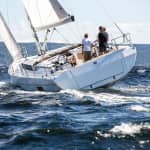
In 2004, qualified by a good Atlantic race, he starts the race, but has to give up off Cape Town after 6,800 nautical miles. The keel suspension broke, fortunately before the remoteness and brutality of the southern oceans. But he carries on. In 2008 he is back, again underfunded, with a completely renovated but outdated boat and no chance. He had already assembled the boat himself at Garcia in Normandy in 2003; the aluminium construction with GRP deck is too heavy, but bulletproof, and the Austrian has no alternative.
Sedlacek to the "Spiegel" reporter: "The goal is the goal." He achieves it. Eleventh place in a record field of 30 starters. The fact that Michel Desjoyeaux with "Foncia" only needs 84 days for his second victory and he needs 126: a minor matter. Sedlacek is perhaps the luckiest of all the last ones to date.
The hard tour under sail
By then, he had already set his sights on the hard tour under sail. In 1996, at the age of 34, the son of a family of civil servants left his secure job as a tram driver in Vienna in favour of a more exciting life on the water. His first attempts at sailing with a small 18-foot cruiser on the Adriatic were followed by another self-built boat. For three years, the tiny 26-footer carried him from Grado on the Italian Adriatic to Grado, single-handed and with long passages.
In 2000/01, he was the first Austrian to circumnavigate the Antarctic in 93 days over 14,300 nautical miles, non-stop. He travelled as far as 62 degrees south, a latitude that no regatta boat reaches today due to the limits set for safety reasons in the world races. His base: a 54-foot aluminium yacht of the Passoa 54 type; he helped build the boat at Garcia in Normandy, once again. He writes books, gives lectures, becomes managing director of Marina Wien. But that's not what he can do and what appeals to him.
The Vendée becomes the centre of his life. Two marriages, two world regattas and years on: he is still looking for the extreme route, he is mature and equipped. But Sedlacek lacks the money, the youth and the right vehicle to take part in the Vendée again. He would need at least five million euros, he is no longer the youngest, and his Vendée boat was already "more soul seller than regatta goat" in 2008 ("Yachtrevue").
Volcanic stone fibre for boat building
Sedlacek discovers a new, additional topic, one that is basically not yet a topic at the time: sustainability in boat building. He was particularly interested in volcanic rock fibre. The material is extruded from solidified and re-melted magma into threads that can be refined into fabrics. The material is not new, but is considered fragile and difficult to process. Together with his sponsor Kapsch, Sedlacek is finding ways to lay the fibre, which is almost as strong as carbon in the longitudinal direction, without weakening it. He built a test vehicle himself (how could it be otherwise), the "Fipofix". The construction of his then wife Marion Koch is a shrunken Open 60, an Open 16 so to speak: smaller than a Mini, more like a Laser with a cabin. The bright yellow, cuddly vehicle was supposed to sail from Les Sables to the USA and back to demonstrate the performance of the design. Of course, things turn out differently.
The fibre manufacturer and partner company goes bankrupt, but he starts anyway, the boat has problems with the power supply, it is towed into Gijon and the rudder fittings break. Business appointments are pressing, time is running out, Sedlacek has his son Harald, who has already provided him with technical support on several projects, complete the Atlantic tour. He manages it, but the outward journey is particularly arduous, with an average speed of less than three knots. Almost five on the way back. Harald is exhausted, having spent a total of over 130 days on the Seezwerg. But the boat passes everything with flying colours.
Imoca derivative Open 60AAL is created
His father thinks ahead: now he wants a big project, and he is drawn back to the sea anyway ("I have to do something, I'm not so good on the sofa"). With his company Innovation Yachts, which he runs together with Marion Koch, he finds support from the municipality of Olonne and - more importantly - a silent investor. On top of that, many partners such as Dimension-Polyant, Incidences Sails, Harken and FSE Robline, who supply materials and technical support.
At the entrance to the town in the harbour area, they have provided him with a 400 square metre hangar, an office and space for mobile homes. Some of the freelancers live there happily, a friendly international mix of migrant workers and professional preparers, boat people for regatta yachts. Sedlacek is happy, "it saves us the guard duty". The boat was built here and is now afloat. Curious: It is the first Open 60 to be built in Les Sables. Actually, that's not true, because it's not really an Open 60 - with three centreboards, it has too many moving underwater parts. The third centreboard sits in the middle in front of the keel and is intended to protect it from ice and flotsam. In addition, the keel fin is welded and not milled, and the boat has not yet passed a heeling test.
Other differences lie in the aforementioned volcanic fibre, in a special epoxy resin that is harmless to health, biodegradable and recyclable. The sandwich core is certified balsa wood, whereas foam is usually used on regatta yachts.
Sedlacek focusses on safety
Named after the shipyard, the 18.30 metre long and 5.80 metre wide "Innovation Yachts" can be shredded and then be used for a second life as a finishing panel in a cruising boat, as a piece of furniture or as a shower enclosure. The mast and boom are made from carbon fibre, the standing rigging from rod. The 29-metre rig is on deck and is tensioned hydraulically. "We put less strain on our boat. A modern Imoca like the 'Virbac', for example, has a load of 30 tonnes on the mast foot - we only have about half that," says the skipper during the YACHT on-board visit. But his boat is also heavier: 9.5 tonnes hang on the scales, while an uncompromisingly speedy Open 60 weighs a whole two tonnes less. This is not only due to the calculated fibre properties, but also to the safe design.
To make the boat resistant to flotsam, water ingress and sinking, it is equipped with seven watertight bulkheads and a multi-partitioned double floor, and the laminates are thicker. Sedlacek focusses on safety. All the traps are double, for example. He runs two self-sufficient autopilots on board and four independent GPS receivers.
The motors are a speciality. Two electric drives from Oceanvolt were installed. The units, each weighing just under 50 kilograms, can be moved upwards in shafts using a line pull, thus reducing water resistance and the risk of collision; when deployed, they work as hydrogen generators, supplying electricity via recuperation - at a speed of seven knots, this should already be 2.3 kilowatts. As there is a risk of overload at high speeds, one of the two propellers is an adjustable model that automatically adapts its pitch to the speed. The pods feed a large bank of lithium ferrite batteries. Cooking is done by induction, so there is no diesel or gas on board, no fossil fuels. Sedlacek wants to do without bagged food ("too bland"). He opts for a more conventional and even joyful calorie intake: from chocolate bars to crisps and "gummy stuff", there is also something healthy for the soul. According to the inventory list, a total of 603,344 kilocalories are on board, not including contraband and late farewell gifts. That's around 3000 kilocalories a day, as Sedlacek is planning on 200 days.
Record to ensure breakthrough of volcanic fibre
A value that is difficult to calculate, the only thing certain about the route are the uncertainties. The start is on 29 July, then it's off to Greenland in Baffin Bay and from there through the Northwest Passage. Whether this will be passable and the more direct route will be free or whether detours will be necessary will only become clear on the spot. The distances on the seven different routes vary around 3100 nautical miles. It is not at all clear whether the passage will be completed in one go this summer. Incidentally, there was a record in 2017, with 23 yachts completing the route, compared to twelve in each of the two previous years.
Then follows a long Pacific stretch along the two American west coasts, first with the north-east trade wind, then more or less against its south-east counterpart, finishing with the first rounding of Cape Horn. Antarctica round mainly with westerly winds is again familiar terrain for the Austrian. Cape Horn will then follow for the second time. Return on the classic south-north Atlantic route and around the Azores High back to the home harbour. The big eight.
In the meantime, Sedlacek has changed his route, as the passage in northern Canada seemed too unsafe to him from the authorities' point of view. Now he is travelling around Spitsbergen and then down into the Atlantic, first around the Cape of Good Hope.

Why this course, the double round-the-world trip, so to speak? "Quite simply: because no one has done it before," says Sedlacek. In fact, the US American Rendell Reeves, who set off from San Francisco in autumn 2017, had to abandon his similar project and is now on his way to completing a conventional circumnavigation. He did so on the "Asma", built by Dübbel & Jesse (Norderney) in 1998, on which Clark Stede from Augsburg circumnavigated both Americas (albeit part of the Northwest Passage as deck cargo).
Sedlacek not only wants first-class performance, he also hopes that success will help volcanic fibre and recyclable boats achieve a breakthrough in yacht building. Innovation Yachts has calculated that although the pure value of the laminates for the hull and deck is around twice as high as for a conventionally built boat, the difference in the total value of a boat is only around one per cent. And this with a fibre that is superior to glass.
There is a long way to go until then, especially for Norbert Sedlacek on the water. Anyone who knows him knows - and his CV confirms this: the former taekwondo athlete will fight, and he will achieve a lot. If not the first time, then after another attempt. The man may be polarising, but he has not only achieved things that others dream of - but he continues to do so.
The article was first published in 2018 and has been revised for this online version.
Technical data of the "Innovation Yacht"
- Design engineer: Marion Koch, Vincent Lebailly
- Concept: Norbert Sedlacek
- Shipyard: Innovation Yachts
- Construction method: About positive form, vacuum
- Materials: Vulcanised fibre balsa sandwich
- Torso length: 18,30 m
- Width: 5,80 m
- Depth: 4,50 m
- Mast height: 29,00 m
- Weight: 9,5 t
- Ballast/proportion: 4,1 t/43 %
- Mast/shrouds: Carbon/Rod
- Sail area on the wind: 261,0 m²
- Sail carrying capacity: 7,6
- Motor (electric): 2 x 10 kW
About Norbert Sedlacek

Born in Vienna in 1962, he left behind jobs as a waiter and tram driver to pursue a career in sailing. From 1996 to 1998, he sailed around the world in a self-built 26-footer. This was followed by a circumnavigation of the Antarctic and finally two participations in the Vendée Globe Challenge.
The designer Marion Koch

Marion Koch was Sedlacek's third wife and, together with Vincent Lebailly, the designer of the "Innovation Yachts". The Austrian studied sports equipment design and focussed on the strength and hydrodynamics of Open 60s in her master's thesis. The sailor has been working as a yacht designer since 2009 and has designed the Open 16 "Fipofix" in addition to a 90-foot cruising yacht and other boats.
Norbert Sedlacek at YACHT TV
Fridtjof Gunkel
Deputy Chief Editor YACHT
