


"Container" from 1991: The second life of a legendary German winning yacht
Fridtjof Gunkel
· 21.12.2025


Sailed by professionals, she was one of the most successful German yachts. Today, anyone can turn the wheel or winch on the former "Container". This is made possible by the Mediterranean Yacht Club.
"Container" - not a great boat name by association, but one with a thunderous echo in international ocean sailing. And still is. The yachts owned by entrepreneur Udo Schütz from Selters in the Westerwald region are synonymous with success and professionalism on the regatta circuit, just like the various racers called "Rubin" owned by Hans-Otto Schümann from Hamburg or "Pinta" owned by the Illbruck family from Leverkusen. What all three racing teams had in common, apart from their great successes, was a love of sailing and, even more so, a love of technology, an involvement with regatta sport down to the last detail.
Also interesting:
- "Pinta Smeralda": Willi Illbruck's last monument is a cruising boat
- Inclusion: Mixed crew gets the former "Illbruck" up to speed
- Listang: OR quarter-tonner was ahead of its time
- One-tonne "New Yorker": Ex-Admiral's Cupper with rough edges is a relic of an era
- Admiral's Cup: Golden Cup - the big story in the timeline
Schütz, a manufacturer of chemical containers and materials for the aerospace industry with a turnover in excess of one billion euros, produced the first honeycomb composite racers together with Willi Illbruck in 1983, using a sandwich core material made from resin-impregnated paper honeycomb. The lightweight core acts as a spacer between the outer laminate layers, which increases the strength exponentially with increasing thickness, just like the principle of the double T-beam. The yachts, which are also compacted under heat and vacuum over a steel core, were built at a time when aluminium was still a viable option for regatta boats and plastic was only considered suitable for series production - a revolution, one that ushered in today's modern yacht building and helped win the Admiral's Cup in 1983. Albeit not in the hoped-for and planned way for self-made man Schütz.
"Container" becomes a technology and test vehicle
"Pinta" and "Container" proved to be the fastest boats, but the latter of all boats lacked points in the German elimination series. In the series, which included regattas off Kiel and Helgoland, the team of three boats that would have the honour of representing Germany in the Cup was to be determined. Firstly, "Container" was unable to start a race because someone had stolen the mainsail. Secondly, there was a serious tactical error at Rund Helgoland during the North Sea Week, when the only professional sailor on the boat, who was in the lead, abandoned his cover and jibed into the long lee of the rock.
The "Pinta" won the series, the two-year-old revolutionary former "Düsselboot" entered the team under its new name "Outsider" with a strong performance, and the "Sabina" - an even older aluminium boat of all things - came third. Schütz had supplied the technology and also promoted the "Pinta" as a sparring partner - but the former Porsche works driver was denied the reward for all his hard work.
But his "Container" served as a technology and test vehicle, the honeycomb material was developed further and further and was used in all later yachts of this name. In 1984, in an even lighter sister ship that won the Sardinia Cup - again with "Pinta" in the team and an almost sister ship, the top-rigged "Rubin", number 7. These were glorious years for German ocean racing, which also made the Judel/Vrolijk & Co design office big and well-known, and which is now a world leader in many segments.
Surprising victory for the German "containers"
Smaller one-tonne boats and two 50-footers followed under the name, no, the seal of quality called "Container", which had also been constructed in accordance with the International Offshore Rule that had been in use for many years. But it would be ten years before they won the Admiral's Cup, the unofficial offshore sailing championship, which they had been aiming for since 1983. With "Pinta", "Rubin" and now also "Container", the big three made up the team in 1993. The favourites were the Italians, who had already driven professionalism to today's level. Trained and well-paid top sailors travelled to Cowes with the best-prepared equipment and their own cook. Other favourites were the French, who had won the previous year with actually inferior boat material thanks to brilliant and extremely small-scale weather forecasts.
It turned out differently. The Italian 50-footer "Mandrake" irreparably destroyed itself and its authorised opponent, and the exceptional two-tonner "La Rouge" lost its rig in the final Fastnet race. Germany surprisingly won the Cup with the narrowest margin in Cup history of 0.25 points with 279.13 total points. Schütz had finally made it and set further highlights with victories in the international 50-footer circus.
He then ended his career, but kept his last boat in the company, which continued to use it in the Mediterranean for trips with business partners. After comebacks with STP 65 and TP 52 yachts, what was probably the best-preserved IOR boat of its era was put up for sale and went to the Mediterranean Yacht Club (MYC), which was founded in 2012.
Mediterranean Yacht Club (MYC) provides "containers"
And it is a curiosity. A handful of German sailors, many of whom work in the water sports industry, such as the former "Container" sailors Sven Hadler and Guido Bastek, were looking for a boat so that they could have fun in winter too, and founded the MYC without further ado - also, as Hadler says, to preserve "this sailing cultural asset". The club is registered with the Schleswig-Holstein State Sports Association, now has more than a hundred members and has become highly internationalised. They come from Germany, Spain, Switzerland and Austria, as well as from Sweden, Poland, Holland and Liechtenstein. Mallorca can be reached easily and cheaply from anywhere in Europe, which strengthens and nourishes the MYC. It deserves the credit for maintaining "Container" from 1991. The members maintain the boat themselves with a little professional help and use it for their goal of "promoting sailing as a recreational and competitive sport".
The club takes part in the winter series of the Club de Vela Puerto de Andratx, but also in international events such as the Palmavela or the Voiles de St. Tropez. If you are the first to sign up, you pay an additional 15 euros a day on top of your annual membership fee of 250 euros - and for this relatively small amount of money you can sail an old but legendary cupper, which is also in pretty good condition, as the visit on board shows.
Club has a young average age with a high proportion of women
However, time has noticeably moved on. The stern is narrow with the typical survey hoe at the aft belt station. There is only one wheel (subsequently swapped for the tiller steering), which runs through a trench in the cockpit floor. The cockpit is huge, has neither coaming nor benches, but plenty of winches. And then there's the rigging: neutrally positioned, non-swept spreaders and double backstays support a filigree 7/8 rig with a jumpstay and heavily tapered top section. The shrouds are attached to the inside of the deck. All in all, a geometry designed to maximise sail trim options and overlapping headsails, hallmarks of the IOR era.
The crew slowly drifts in, joking and chatting. Two of them lay out the sheets, others stow the headsails and look for the Genoa IV. Nobody really feels the need to delegate. The atmosphere is relaxed, it's not about anything, just a short trip. At around 40, the average age of the entire club is not too old and the proportion of women is high.
The older training mainsail is not on board, a volunteer delegation drives to the container of the "Container", which is parked at the side of the road in a field and takes tools, spare parts and even more of the extensive wardrobe. There is no shortage of sails: they have three mainsails, nine genoas, two jibs, spinnakers and gennakers as well as eleven spinnakers, so you can get mixed up and spend a lot of time searching.
And just as it happens: the first sailors are already heading back to the harbour pub, taking it easy or trying to. Club chairman Hans-Ulrich Heisler is relaxed, "that's just the way it is, and why get upset, we're all here for fun". Things only get serious when it comes to safety, the yacht dealer continues, and when it comes to damage, i.e. costs. In this context and in view of the delicate rig, which is highly prone to errors in the jibe in strong winds, in combination with the heterogeneous level of training of the various sailors, he is surprised that the mast has not already come down from above.
Sailing on "Container" should first and foremost be fun
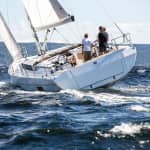
At some point, the boat sets off. The "MYC One" pushes a brilliant displacement wave with a white crest onto the azure blue sea off Andratx. Everything works, the winches clack quietly and neatly, the blocks turn silently, the wheel transmits the steering commands without slipping. The boat works without giving the impression of being over-maintained.
The crew has fun, but has to sort out who does what and when and where they sit. It doesn't really run smoothly, nor does it have to. After all, the level is very different and the club has also set itself the goal of training. New sailors are trained by the regular crew. Or as fellow sailor Jutta Birfelder, a wedding planner from Mallorca, puts it while standing at the wheel: "It's not a training centre here."
But it's a club whose concept is clearly working and which is even expanding its boat fleet. It now has three Laser dinghies moored in Arenal, as well as a Sun Odyssey 45 and a Dufour 355 at the Real Club Nautico in Palma de Mallorca - a small, chic fleet for every taste. But the flagship remains the "MYC One", which is used like a large daysailer - and is not suitable for much more. It would be ideal for long journeys, but as an overnight accommodation option in the harbour, it only works with a very sporty attitude. The interior of the ship has been kept true to the original, i.e. equipped in accordance with the cosiness regulations of the International Offshore Rule. Whereby cosy means: berths (tubular frames that can be adapted to the heel), galley (coal board with cooker and plastic bowl), toilet (free-standing chemical toilet, now with curtain).
The interior is open, it has no bulkheads, only thin ring frames, high stringers and a strong floor assembly. Various trim lines are led aft below deck and emerge from the deck within easy reach of the mainsheet trimmer. The drive shafts of the grinders whir under the cockpit floor. The ship seems healthy. Nothing cracks or creaks.
Just like back in the glory days, which you can immerse yourself in again thanks to the Mediterranean Yacht Club. Never before has it been so easy and so affordable to sail on a cupper - and on a legendary German winning yacht to boot.
Unfortunately, that is now also history. "Container" was sold to an Englishman who took her to the Spanish mainland. The Mediterranean Yacht Club has acquired a First 44.7, a modern production boat that is somewhat easier to sail and offers significantly more comfort.
Technical data of the generations in comparison
"Container" 1991

- Type: IOR-50 foot
- Shipyard: Schütz works
- Construction: Judel/Vrolijk & Co
- Torso length: 15,15 m
- Width: 4,57 m
- Depth: 2,91 m
- Weight: 12,5 t
- Mainsail: 90 m²
- Foresail: 77 m²
- Spinnaker: 165 m²
- GPH: 546 sec/nm
- Sail carrying capacity: 5,57
- Rig: Four salings, double baking days, jump day
"Container" 2011

- Type: TP 52
- Shipyard: Knierim
- Construction: Judel/Vrolijk & Co
- Torso length: 15,85 m
- Width: 4,30 m
- Depth: 3,35 m
- Weight: 7,3 t
- Mainsail: 93 m²
- Fock: 65 m²
- Gennaker: 260 m²
- GPH: 451 sec/nm
- Sail carrying capacity: 6,48
- Rig: Three spreaders, double figure of eight stays
The article was first published in 2017 and has been revised for this online version.

Fridtjof Gunkel
Deputy Chief Editor YACHT
