


Order is in the nature of the DS27. The 8.30 metre long daysailer project started with the desire for a tidy and efficient deck for "maximum sailing pleasure with minimum preparation". Fast sailing on a responsive and easy-to-handle boat that can also be manoeuvred in a relaxed manner should follow a speedy launch.
For the "Laid Back" attitude, the back cushions are positioned on solid railings in stub format. The lines on the mast are concealed under small bonnets and the cockpit is neat and tidy, as expected. Some of the halyards and sheets are led below deck to the long foot rails at tiller height. There is no traveller to get in the way. The mainsheet is taken up by a narrow-legged cockpit above the rudder head.
"High-quality export product"
The retractable twin rudders hang from the transom, the swing keel reaches a maximum of 1.90 metres downwards or nestles against the underwater hull with a residual draught of 0.70 metres for trailering. A fixed T-keel is available on request. The DS27 has also been designed so that it can be transported and stored in a 40-foot container.
The man behind the project is Argentinian Juan Pablo Gomez Lamarque, who worked together with Javier Soto Acebal. "We are utilising Argentina's first-class nautical expertise to develop a high-quality export product that can compete in the premium segment of Europe and North America and is specifically geared towards the demand for integrated technology and intelligent systems," says Gomez Lamarque.
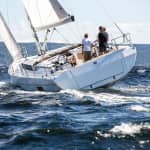
Round crack from Soto Acebal
The collaboration with Soto Acebal Naval Architects began almost a year ago. The Argentinian design office is known for striking designs commissioned by Solaris. From the front, the DS27 shows a full bow section with a softened flat nose; from a bird's eye view, the outline presents itself in a consistent delta shape: almost half of the deck is rectangular and 2.70 metres wide. And yet Soto Acebal's outline is not too extreme. A low freeboard, the moderate deck step and a circumferential chine, which slims downwards and considerably reduces the wetted area, have a pleasing effect.
Between single-handed and Grand Prix
The Argentinians claim to have optimised the concept for the conditions of lakes in Germany, Austria, Switzerland and northern Italy. The mast is almost in the centre for a high J-dimension, strongly swept spreaders make additional stays aft superfluous. A 16.6 square metre headsail runs over the integrated self-tacking rail. The recovery system for the gennaker, which disappears into the hull via the rounding in front of the mast, is borrowed from the Grand Prix circus.
Aluminium or carbon rig
With 90 square metres of flying cloth, the Polars are capable of up to 16 knots at a wind angle of 105 degrees. The square profile of the bowsprit is striking, which means it should retract as if on rails. The DS27 could be a direct competitor in the ClubSwan 28 which, however, plays in its own one-class league. Without sail power, a retractable E-system is to be used. There are two options for the rig: aluminium as standard or the carbon performance package. The hull is laminated in Argentina with multiaxial glass fibres, PVC foam core and epoxy resin using vacuum infusion.
Tactics and trim AI-supported
The development team is currently focussing on two main aspects: Firstly, a true-to-scale deck mock-up is being designed to optimise the ergonomics and placement of the hardware. Secondly, the Advanced Sailing Navigation and Coaching System (ASNCS), which is to be introduced with this boat, is being further developed. The AI-controlled system is intended to function like an intelligent co-pilot and provide instructions for tactics or manoeuvres and trim recommendations depending on crew strength.
Premiere at the boot 2027
Javier Soto Acebal's design is 100 per cent calculated. The schedule for further development envisages that the first prototype will be launched in the second quarter of 2026 in order to make fine adjustments and optimisations. Four or five more boats are to be produced in the third quarter of 2026. Juan Pablo Gomez Lamarque's goal is to present the DS27 at boot Düsseldorf in January 2027.

Technical data DS27
- Length over everything: 8,30 m
- Width: 2,70 m
- Depth: 0,7 - 1,9 m
- Weight: 1,350 kg
- Ballast content: 42 %
- Sail area on the wind: 42 square metres
- Sail area before the wind: 102 square metres
- Construction: Soto Acebal Naval Architects
- Construction method: Vacuum infusion, PVC foam core, epoxy resin

Sören Gehlhaus
Stellvertretender Chefredakteur BOOTE EXCLUSIV
