


Since its debut, the VX One keel dinghy with its modern, flat hull and distinctive chines has attracted attention, particularly due to its performance potential. The VX One is built by Ovington and Mackay Boats, two shipyards with extensive experience in the high-performance Olympic segment.
Lightweight construction and easy handling
The VX One is made entirely of epoxy fibreglass with an Airex foam core and has carbon fibre reinforcements in particularly stressed areas. This explains the extremely low weight of just 260 kilograms for a length of 5.79 metres, including the 80 kilogram keel with lead bomb. This is fixed in the lowered position by means of a base plate and four screws and can be lifted in a few simple steps via a tackle on the main halyard. This means that the keel dinghy can also be slipped easily.
The boom, bowsprit and mast are made of carbon and come from Southern Spars, the mast is stiffened with a pair of spreaders and without a backstay. The upper shrouds can be adjusted by hand so that it is possible to react to changing wind conditions while sailing. The trimming equipment includes everything that is needed: The mainsheet is fastened aft to an adjustable capstan and runs under the boom to the centre, as on the 49er. This means that it can be operated by the helmsman or foresailor without a foot block on the cockpit floor getting in the way.
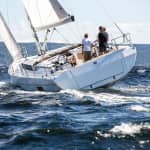
A gnav, a boom vang, keeps the front area free so that even less agile sailors can easily change sides. The jib is self-tacking, the gennaker is set and recovered using a single-line system, which means that the gennaker pole does not have to be operated separately, but retracts and extends automatically. The VX One is designed as a strict one-size-fits-all class, but there is no weight limit for the crew. The ideal total weight is between 180 and 220 kilograms, so it can be sailed with three lighter people or two heavyweights. The sailmaker is freely selectable.
Adrenalin on rough courses
YACHT tested the VX One back in 2015 - here are our impressions:
In gusts of up to 6 Beaufort, it became clear that the Hamburg Outer Alster is far too small for this boat - at least if you want to enjoy planing under gennaker at twelve knots and more; the other shore is reached far too quickly. The wide, flat shape of the aft hull with its pronounced chines gives the boat a lot of stability on the beam and at the same time enables fast planing.
Although the 26-square-metre gennaker may not seem very large at first, it is more than sufficient, especially in strong gusts, and pulls the boat effortlessly behind it. In constant strong wind conditions, not only in gusts in the centre of Hamburg, the VX One is said to have reached speeds of up to 20 knots. In the meantime, it was also sailed with a large masthead gennaker, but this has now been cancelled with the international status.
High up on the wind, the crew has to decide between a mode with a lot of height and relatively tight sails and a lower course. On the Alster, which is never very wavy, the pinch mode with a speed of around six knots seemed to be the better option, but the VX One should also be able to glide at the cross. The crew can give it their all and ride out or make themselves comfortable with one buttock over the edge - the keel helps them back into the vertical in stronger conditions.
Price and target group
With a complete package of boat, rig and sails, the VX One is in the range of high-quality sports boats, depending on the equipment and supplier, at just under 50,000 euros today, ten years ago at the time of testing it was still around 30,000 euros including trailer. The prices for the few used boats that can be found are between 25,000 and 35,000 euros, depending on age and equipment.
The VX One is characterised by a wide range of uses. The combination of performance, comparatively easy handling and robust construction makes the VX One attractive for those switching from dinghy classes who are looking for more stability but not a "small cruising boat".
The VX One is also suitable for short weekend trips with family or friends due to its increased capsize safety and the possibility of sailing with little physical effort, i.e. not necessarily having to ride out.
A word about capsize safety: the keel dinghy can capsize. However, a video from 2013 shows that she only lies on her side by about 90 degrees at full speed with a gennaker. Even though only the helmsman is sitting on the edge. After a short time, the boat rights itself again in the video, without any active help from the crew. "Even 180 degree capsizes are possible. But only if you ignore all your sailing instincts," says Iris Kamml, Chairwoman of the German Class Association. In other words, don't furl the sheet when the situation starts to change and don't go to the high edge. The boat then assumes a stable upwind position, from which it must be brought out and righted using a grew weight on the keel, just like any dinghy.
However, it is primarily aimed at sailors who are looking for a modern, strict standardised class in which the focus is clearly on sailing skills and tactics, i.e. in which there is real comparability.
According to the class rules, there is no trapeze. However, the mast can be ordered with trapeze preparation. According to Iris Kamml, harnesses are indeed used for fun: "It's simply more fun, even in pairs. When we sail regattas, we ask each participant beforehand whether they want to sail with or without a harness. If everyone wants to sail with it, we sail with it; if only one person wants to sail without it, everyone sails without it." With a crew of three and a harness, speeds of up to ten knots should be possible in strong winds. International regattas are sailed without a harness.
Recognised by World Sailing
The standardised nature of the class and its distribution on almost every continent have led to the VX One being recognised by the World Sailing Association in December 2025 as a International class has been recognised. This classification requires an active class association, formal class rules and demonstrably strong regatta activity on several continents.
With the international status, the VX One is now authorised to organise World Championships sanctioned by World Sailing and to use officially appointed race officers and officials. The class association is already preparing the first world championship, which is planned for early 2027, and possible venues are currently being examined.
Around 400 boats have been built worldwide to date. Most of them, around 250, sail in the USA, only 18 in Germany. Around ten crews regularly meet up for regattas in this country.
The German Class Association offers trial sails to interested parties.
Technical data VX One

- Total length: 5.79m
- Width: 2.19m
- Sail area main & jib: 19.97 m²
- Sail area Gennacker: 26 m²
- Draft centreboard: 1.32m
- Weight ready to sail: 260kg
- Crew: 2-3 persons
- Design: Brian Bennett
- max. speed: approx. 24 knots
- Yardstick: approx. 94 (roughly equivalent to a MUSTO SKIFF)
- Shipyard: Ovington (Europe), Mackay (New Zealand)
- Epoxy/carbon hull
- Full carbon rig (mast height: 8.35 m)
- Self-tacking jib with roller device
- Gennaker with single-line system
- Carbon tiller boom
- All fittings and blocks from Harken
- Trapeze preparation
- Harbeck combi trailer for slip trailers
Distribution
Videos of the VX One
The YACHT test
Australian Championship 2023
A capsize

Lars Bolle
Chief Editor Digital
