


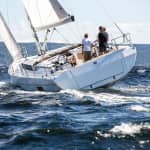
YYachts from Greifswald has started building a Y8 with hybrid drive. The YF12 propulsion system comes from Yanmar and combines a conventional diesel engine with an electric motor. Owners can choose between the two drive types depending on the situation. The 80-foot yacht can be driven in diesel or electric mode. The hybrid system is intended to fit in with the shipyard's philosophy of combining sustainable solutions with comfort. The electric motor draws its energy from lithium batteries and enables emission-free sailing in harbours and anchorages. The batteries can be charged using shore power or on-board solar panels or the Yanmar, which then works as a generator. The diesel engine is approved for operation with HVO, a fuel made from hydrogenated vegetable oils, which reduces CO₂ emissions.
Five operating modes for different requirements
The YF12e hybrid system offers five different operating modes that can be selected via the touch display. In Engine Mode, the diesel engine operates as usual and delivers the full power of the 4JH unit. Hybrid mode uses the diesel engine for propulsion while the electric motor charges the batteries as a generator. Yanmar describes this operating mode as particularly efficient for power generation. In Electric Mode, or EV Mode for short, only the electric motor drives the boat and enables emission-free driving. Silent Generator Mode utilises the battery capacity to supply electrical consumers without the engine or generator having to run. Quick Charge Mode or Generator Mode allows the diesel engine to run solely to generate electricity without generating propulsion. The electric motor operates in a speed range of 1,000 to 6,000 revolutions per minute and continuously delivers 8.3 kilowatts at 4,969 revolutions.

Battery system with two capacity levels
The battery system is based on individual modules with a capacity of 5.75 kilowatt hours each. In the standard configuration, the system comprises four modules with a total of 23 kilowatt hours; eight modules with 46 kilowatt hours are available as an option. Each battery module measures 243 millimetres in width, 352 millimetres in length and 300.5 millimetres in height. The weight is 148 kilograms for the small and 296 kilograms for the large battery variant. The batteries work with a nominal voltage of 51.8 volts, the voltage ranges between a minimum of 43.4 and a maximum of 58.1 volts. An integrated battery management system monitors the cells. The IP55 protection class makes the batteries resistant to dust and water jets. Yanmar lists Victron, Delta-Q and Zivan devices as compatible chargers. According to the manufacturer, the battery capacity is sufficient to operate air conditioning systems overnight.

Generator output and charging concept
In generator mode, the diesel engine operates in a speed range of 800 to 3,000 revolutions per minute. At 1,200 rpm, the system delivers at least 4.5 kilowatts of generator power; at 2,500 rpm, the power increases to at least 10.5 kilowatts. Yanmar advertises the concept with the formula "One for one hybrid": one hour of driving in hybrid mode should be enough to charge the batteries for one hour of electric driving. The manufacturer claims that charging while driving is on average 20 per cent more efficient than conventional generators. A practical example from test data shows the typical use: the departure is in EV mode, during the lunch break the battery supplies the electrical consumers. After the break, the diesel engine starts for the first time and recharges the batteries during the onward journey to the berth. In the evening, the capacity is then sufficient for all electrical consumers including air conditioning overnight.
Technical data
Diesel engine
- Compatible motors: 4JH80 and 4JH110
- Rated power 4JH80: 80 hp, 58.8 kilowatts
- Rated power 4JH110: 110 hp, 80.9 kilowatts
- Nominal speed: 3,200 revolutions per minute
- Dry weight: 229 kilograms
- HVO approval: Yes
Electric motor
- Continuous power: 8.3 kilowatts at 4,969 revolutions per minute
- Boost power: 12.1 kilowatts
- Speed range: 1,000 to 6,000 revolutions per minute
Generator operation
- Speed range: 800 to 3,000 revolutions per minute
- Power at 1,200 revolutions: at least 4.5 kilowatts
- Power at 2,500 revolutions: at least 10.5 kilowatts
More about YYachts

Fridtjof Gunkel
Deputy Chief Editor YACHT
